OVERVIEW
POPULAR ARTICLES

Everyone wants the returns that come from holding a great company for decades. But not everyone can actually sit through the 50%-plus drawdowns that come along the way. In our new book, The Art of Enduring, we explore why time favours great companies, and why staying invested in them is so hard, but can be rewarding. If you would like to know more about how we invest in high-quality franchises, please contact us at ccp.marcellus.in or simply reply to this email
Compounding is often called the eighth wonder of the world. Two elements drive it – the rate of return and time – and in the compounding formula, time is the exponent, with the rate of return raised to its power. The result is, well, exponential. Over long horizons, adding years can do far more for your wealth than adding percentage points to the return. For instance, a 15% return for 40 years turns Rs 1 into Rs 268. The same 15% for just 20 years gives you barely Rs 16.
In fact, in the context of a portfolio (rather than a single stock), compounding is even more powerful. Suppose you have invested Rs 100 equally across two stocks, X & Y. Suppose overnight the share price of stock X goes to zero thus wiping out the Rs 50 you invested in that stock. However, stock Y turns out to be a great investment and compounds at 26% CAGR over ten years thus turning Rs 50 into Rs 500. At the portfolio level, your ten-year returns is 17.5% CAGR (Rs 100 becoming Rs 500) even though half of your portfolio was a total write-off. Great compounders therefore create room in your portfolio for all the too-human mistakes which are part & parcel of investing.
It is this element of time that is usually the biggest impediment to realising the true power of the ‘eighth wonder of the world’. Finding companies whose stocks can deliver healthy rates of return is difficult, though not impossible. But holding those stocks for decades is where most investors falter.
Holding for decades is hard for two reasons. First, the company itself has to keep compounding that long – and only the rare ones manage to do so. That is why the hunt for genuinely enduring businesses is so difficult. Second, even when you own an enduring business, the ride is never smooth. Even the best compounders see their stock halve at times. Many see such drawdowns several times along the way, leaving most investors shaken and out of these stocks long before the compounding can work its magic. In the concluding chapter of The Art of Enduring , we looked at both halves of this problem – why a rare set of companies keeps getting stronger with age, and what it takes to stay invested in them through the storms. In our previous blogs, we have written about the first half and identified three traits that enabled the five companies featured in the book to endure over decades – they identify a core set of distinctive capabilities and focus sharply on them, they harness and invest in top talent and they take crises head on, inscribing the learnings in their institutional memory.
In this blog, we address the second half.
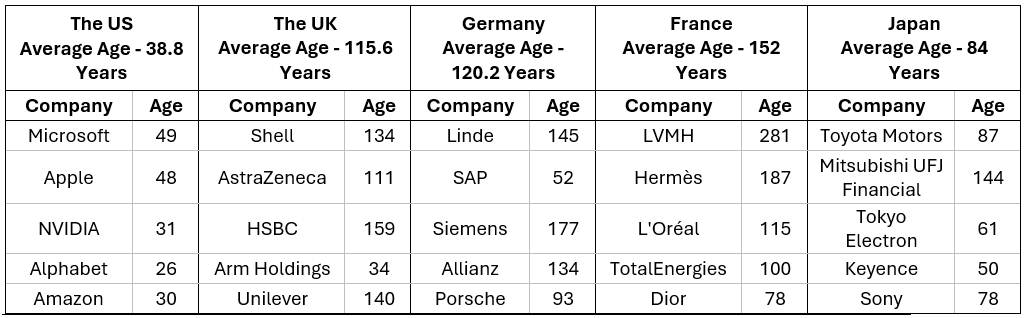
As we write in the book, “All great companies tend to build virtuous cycles of growth. Building strong competitive advantages abets longevity. Longevity in turn allows the company to invest more in further strengthening and sustaining those competitive advantages. Time is therefore an ally of great compounding machines because these companies become better, stronger and fitter over time. The world over, the greatest companies compound over decades, even centuries. Take the example of the top five companies by market capitalization in Germany. The average age of these companies is a staggering 120 years. In the case of the UK, the average age of the top five companies by market capitalization is 116 years, in France close to 150 years and 84 years in Japan. Even in the US, where the technology companies now top the list of most valued companies, the average age is almost thirty-nine years. One might think of Nvidia as a rising star in the AI world, but the company is over thirty years old.”
Exhibit 1: Average age of top 5 companies by market capitalization in developed markets
Why should the passage of time compound a company’s advantages rather than erode them?
The examples above…“drive home the point that great companies get built over time. And longer the lifespan, higher the chances of them creating enduring value. We believe that this is because with the passage of time, these companies learn to focus more fiercely on building a core set of distinctive capabilities. Secondly, they learn to identify and harness top talent. And thirdly, they build institutional capability in dealing with crises.
The median age of the five companies featured in this book is about thirty-five years. Considering the competitive advantages they have built, their continued focus on the core business, their ability to attract and retain people and their learnings from handling crises, they have a long road ahead in growing and compounding their business.”
But none of this is a smooth ride. Neither for the company, nor for the investors who own it.
“Of course, the road to long-term growth is not easy and it is definitely not linear. As we have seen, each of our five companies have faced almost existential questions at some point in their history. These pivotal periods tested the resilience not just of the managements of these companies but also of investors in these companies. One can’t befriend time without surviving the pain of a sharp share price drawdown.
Take the example of Bajaj Finance. The company’s stock price has declined by more than 50 per cent on multiple occasions through its listed history. The most recent being a 63 per cent decline between February 2020 and May 2020. The most severe decline in the case of Bajaj Finance was a long-drawn, three-year affair, when the stock price fell by 91 per cent between March 2006 and March 2009, mirroring the deterioration in business fundamentals (ROE fell to a low of 2.1 per cent in FY08).
The behaviour of the Bajaj Finance stock is not unique to our five companies. Tata Elxsi’s stock has had five peak-to-trough movements of greater than 50 per cent in the last thirty years and has still managed to grow investors’ wealth by 549 times . In its thirty-year compounding journey when the stock rose fifty-six times, Titan saw three drawdowns of greater than 50 per cent. The stock of Divis has also lost more than half its value on three separate occasions since listing, with a 60 per cent fall between August 2016 and May 2017, driven by the import alert from the US FDA in March 2017.”
Which brings us to the question every long-term investor eventually has to answer, and to why a book like this exists at all:
“As we give finishing touches to this book in early 2026, Tata Elxsi is going through another round of a large decline in its stock price, this time on growth concerns and concerns about Gen AI putting the business model at risk. Should one remain invested in the stock? The future is unknowable but we do have history to turn to… if one were to remain invested in any of these companies through a large and long-drawn-out decline in their stock prices, one needs to know the company deeply. It is important to understand the DNA and the culture of these companies and the war stories from the veterans who fought in the trenches. This is what makes exercises like writing the sequel to The Unusual Billionaires worthwhile.”
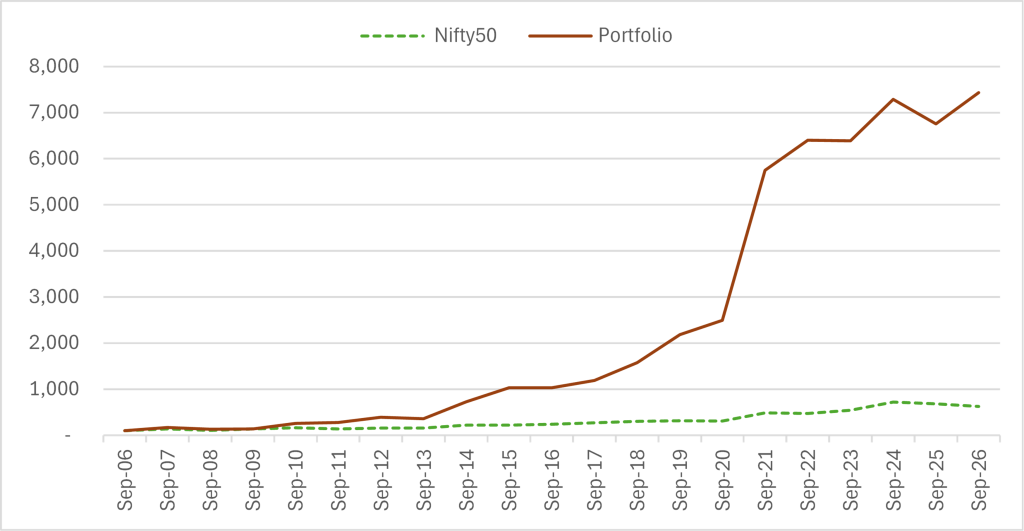
For these five companies, the reward for this patience has historically been considerable. Over a twenty-year period ending September 2026, the five companies in the book have compounded on average at about 23.2 per cent a year, against 9.6 per cent for the Nifty50. This means that Rs 100, equally invested in the five stocks in September 2006, would have grown to Rs 7,434 (excluding dividends) over the following twenty years. The same Rs100 invested in the Nifty50 index would have been worth just Rs 630 – a solid 11.8x outperformance. would have been worth Rs 630, i.e. the basket’s ending value was about 11.8 times that of the Nifty50 investment.
But the deeper lesson of the chapter is not the destination, it is the journey. Time has historically rewarded the owners of great companies, but only those who can stay in their seats through declines of fifty, sixty, even ninety per cent. And the only thing that makes it possible to stay seated is knowing the business deeply enough to tell a temporary setback from an existential challenge. That knowledge – of a company’s DNA, its culture, its war stories – is what can turn time from an investor’s enemy into their closest ally. It is, like we explain in the book, what befriending time means.
Exhibit 2: An equal-weighted portfolio of the 5 companies has beaten the broader market by 11.8 times over a 20-year period
Why does this matter to you?
If you like the idea of investing in such companies, you should consider investing in our Consistent Compounders Portfolio (CCP as well call it). CCP consists of 20 clean, well-managed franchises with ‘Unusual Billionaire style’ moats.
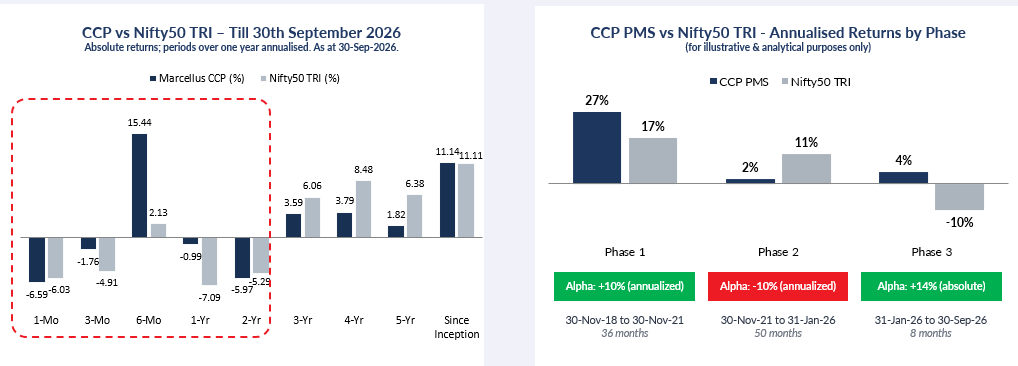
The results of this rewiring of our portfolios around India’s new realities have begun showing up in FY27 – see chart below.
Marcellus Performance Data shown is net of fixed fees and expenses charged till latest quarter and is net of Performance fees charged for client accounts, whose account anniversary / performance calculation date falls upto the last date of this performance period; since inception & 3 years returns are annualized; other time period returns are absolute. For relative performance of particular Investment Approach to other Portfolio Managers within the selected strategy, please refer https://www.apmiindia.org/apmi/welcomeiaperformance.htm?action=PMSmenu, Under PMS Provider Name please select Marcellus Investment Managers Private Limited and select your Investment Approach Name for viewing the stated disclosure. The calculation or presentation of performance results in this publication has NOT been approved or reviewed by the SEC, SEBI or any other regulatory authority.
Indeed, some of the UB companies are sitting inside CCP and compounding as we speak, After 5 blockbuster years ending Diwali 2021 when portfolio compounded at 27% p.a., CCP ran into rough weather for the next 4 years as Quality itself got hammered in India. In 2026 however Quality is back with a bang as you can see on the charts above.
CCP is available as a PMS offering from Marcellus. Indians and NRIs can invest in it with a minimum investment amount (as per SEBI’s rules) being Rs 50 lakhs.
Note – The calculation or presentation of performance results in this publication has NOT been approved or reviewed by the SEC, SEBI or any other regulatory authority. Past performance is not indicative of future results.

Note: This tool is designed to help users explore products and asset allocation guidance; it does not constitute a formal financial plan or investment advice.
Click Here for details about our regulatory registration and licensing information.
The stocks mentioned above may form part of Marcellus’ portfolio. Marcellus, its clients, and/or its employees may therefore have an interest in the said stock(s).
Note: the above material is neither investment research, nor investment advice. Marcellus does not seek payment for or business from this material/email in any shape or form. Marcellus Investment Managers Private Limited (“Marcellus”) is regulated by the Securities and Exchange Board of India (“SEBI”) as a provider of Portfolio Management Services. Marcellus is also a US Securities & Exchange Commission (“US SEC”) registered Investment Advisor and is regulated by the International Financial Services Centres Authority (IFSCA) as a Fund Management Entity. No content of this publication including the performance related information is verified by SEBI, IFSCA or US SEC. If any recipient or reader of this material is based outside India and USA, please note that Marcellus may not be regulated in such jurisdiction and this material is not a solicitation to use Marcellus’s services. The PMS strategy, Category III AIF products and IFSCA retail schemes are distinct offerings with different regulatory frameworks, risk profiles, fee structures and investment thresholds. Investors should refer to product-specific documents for details before investing. All recipients of this material must, before dealing and or transacting in any of the products and services referred to in this material, make their own investigation and seek appropriate professional advice. Past performance is not indicative of future results. Marcellus and/or its associates, the authors of this material (including their relatives) may have financial interest by way of investments in the companies covered in this material. Marcellus does not receive compensation from the companies for their coverage in this material. This material may contain confidential or proprietary information and user shall take prior written consent from Marcellus before any reproduction in any form. As per SEBI Master Circular dated June 07, 2024, clients have an option to be on-boarded directly by the Portfolio Manager without intermediation of persons engaged in distribution services.