OVERVIEW
POPULAR ARTICLES

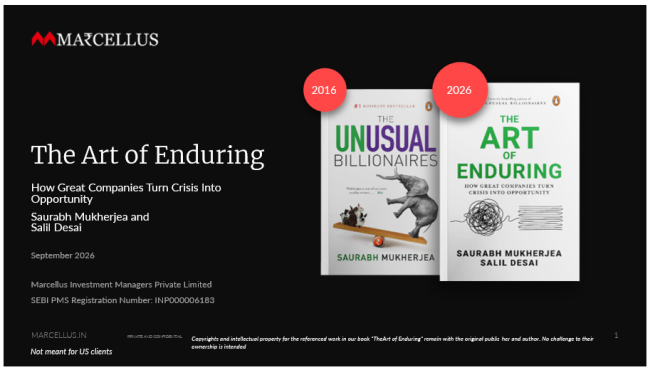
“People first” is the most overused phrase in business, and the least believed. In our new book, The Art of Enduring, we found that the companies that truly live it share two habits: they empower people (and protect them when bets fail), and they expose people to enough roles to grow them into leaders. Bajaj Finance and Titan show what that looks like in practice.
If you would like to compound your wealth by investing in high-quality franchises, please contact us at ccp.marcellus.in or simply reply to this email.
Every annual report makes claims about the company being “people first”. It also comes up in every job interview. And yet most “people-first” cultures involve little more than team-bonding games, dress-up days and the occasional office party. These are fun, no doubt. But do they create real engagement?
In our new book, “The Art of Enduring: How Great Companies Turn Crising Into Opportunity”, we found a different kind of people focus that was common across all the five companies we studied and featured in the book. Empowerment – the kind protected by psychological safety – and Exposure.
Empowerment – and the safety net beneath it
Empowerment, in our view, is handing people real authority – specifically the authority to experiment and to take risks.
At Titan, this has become routine. As we note in the book, “In Titan for example, this is almost institutionalized, with ventures such as GoldPlus and Eye+ coming out of employee suggestions and being executed by them.” An employee does not merely propose a new business. They are trusted to go and build it.
At Bajaj Finance, the same empowerment shows up as a culture that people who leave miss, and often come back to. The book quotes Rajeev Jain, Vice Chairman and MD: “People (senior employees) leave our company, join competition and they come back to BFL. They told me, it’s just not the same experience. They told me that the passion, empowerment (to build businesses) and the accountability that they get here, they simply did not get (wherever they went) and hence they returned to BFL. If there’s one thing I’ve learnt in my sixteen years here, it’s that the foundation frame of our business is culture.”
But empowerment on its own is not enough. If people are told to take risks but carry a fear of being blamed when a bet fails, no one would take risks and the organisation would stagnate. The missing ingredient is psychological safety – “a tacit belief held by members of a team that one will not be punished or humiliated for speaking up with ideas, questions, concerns or mistakes.” Titan builds exactly this backstop. As we write in the book, “support for experiments that do not work sets up people to think boldly without the fear of failure.”
Empowerment gives employees the permission to take risks, but psychological safety gives them the courage to actually do it.
That is the real test of a people-first culture
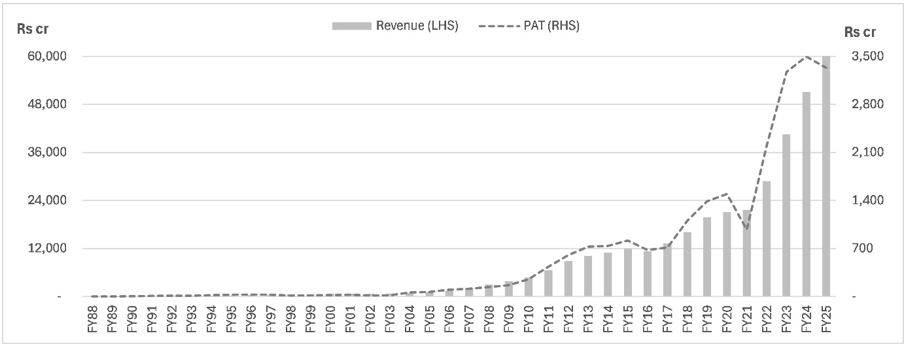
Exhibit 1: Titan has grown revenues and PAT at 25% and 30% CAGR respectively over a 37-year period
Exposure – growing people wide, and growing leaders
By exposure we mean the wide range of roles and responsibilities that employees are routinely rotated through. Titan is a striking example to understand this.
Excerpt from the chapter on Titan:
“Titan has a unique work culture that was inculcated from the outset when a high-quality diverse team became the original founders. This culture has been honed over the years by assiduously encouraging both participation and innovation, as discussed earlier. This is bolstered by encouraging the movement of people across functions, who bring in a fresh perspective to a role, spurring innovative ideas.
Take the case of Revathi Kant. From 1995 to 2005, she was in charge of marketing and in a consumer-facing role until she was offered the role of design head for watches. In 2010, she moved on to head design, innovation and NPI for the Jewellery division and in 2017, she was elevated to chief design officer and set up the Design Excellence Centre that caters to the design needs of the entire organization. Kant’s understanding of consumer needs translates into designs that are winners for Titan, from watches to jewellery to eyewear to accessories.
Ronnie Talati, who led Fastrack and later became the CEO of the Eyewear division, started as an accountant at Tata Press in 1976, later moving to Titan alongside Xerxes Desai in 1986. Around 2005, Talati was tasked with and successfully led the revival of the Fastrack brand. This, we believe is unique, where an employee in what is considered a support role, moves to a business function and eventually heads it. The current CEO designate Ajoy Chawla has in his LinkedIn profile mentioned his designation for the period June 1991 to September 2002 as, ‘Various roles in Sales, Channel management, Commercial, Demand planning’ – clearly, he must have spent his first eleven-odd years at Titan doing too many different things to list separately.”
The reason exposure is important is that as people acquire a broader and wider perspective of the business, they grow from being subject matter experts or specialists to generalists. This is an essential part of growing employees into managers and managers into leaders.”
In conclusion
Put together, the pattern is clear. Empowerment without a backstop produces fear, not initiative. Exposure without empowerment produces well-rounded people who are never allowed to act. It is the combination – real authority, genuine protection when a bet fails, and a deliberate widening of each person’s experience – that turns employees into leaders. That is why all of our five companies have kept their best people for decades, and why their benches are deep enough to survive the departure of any single star.
“People first” is easy to say. Practising real empowerment and exposure is hard. And it is that practice – followed with discipline, year after year – that lets companies endure for decades.
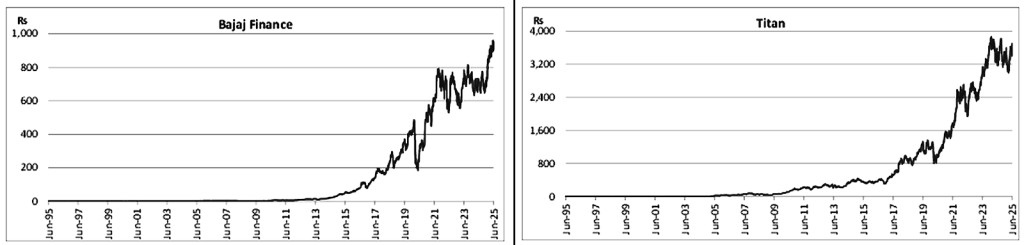
Exhibit 2: The Bajaj Finance and Titan stocks have compounded at a 25% and 24% CAGR respectively over a 30-year period
Why does this matter to you?
If you like the idea of investing in such companies, you should consider investing in our Consistent Compounders Portfolio (CCP as well call it). CCP consists of 20 clean, well-managed franchises with ‘Unusual Billionaire style’ moats.
The results of this rewiring of our portfolios around India’s new realities have begun showing up in FY27 – see chart below.
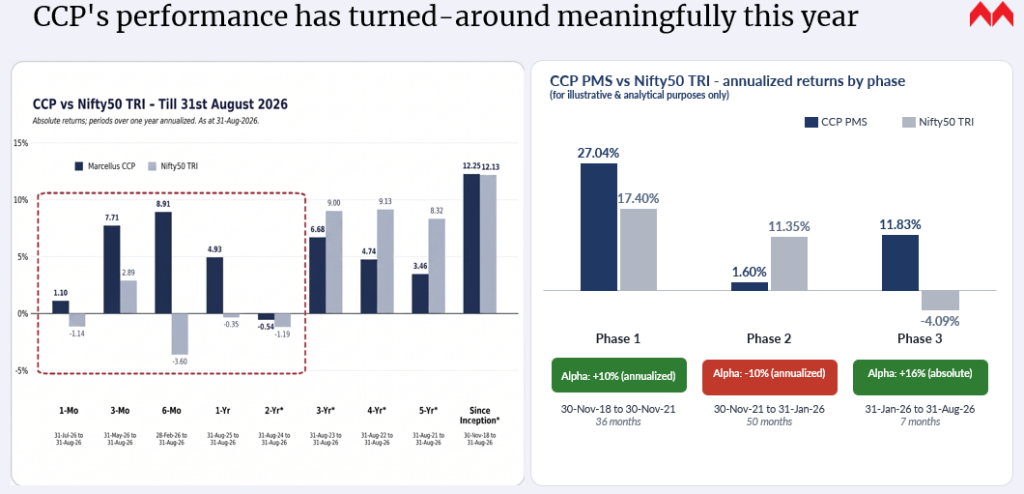
Marcellus Performance Data shown is net of fixed fees and expenses charged till latest quarter and is net of Performance fees charged for client accounts, whose account anniversary / performance calculation date falls upto the last date of this performance period; since inception & 3 years returns are annualized; other time period returns are absolute. For relative performance of particular Investment Approach to other Portfolio Managers within the selected strategy, please refer https://www.apmiindia.org/apmi/welcomeiaperformance.htm?action=PMSmenu, Under PMS Provider Name please select Marcellus Investment Managers Private Limited and select your Investment Approach Name for viewing the stated disclosure. The calculation or presentation of performance results in this publication has NOT been approved or reviewed by the SEC, SEBI or any other regulatory authority.
Indeed some of the UB companies are sitting inside CCP and compounding as we speak. After 5 blockbuster years ending Diwali 2021 when portfolio compounded at 27% p.a., CCP ran into rough weather for the next 4 years as Quality itself got hammered in India. In 2026 however Quality is back with a bang as you can see on the charts above.
CCP is available as a PMS offering from Marcellus. Indians and NRIs can invest in it with a minimum investment amount (as per SEBI’s rules) being Rs 50 lakhs.
If you would like to invest with us, please scan the QR code below.
Click Here for details about our regulatory registration and licensing information.
The above material is neither investment research, nor investment advice. Marcellus does not seek payment for or business from this material/email in any shape or form. Marcellus Investment Managers Private Limited (“Marcellus”) is regulated by the Securities and Exchange Board of India (“SEBI”) as a provider of Portfolio Management Services. Marcellus is also a US Securities & Exchange Commission (“US SEC”) registered Investment Advisor and is regulated by the International Financial Services Centres Authority (IFSCA) as a Fund Management Entity. No content of this publication including the performance related information is verified by SEBI, IFSCA or US SEC. If any recipient or reader of this material is based outside India and USA, please note that Marcellus may not be regulated in such jurisdiction and this material is not a solicitation to use Marcellus’s services. The PMS strategy, Category III AIF products and IFSCA retail schemes are distinct offerings with different regulatory frameworks, risk profiles, fee structures and investment thresholds. Investors should refer to product-specific documents for details before investing. All recipients of this material must, before dealing and or transacting in any of the products and services referred to in this material, make their own investigation and seek appropriate professional advice. Past performance is not indicative of future results. Marcellus and/or its associates, the authors of this material (including their relatives) may have financial interest by way of investments in the companies covered in this material. Marcellus does not receive compensation from the companies for their coverage in this material. This material may contain confidential or proprietary information and user shall take prior written consent from Marcellus before any reproduction in any form. As per SEBI Master Circular dated June 07, 2024, clients have an option to be on-boarded directly by the Portfolio Manager without intermediation of persons engaged in distribution services.
The stocks mentioned above may form part of Marcellus’ portfolio. Marcellus, its clients, and/or its employees may therefore have an interest in the said stock(s).