OVERVIEW
POPULAR ARTICLES

Good companies don’t become great by avoiding crises. They become great by how they handle them. We found this as a common trait across all the five companies featured in our new book, “The Art of Enduring”. This is the story of how Tata Elxsi and Divi’s turned their worst moments into turning points. If you would like to know more about how we invest in high-quality franchises, please contact us at ccp.marcellus.in or simply reply to this email.
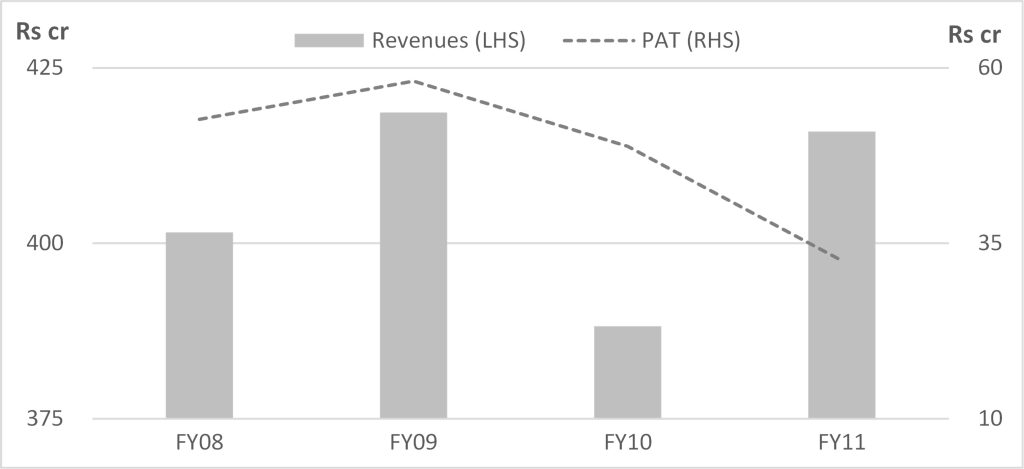
The first was in its infancy when the parent Elxsi went defunct, even before the company was incorporated in India. Then came the economic reforms of 1991 that made the company’s business model of local manufacturing redundant and necessitated a rights issue to prevent an erosion of net worth. Then there was the aftermath of the global financial crisis in 2009 when customers cancelled contracts on short notice, leading to profits nosediving. Each time, the company not only survived the crisis but emerged stronger from it, learning key lessons and making sure the organization was ready for the next.It is the third of those crises, the aftermath of the global financial crisis, that exemplifies how best to lead through hard times. Tata Elxsi saw a few of its largest customers cancelling contracts and pulling out their business in a matter of weeks. As a result, profit fell by nearly 45% over a 2-year period from FY09-11. One natural reaction would have been to cut the roles and let people involved in the cancelled projects go. Tata Elxsi did the opposite.
Source: Marcellus Investment Managers; Company data
As we write in the chapter on Tata Elxsi:
“A seemingly obvious thing to do was to have eliminated the roles involved in the two projects and sacked the relevant people. But that is not what was done. Instead, the management chose the next best option to save costs and announced a freeze on salaries for FY10, with a plan to make up for the amount deferred…if certain revenue targets were achieved.”
Unfortunately, the specified target was narrowly missed, leading to weakening morale and rising attrition.
“During this time in 2009, the management team came together and used every behavioural aspect of management they knew (or what circumstances had taught them) to get the workforce out of the rut. One of the key initiatives they undertook was a series of townhall meetings with employees where they were transparent in sharing the state of affairs. They explained the options they had to keep the company profitable and the rationale for choosing the options they chose and the actions they took. They reiterated their commitment to setting things right when business got better. The transparency and honesty paid off. Not only did it help to calm the nerves of the employees but got them engaged to an extent that the townhall lasted longer than planned. People got genuinely interested in understanding how the business could be turned around and how they could contribute. The management, true to their word, reintroduced wage revisions and salaries were revised in FY11.”
With morale steadied, the company went about rebuilding the business – reorienting its go-to-market strategy and channelling the renewed energy of its people into winning a marquee project that set the revival in motion.
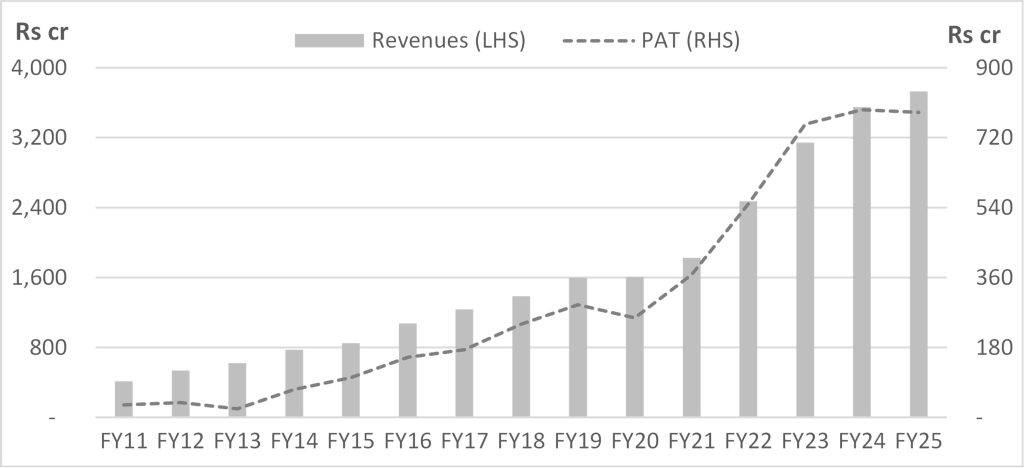
The proof is in the numbers: Tata Elxsi’s profit after tax has since compounded at a CAGR of 25.5% (FY11 to FY25).
Exhibit 2: Tata Elxsi grew its profits at a 25.5% CAGR over FY11-25
Source: Marcellus Investment Managers, Company data
The Same Pattern Across Five Companies
At Divi’s Laboratories, the crisis came in 2017, in the form of a US FDA import alert on one of its plants that cut off the company’s access to its largest market. Rather than paper over the problem, Divi’s rebuilt its systems from the ground up “to ensure that there would be no second letter from the FDA.” Remarkably, the company had by then made itself so indispensable to the global drug supply chain that its own customers lobbied the regulator on its behalf. The crisis did not expose a weakness so much as reveal the depth of Divi’s moat. As we said at the outset, no company is spared a crisis. What separates the good from the great is how far their competitive advantages carry them through it.
We see a similar example in Titan, where the company’s Tanishq business made losses for years and was one board meeting away from being shut down before the management turned it around. Or Bajaj Finance, which used every external crisis to strengthen underwriting and collections using technology, to make the business resilient when the next shock arrived.
How Do Crises Help?
As we write in The Art of Enduring:
Crises tend to bring management teams closer together. With all hands coming on board towards a single, shared goal of survival, a new and extremely high level of cooperation follows. People are forced to put aside personal ambitions and agendas and instead collaborate for the common good. This also builds deep trust between the team members and the shared struggles and experiences create everlasting bonds.
The learnings from dealing with challenging times also become critical additions to the firm’s institutional knowledge. Such times give an opportunity for the management to go back and reevaluate their strategies in a changed external environment and reassess the strength and sustainability of their competitive advantages.”
“Finally, it also teaches management teams how to read early warning signs so that they can be better prepared when such challenges come in the future. And to be sure, the business world is extremely dynamic and the resilience of the businesses and of the management teams gets tested from time to time. How they navigate these challenges is a key indicator of future success. As Nassim Nicholas Taleb writes in his pathbreaking book, Antifragility, ‘The resilient resists shocks and stays the same; the anti-fragile gets better.’”
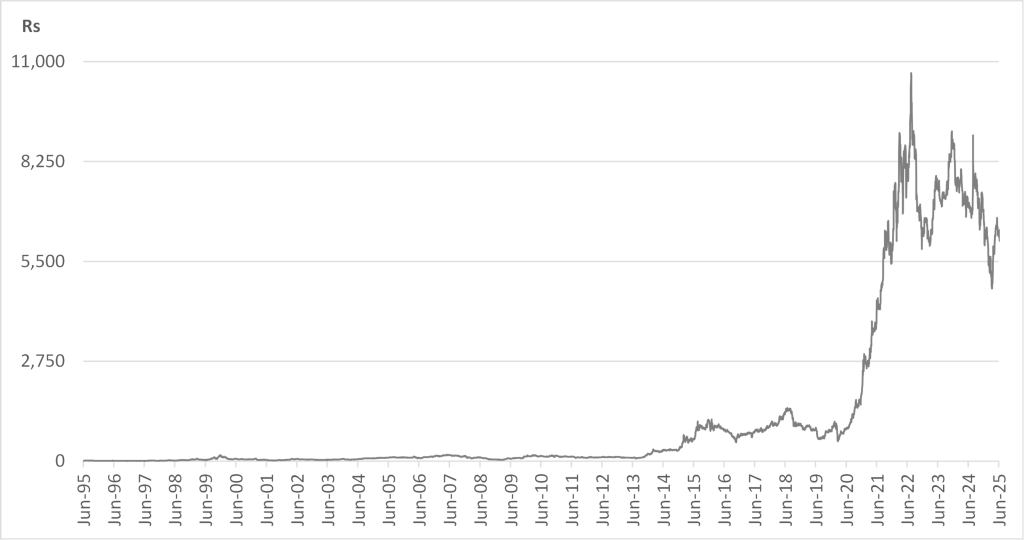
Exhibit 3: A Rupee invested in Tata Elxsi in June 1995 would have been worth Rs549 by June 2025
Source: Marcellus Investment Managers, Bloomberg
Why Does This Matter to You?
If you like the idea of investing in such companies, you should consider investing in our Consistent Compounders Portfolio (CCP as we call it). CCP consists of 20 clean, well-managed franchises with ‘Unusual Billionaire style’ moats.
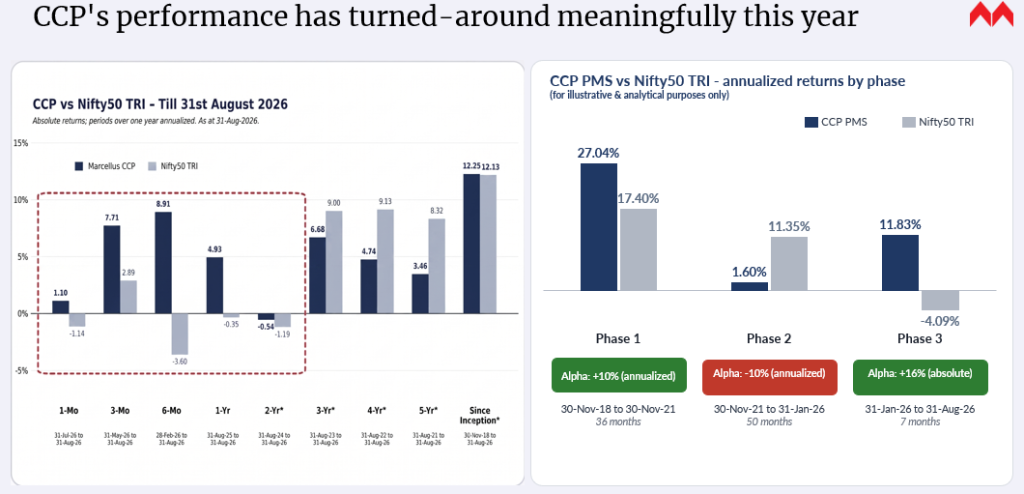
Marcellus Performance Data shown is net of fixed fees and expenses charged till latest quarter and is net of Performance fees charged for client accounts, whose account anniversary / performance calculation date falls upto the last date of this performance period; since inception & 3 years returns are annualized; other time period returns are absolute. For relative performance of particular Investment Approach to other Portfolio Managers within the selected strategy, please refer https://www.apmiindia.org/apmi/welcomeiaperformance.htm?action=PMSmenu, Under PMS Provider Name please select Marcellus Investment Managers Private Limited and select your Investment Approach Name for viewing the stated disclosure. The calculation or presentation of performance results in this publication has NOT been approved or reviewed by the SEC, SEBI or any other regulatory authority.
If you like the idea of investing in such companies, you should consider investing in our Consistent Compounders Portfolio (CCP as we call it). CCP consists of 20 clean, well-managed franchises with ‘Unusual Billionaire style’ moats.
The results of this rewiring of our portfolios around India’s new realities have begun showing up in FY27.
Indeed, some of the UB companies are sitting inside CCP and compounding as we speak. After 5 blockbuster years ending Diwali 2021 when the portfolio compounded at 27% p.a., CCP ran into rough weather for the next 4 years as Quality itself got hammered in India. In 2026 however, Quality is back with a bang.
CCP is available as a PMS offering from Marcellus. Resident Indians and NRIs can invest in it, with the minimum investment amount (as per SEBI’s rules) being Rs 50 lakhs.
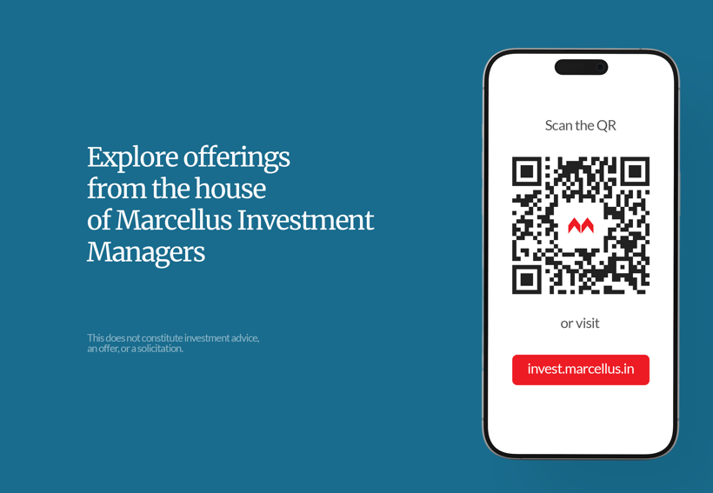
If you would like to invest with us, please scan the QR code below.
Click Here for details about our regulatory registration and licensing information.
The stocks mentioned above may form part of Marcellus’ portfolio. Marcellus, its clients, and/or its employees may therefore have an interest in the said stock(s).
The above material is neither investment research, nor investment advice. Marcellus does not seek payment for or business from this material/email in any shape or form. Marcellus Investment Managers Private Limited (“Marcellus”) is regulated by the Securities and Exchange Board of India (“SEBI”) as a provider of Portfolio Management Services. Marcellus is also a US Securities & Exchange Commission (“US SEC”) registered Investment Advisor and is regulated by the International Financial Services Centres Authority (IFSCA) as a Fund Management Entity. No content of this publication including the performance related information is verified by SEBI, IFSCA or US SEC. If any recipient or reader of this material is based outside India and USA, please note that Marcellus may not be regulated in such jurisdiction and this material is not a solicitation to use Marcellus’s services. The PMS strategy, Category III AIF products and IFSCA retail schemes are distinct offerings with different regulatory frameworks, risk profiles, fee structures and investment thresholds. Investors should refer to product-specific documents for details before investing. All recipients of this material must, before dealing and or transacting in any of the products and services referred to in this material, make their own investigation and seek appropriate professional advice. Past performance is not indicative of future results. Marcellus and/or its associates, the authors of this material (including their relatives) may have financial interest by way of investments in the companies covered in this material. Marcellus does not receive compensation from the companies for their coverage in this material. This material may contain confidential or proprietary information and user shall take prior written consent from Marcellus before any reproduction in any form. As per SEBI Master Circular dated June 07, 2024, clients have an option to be on-boarded directly by the Portfolio Manager without intermediation of persons engaged in distribution services.