Marcellus Investment Managers - One of the Best Portfolio Management Service Companies in India
  • Region
    India USA
  • Our Philosophy
  • Offerings

    Portfolio Management Services (PMS)


    Indian Equities
    Consistent Compounders Rising Giants Little Champs Kings of Capital MeritorQ PMS Curation Portfolio
    Global Equities
    Global Compounders PMS
    Global Equities Fund (Retail)
    Multi Asset
    Multi Asset PMS

    Asset Allocation Services


    Asset Allocation        

    Portfolio Advisory Services


    Indian Equities
    MeritorQ Advisory (Smallcase)        
    Multi Asset
    Aggressive Allocation Balanced Allocation Conservative Allocation
  • Insights

    Newsletters


    Consistent Compounders Kings Of Capital Little Champs Rising Giants Marcellus Erudite MeritorQ PMS Global Compounders

    Insights


    Recents Blogs Newsletters Portfolio Updates 3 Longs and 3 Shorts

    Videos


    Featured Webinars Client Exclusive

    Podcasts


    All MeritorQ Podcasts (English) MeritorQ Podcasts (Hindi)
    Client Exclusive Content

    Others


    Client Exclusive Content Three Longs & Three Shorts Blogs Videos Media Centre
  • Resources
    Support Resources Online Access Guide Marcellus’ Forms UPI Payment
    Disclosure document GIFT City Disclosure PMS Fees Calculator
  • Team
  • PLAN YOUR GOALS
    • Invest Now
      • Portfolio Management Services (PMS)
      • Investment Advisory Services
      • Global Equities Fund (Retail)
  • Subscribe
  • Connect
  • Login
  1. Newsletter
  2. August 2021
Aug 2021 Consistent Compounders

Amidst the Covid turmoil, CCPs invested in tech & in institutionalisation

Published on Aug 01, 2021 · 3 Min Read

Longevity of free cashflow compounding is the most undervalued aspect of a high-quality stock. Besides strength of the existing business, the sources of longevity for a business include incremental reinvestment in areas which will deliver cashflows beyond the next 3-5 years, and the institutionalization of strategy and business execution. In the recent past, most CCP companies have: a) accelerated investments around technology with an aim to reinforce the sustainability of their pricing power; and b) made further progress around ‘building an institution’ through decentralization of processes and incentivization / empowerment of high quality professionals. In this newsletter, we have given examples of such initiatives taken by some of our CCP portfolio companies (like Asian Paints, Page Industries and Bajaj Finance).

Performance update – as on 31st July 2021

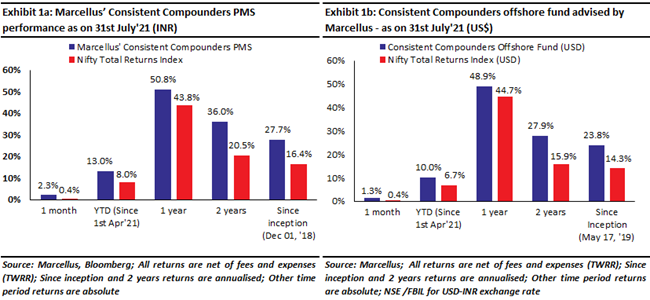
We have a coverage universe of around 25 stocks, which have historically delivered a high degree of consistency in ROCE and revenue growth rates. Our research team of eleven analysts focuses on understanding the reasons why companies in our coverage universe have consistently delivered superior financial performance. Based on this understanding, we construct a concentrated portfolio of companies with an intended average holding period of stocks of 8-10 years or longer. The latest performance of our PMS and offshore fund (USD denominated) portfolios is shown in the charts below.
Some of the common themes in FY21 annual reports of CCP companies

In our January 2020 newsletter (The conventional DCF method undervalues longevity of a business) we had explained that one of the most undervalued aspects of the valuation of a great quality business is the longevity of its healthy free cashflow compounding.

Two important tools in Marcellus’ proprietary longevity assessment process include the lethargy framework (discussed in our 1 August 2020 newsletter) and the succession planning framework (discussed in our 1st September 2020 newsletter). The lethargy framework analyses capital reinvestment initiatives being adopted by the firm to deepen its existing competitive advantages over the next 3-4 years, add new revenue growth drivers to the business every 5-7 years, and radically disrupt its own industry over the next 10 years. The succession planning framework tracks softer aspects such as institutionalization of the business at different levels i.e. decentralization of decision making amongst members of the Board, CXOs, as well as ground level execution through systems and processes.

Annual Reports are one of many sources of data which contribute to our lethargy and succession planning frameworks. There have been two themes common in the FY21 annual reports of several of our portfolio companies:

  • Reinvestment of surplus cashflows on tech-oriented initiatives with a focus on using tech to radically disrupt their own industry in addition to using tech to enhance operating efficiencies.
  • HR related initiatives towards further incentivizing and empowering professionals and hence build an ‘institution’.

We discuss these attributes with some examples from FY21 annual reports of Asian Paints (click here for a marked-up version of the annual report) and Page Industries (click here for a marked up version).

Technology investments to incrementally strengthen competitive advantages
In our 2nd October 2020 newsletter (The Role of Technology in Consistent Compounding), we had highlighted that companies which have consistently innovated over longer periods of time have combined tech initiatives using a recipe that is heavy on intangibles and difficult to replicate. It is this recipe which enables consistent compounding over long periods of time despite several disruptions in the external as well as internal environment of a firm.

Examples from Asian Paints’ FY21 annual report (text in italics has been quoted from the annual report): Asian Paints (APNT) spent Rs 83 crores on Research & Development and invested Rs 42 crores on Information Technology in FY21. In our 1st May 2020 newsletter, we had highlighted that with labour costs contributing to more than two-thirds paint projects at a household level, Asian Paints’ attempts to offer value added labour / experience to the customer could redefine (i.e. radically disrupt) the drivers of market share in the paints industry. The firm’s latest annual reports shows that it is taken several strides forward in this regard.

One of the key focus areas for use of technology in FY21 has been the Home Décor business. This includes an omnichannel model to offer design ideas to customers through digital properties such as www.beautifulhomes.com and an expanding network of AP Homes stores. “All (AP Homes) stores are using digital technology to provide consultation to consumers and have rapidly enhanced their fulfilment capability through the paint total service and the décor execution service offered at these stores.” This channel offers state-of-the-art 3D visualisation platform with physical displays, not just for paints but for a complete décor product range that covers custom-design-to execution furniture, furnishings, lightings, customised tiles, full-modular kitchens to bath and sanitary products.

Asian Paints engaged with a start-up to create a tool to visualise the design implementation and by incorporating an algorithm, has launched the Design Visualization Tool for customers to plan their home décor architecture and design. A key differentiator in these offerings has been the flexibility offered to the consumer to make modifications and see digital customization of how her home might look.

Asian Paints also launched the Beautiful Homes Service (BHS), a ‘custom-design-to-execution’ service across eight top cities, with the aim of expanding to many more such centres. The firm partnered with multiple designers, architects, and end-delivery contractors as part of BHS to offer end-to-end services – from personalised interior design to professional execution. “This AI-driven platform would help bring in seamlessness and personalisation between the physical store and digital journeys of the Home Décor customer. Asian Paints has deployed cutting-edge digital technology on the retailing front to not just providing engaging experiences in selecting the right colours, paint, products, services, contractors, but also in ensuring authentic and genuine products are delivered by the anti-counterfeiting systems and processes”.

Supply chain efficiencies have historically been the biggest driver of competitive advantage for Asian Paints. The FY21 annual report suggests further progress was made in this domain. “We continue to treat data as a strategic asset and have deployed many projects using the power of AI/ML in analytics. A recommendation engine power of new-age algorithms has been deployed to help dealers select the right schemes/products while placing the orders on the self-service digital channels”…. “Further invested in advanced Machine Learning algorithms for demand forecasting. In a world of flux, having an agile and responsive supply chain will be key to determining which companies will be able to serve ever-changing customer needs. To fulfil this objective, our Company has embarked on the deployment of the latest solutions in areas of advanced supply chain visibility and execution by partnering with leading software vendors in this space”… “a completely automated warehouse in one location integrated with the S/4 HANA Extended Warehouse Management Systems.” … “Our logistics distribution network is designed to ensure benchmark service levels in terms of Order Fill Rates and Order Cycle Times to our dealer network. We constantly use advanced algorithms that allow us to improve our demand forecasting, inventory planning, distribution planning and transportation planning thereby making our distribution network cost efficient.”

On the manufacturing front, incremental operating efficiencies have been one of the biggest reasons for why Asian Paints hasn’t needed to take significant price hikes over the past few decades. In FY21, the firm implemented further automation in manufacturing. “We have focused on automation to improve the accuracy of our production processes and deliver consistency throughout our manufacturing process and reduce waste. Our plants use Industry 4.0 technology capability which allows us to operate, monitor and optimize our manufacturing processes through effective use of data gathered at each step of our manufacturing process. We introduced a robust automated data analytics system across our plants. We have analysed data flowing through our state-of-the-art Manufacturing Execution System (MES) and a Distributed Control System (DCS). Each of our machines has sensors that provide us with valuable feedback on accuracy of material additions, adherence to recipe parameters, etc, which help us optimise our manufacturing practices to best suit our cost reduction objectives and manufacturing excellence. This has resulted in real business impact in terms of machine cycle time reduction, energy cost savings, and material cost savings by improving accuracy of additions.”. Low quantum of price increases, thanks to incremental operating efficiencies, makes it difficult for Asian Paints’ competitors get much joy out of price wars or aggressive channel incentives, thereby supporting market share gains and profitability for Asian Paints.

On the Research & Development front, there is a lot of discussion on chemistry-led R&D in the FY21 annual report. Asian Paints’ focus on R&D has been increasing over last 4-5 years after the firm constituted the Technology Council in FY15 (a council consisting of experts/scientists/academia/internal people) to guide the R&D process. The R&D team consists of 200+ scientists on Asian Paints’ payroll, who have published six research papers in FY21 in national and international journals. 14 patents were granted and 20 patents were filed during FY21, including three for industrial paints and two for global operations. The cumulative patent filing count is 76 for Asian Paints of which 22 have been granted and a commercialisation percentage of 26%. Of the 76 patents filed, roughly 50% have been filed in FY20 and FY21. Some of the key benefits of Asian Paints’ R&D initiatives include: (a) substantial savings in raw materials – the R&D team works with vendors and the Joint Value Creation team to find alternate suppliers and raw materials to the make the products cost efficient; and (b) some key products developed in new product categories, including a water-based synthetic resin adhesive called TrueGrip Dynamo, DIY range of products branded as Asian Paints ezyCR8, etc.

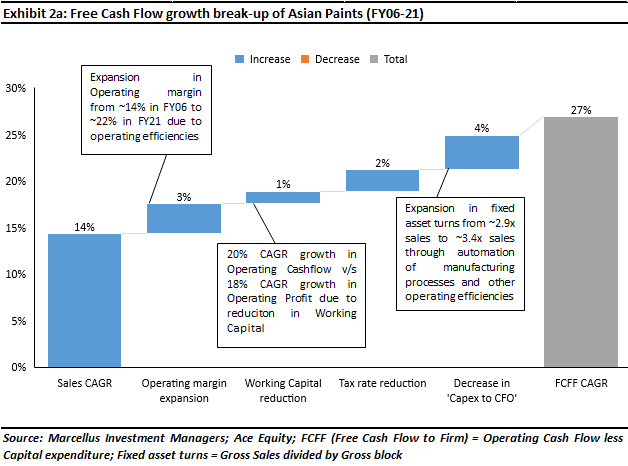
There is also plenty of focus in the Annual Report on Free Cashflow generation through working capital compression and asset turns expansion. “Efficient debtors and inventory management measures have consistently driven strong cash flow generation over the years. The approach is to generate adequate demand in the market so that dealers can rotate their inventory faster and thus operate on a lower credit period with Asian Paints and to increase the credit granted by creditors. The latter is done by leveraging our long-term relationships with vendors and suppliers built on a solid foundation of trust through timely repayment of dues. On the inventory management front, we focused on reducing generation of dead, damaged and defective materials”. Strong focus on generating growth in free cashflows is the key reason why Asian Paints has delivered 24% FCFE CAGR over the past 20 years, including healthy 19% FCFE CAGR over FY16-21, a five year period adversely affected by several macro disruptions like demonetization, GST introduction, the Covid crisis and hence an overall weak economic growth.

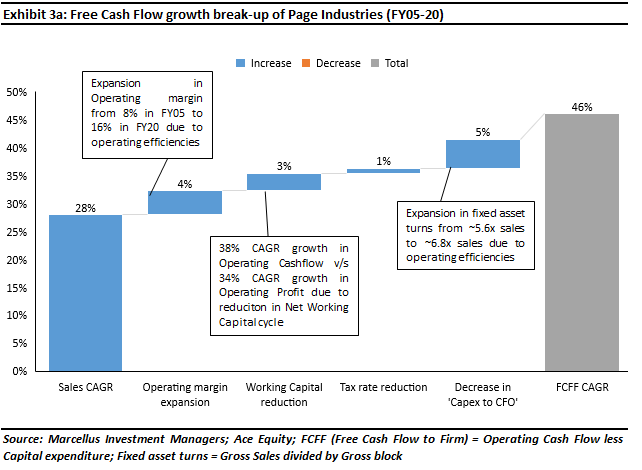
Examples from Page Industries’ FY21 annual report (text in italics has been quoted from the annual report): Given the varied sizes and styles of innerwear and outerwear apparel across mens, womens and kids offerings, Page manufactures and sells a wide range of SKUs across the country. In this context, investments in technology are key to scaling up the business without compromising on its free cashflow generation. Over the past three years, Page has transformed its IT infrastructure and its systems and processes across all its functions. For example, our channel checks suggest that Page has provided handheld devices to the sales team of its distributors and has enabled auto-replenishment systems for restocking of inventory. The FY21 annual report suggests further steps have been taken towards technology adoption.

In FY21, Page setup a smart distribution center for finished goods. “The Company has also embarked on its journey with 3PL Warehouse Outsourcing model with one of the trusted partner – DHL at Attibele- Anekal MCS facility. It is catering to both our E-commerce & Channel Distribution business requirements. Spread across 2 Lakh Sft., the warehouses are built with best-in-class infrastructure at par with global industry standards. This is (i) Company’s first mechatronic warehouse for Channel Distribution with minimal human intervention through seamless integration of processes & technology implementation; and (ii) Best in class E-com warehousing model to cater seamless order processing with focus on service quality and speed to market along with improved inventory accuracy and productivity.”

As part of its progress through digitization, Page is upgrading its enterprise planning tool to ‘BlueYonder’ (formerly known as JDA). “With this, our agility and nimbleness in various areas of demand forecasting, customer responsiveness, improved fulfillment, productivity improvement, cost improvement and inventory optimization shall be a reality.”

On the manufacturing front, Page has successfully completed piloting the digital factory initiative in its Hassan facility. “With this initiative we can have real time data, interventions and multi-tier reports on key manufacturing activities like skill deployment, WIP management, efficiency tracking, online inventory management, skill inventory initiatives, down time tracking and reduction.” Separately, the firm has continued upgrading and modernizing the machines used in its manufacturing plants in areas such as: a) kids socks manufacturing machines with auto toe-link technology for a seamless toe line; b) best in class auto-cutter etc.

Examples from Bajaj Finance’s FY21 annual report: Marcellus’ latest KCP newsletter (Bajaj Finance: The Enigma Is Set For Another Transformation) highlights how Bajaj Finance’s digital transformation 2.0 is likely to be one of the most radical transformations for an Indian listed company. The key theme is to create an app based omni-channel ecosystem which will provide flexibility to customers to move online to offline and vice versa in a frictionless manner. Transformation 2.0 will enable BAF to not only double its existing customer base but also mine the wallet share of its existing customers in a cost-effective manner.

Incremental HR initiatives to build an ‘institution’
“Successful business leaders who have helped build institutions of lasting value – all are committed to talent and a culture of excellence. This is usually accomplished by the identification, retention, and development of great people” – Bobby Kotick, CEO of Activision Blizzard and Board member of The Coca Cola Company (source: Forbes interview published in 2016)

Whilst some CCP companies are already run as ‘institutions’ (which means that they demonstrate attributes such as decentralization of execution and strategy, empowerment and incentivization of professionals, succession planning, etc), others are taking steps towards institutionalization of their business. Regardless of how advanced a company already is in its journey of ‘building an institution’, most CCP companies continue to make incremental progress around such attributes. Here are some examples –

Examples from Asian Paints’ FY21 annual report: Asian Paints’ talent proposition has always been one of its biggest strengths. “Asian Paints is not about a few individuals. The average quality of employees in any role is markedly superior to any other company, and that comes by hiring better people at all levels consistently.” – said Saurabh Mukherjea in ‘The Unusual Billionaires’ (2016). Empowerment of high quality talent drives creativity, innovation and underpins a culture of operational efficiency.

Asian Paints reported an attrition rate of 7.8% in FY21. Rs 20 crores was invested towards ‘learning and development’ with curriculums for new joiners as well as lateral hires designed by internal subject matter experts and renowned professors from IIM, ISB, National Law School (Bangalore), etc. In FY21, Asian Paints launched its first ever ESOP plan, which replaces the existing Deferred Incentive Scheme (that provides for deferred cash pay-outs based on performance of the employees and satisfaction of vesting conditions).

The structure of Asian Paints’ ESOP is unique in some ways. The size of the ESOP scheme is 25 lakh shares. The grant of stock options can be made over a period of 10 years. Employees covered under the scheme include MD/CEO + Employees in cadre M4 (Chief Manager) and above. The aspects of the scheme which we found interesting were: a) unlike the ESOP schemes of most other firms, APNT’s ESOP issuance is not concentrated on one or two employees – no eligible employee can get more than 5 lakh stock options (i.e. 20% of the ESOP pool) over 10 years; b) the exercise price of ESOPs is at a 50% discount to the last one month’s average share price prior to grant of ESOPs (unlike most other firms which issue ESOPs with exercise price as the share price prevailing at the time of grant of ESOPs). Considering the number of eligible employees in the firm and their compensation, a simple maths suggests that bulk of APNT’s senior management team will get a significant part of their total compensation in the form of ESOPs over the next 10 years. This, we believe, is a very effective way of incentivizing the senior management team.

On the process of succession planning, the annual report states that “Nomination and Remuneration Committee (NRC) plays a pivotal role in identifying successors to the members of the Senior Management. During the year under review, the NRC spent substantial time with the MD & CEO on succession planning exercise. The succession plan was closely aligned with the strategy and long term needs of the Company”. A team called One Link consisting of GMs, AVPs, VPs led by CEO as a forum for developing next leadership was created last year. A rating system for measuring effectiveness of this system was designed during the year. In FY21, the NRC engaged Egon Zehnder, external consultants, to conduct evaluation of the Board, Committees of the Board and Directors which involved a questionnaire-based approach followed by one on one discussions with all Board members. The outcome of the engagement review process focused on Board dynamics and softer aspects.

Amongst the 32 employees whose remuneration has been disclosed in the FY21 Annual Report, the average time period for which an employee has worked at Asian Paints is 20 years. Only 3 employees out of 32 have been with Asian Paints for less than 10 years. This provides a robust pipeline of internal candidates for succession in CXO roles, thereby helping nurture the DNA of the organization on an ongoing basis.

Examples from Page Industries’ FY21 annual report: Although Page Industries is less institutionalized compared to Asian Paints, there have been some structural changes implemented at Page in the recent years to hire, train, incenvitise and retain high quality talent. For instance, until five years ago, only the senior management team at Page used to be incentivized on firm-wide performance, while the middle management team was incentivized largely on functional targets. In FY21, Page has introduced “Variable Pay ranging from 10% to 30% of the CTC, depending on the grade which commences from Assistant Manager to CEO and the Dy. Managing Director. Variable Pay will be paid based on the overall performance of the Company. Variable Pay shall be paid after the close of the financial year.” Over the last 3 years, Page has also significantly strengthened its IT team with new hires and changed the incentive structures of the front-end sales team.


Investment implications

As technology becomes an increasingly bigger driver of competitive advantage, and as tech-based disruptions become some of the biggest wealth creating themes, investors increasingly are obviously inclined to look for the next winning tech stock. However, one of the risk that investors need to avoid through such investments is of longevity i.e. sustainability of competitive advantages even 10 years from now, and of discipline in strategic decision making and ground level execution.

In this context, we find our CCP Portfolio companies to be some of the biggest, most sustainable (and hence least speculative) beneficiaries of this theme. This is because: (1) these firms have a technology based DNA which helps them to consistently and incrementally deepen their competitive advantages over time; and (2) they have also made significant progress around the softer aspects of ‘building an institution’ which sustains competitive advantages beyond one man / one product / one capability.

Regards
Team Marcellus
Disclaimer:

Copyright © 2026 Marcellus Investment Managers Pvt Ltd, All rights reserved

Note: the above material is neither investment research, nor investment advice. Marcellus does not seek payment for or business from this material/email in any shape or form. Marcellus Investment Managers Private Limited (“Marcellus”) is regulated by the Securities and Exchange Board of India (“SEBI”) as a provider of Portfolio Management Services. Marcellus is also a US Securities & Exchange Commission (“US SEC”) registered Investment Advisor. No content of this publication including the performance related information is verified by SEBI or US SEC. If any recipient or reader of this material is based outside India and USA, please note that Marcellus may not be regulated in such jurisdiction and this material is not a solicitation to use Marcellus’s services. This communication is confidential and privileged and is directed to and for the use of the addressee only. The recipient, if not the addressee, should not use this material if erroneously received, and access and use of this material in any manner by anyone other than the addressee is unauthorized. If you are not the intended recipient, please notify the sender by return email and immediately destroy all copies of this message and any attachments and delete it from your computer system, permanently. No liability whatsoever is assumed by Marcellus as a result of the recipient or any other person relying upon the opinion unless otherwise agreed in writing. The recipient acknowledges that Marcellus may be unable to exercise control or ensure or guarantee the integrity of the text of the material/email message and the text is not warranted as to its completeness and accuracy. The material, names and branding of the investment style do not provide any impression or a claim that these products/strategies achieve the respective objectives. Further, past performance is not indicative of future results. Marcellus and/or its associates, the authors of this material (including their relatives) may have financial interest by way of investments in the companies covered in this material. Marcellus does not receive compensation from the companies for their coverage in this material. Marcellus does not provide any market making service to any company covered in this material. In the past 12 months, Marcellus and its associates have never i) managed or co-managed any public offering of securities; ii) have not offered investment banking or merchant banking or brokerage services; or iii) have received any compensation or other benefits from the company or third party in connection with this coverage. Authors of this material have never served the companies in a capacity of a director, officer or an employee.

This material may contain confidential or proprietary information and user shall take prior written consent from Marcellus before any reproduction in any form.

Regards, Team Marcellus

If you want to read our other published material, please visit https://marcellus.in/pms-investment-blog/


Copyright © 2026 Marcellus Investment Managers Pvt Ltd, All rights reserved


RELATED NEWSLETTERS

  • Aug 12, 2026

    Marcellus Portfolio Updates & Insights – August 2026

    READ MORE
  • Aug 06, 2026

    Global Compounders: Why have we underperformed the S&P500 in 2026?

    READ MORE
  • Jul 27, 2026

    Isaac Newton and the Madness of Men

    READ MORE

RELATED NEWSLETTERS

  • Aug 12, 2026

    Marcellus Portfolio Updates & Insights – August 2026

    READ MORE READ MORE
  • Aug 06, 2026

    Global Compounders: Why have we underperformed the S&P500 in 2026?

    READ MORE READ MORE
  • Jul 27, 2026

    Isaac Newton and the Madness of Men

    READ MORE READ MORE
PREV ISSUE

Bajaj Finance: The Enigma Is Set For Another Transformation


Published on Jul 17, 2021
NEXT ISSUE

Little Champs Show India Inc How To Diversify


Published on Aug 09, 2021

Did`t receive OTP? 00:00 Resend
Be the First to Know

Marcellus logo

At Marcellus, our Purpose is to make wealth creation simple and accessible by being trustworthy and transparent capital allocators.

  • Twitter-Marcellus Investment
  • LinkedIn-Marcellus Investment

Marcellus Investment Managers Private Limited

Please reach out to us at

Board Line : 0806-9199-400

Sales Desk: 0806-9199-401

e-mail: invest@marcellus.in


Marcellus Investment Managers
102, First Floor, Boston House, Suren Road,
Near 'Western Express Highway' Metro Station,
Andheri East, Mumbai 400093

Please reach out to us at

e-mail: help.gift@marcellus.in


Marcellus Investment Managers
IFSC Branch – Unit no. 431 and 432, Signature Building, Fourth Floor, Block 13B, Zone-1, GIFT SEZ, GIFT City, Gandhinagar – 382 355/382 050

  • Home
  • Our Team
  • Invest with us
  • GIFT City Corporate Disclosures
  • Marketing Disclosure
  • Investing Books
  • FAQs
  • Videos
  • Newsletters
  • Corporate Regulatory Disclosure
  • Company Information
  • Terms & Conditions
  • Privacy Policy
  • Responsible Investing
  • Contact Us

2026 © | All rights reserved.

Privacy Policy | Terms and Conditions

Please read the following carefully and select your residency jurisdiction


If accessing this website by giving false declaration, the person shall be solely liable/responsible for any adverse consequences suffered, legally as well as financially, pursuant to use of any information contained in this website

Beware of fraudulent websites and applications!

Marcellus or its employees will never ask you to join WhatsApp groups or social media accounts created by or on behalf of Marcellus. Marcellus does not have any App facilitating trading in securities, nor does Marcellus issue any advertisement for investment in any specific stocks or for any cash transactions.

If you come across any such activity, please report to the appropriate law enforcement authorities, and inform us on compliance@marcellus.in.

Click here for the list of our official social media handles.

Close