OVERVIEW
POPULAR ARTICLES

Summary: In our 8th May blog (A Quadruple Shock to the Cost of Living) we warned that the West Asia war would push inflation sharply higher. October’s CPI print of 6.09% breached the RBI’s 6% ceiling. Crude has since cooled, but inflation hasn’t, because it has spread into stickier ‘core’ items. We expect inflation to stay elevated for three to four quarters, the RBI to hike by another 150-200 bps, and high-quality lenders and franchises with pricing power to pull away from the rest. Please visit invest.marcellus.in if you would like to invest with us.
“Inflation is taxation without legislation.” – Milton Friedman, Nobel Prize-winning economist
Oil has cooled. Inflation hasn’t.
When the war choked oil flows through the Strait of Hormuz, the consensus was that inflation would fade once crude cooled. Brent has fallen about 20% from its late-October high to around $92 a barrel. Yet CPI inflation rose to 6.09% in October, from 2.74% in January. Food is only part of the story; the weakest monsoon since 2015 has left rabi sowing 46% lower than last year.
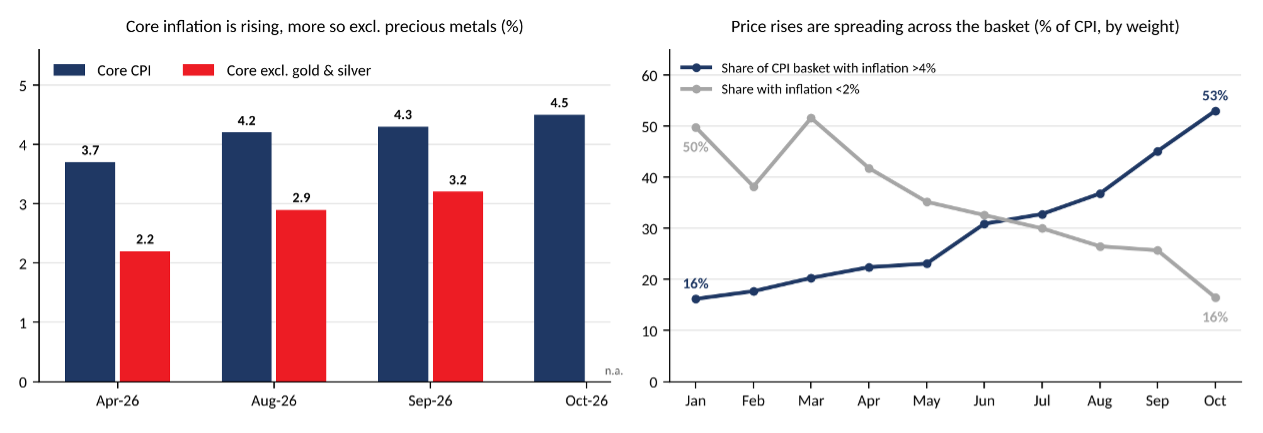
What worries us is where the rise is coming from. Core inflation, which excludes food and fuel, has climbed from 3.7% in April to 4.5%; excluding gold and silver it rose from 2.2% to 3.2% by September. The share of the CPI basket with inflation above 4% has jumped from 16% in January to 53% in October, with clothing, household goods, transport, restaurants and electronics all getting dearer.
Exhibit 1: Core inflation is rising and price rises are spreading across the basket
Source: Marcellus Investment Managers; RBI Monetary Policy Report (October 2026) via Business Standard; Crisil Intelligence; MoSPI; RBI diffusion indices as published by The Indian Express (15th November 2026). Core excluding precious metals for October not yet available.
What happens now? Three trends
- Inflation stays higher for longer
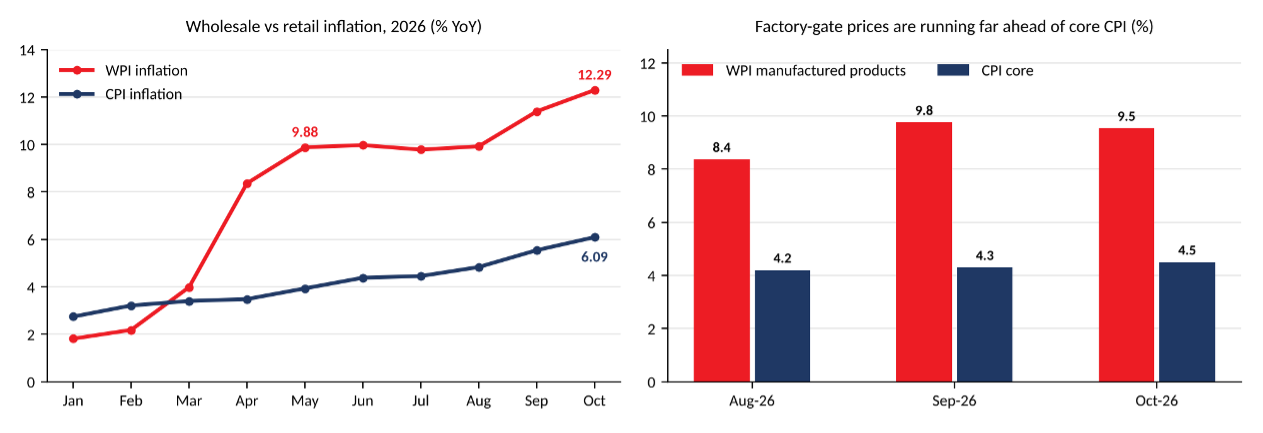
Core prices, such as rents, school fees and restaurant menus, rarely come back down once raised. And more increases are in the pipeline: wholesale inflation has run at 9-10% since May and hit 12.29% in October, with manufactured products alone at about 9.5%, double core CPI. Companies have absorbed much of this so far; they are unlikely do so indefinitely. Households already expect inflation of 10% over the next year according to the RBI’s September 2026 survey.
Exhibit 2: Wholesale inflation is double retail inflation, so more price hikes are coming
Source: Marcellus Investment Managers; Office of the Economic Adviser, DPIIT (WPI, base 2022-23); MoSPI CPI; core CPI as reported in the press.
- More rate hikes and a squeeze on households
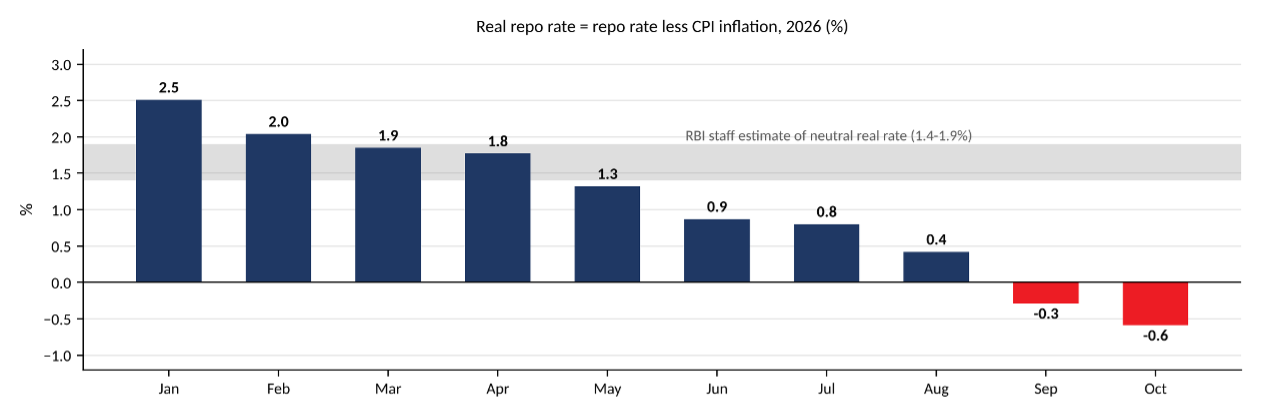
After October’s 25 bps hike to 5.50%, the real repo rate is -0.6%, against +2.5% in January. RBI research puts the neutral real rate at 1.4-1.9%; getting back there implies another 150-200 bps of hikes, depending on where inflation settles. Two-thirds of banks’ floating-rate loans are now repo-linked to external benchmarks such as the repo rate, so EMIs are likely to rise quickly: each 25 bps adds about Rs 817 a month to a Rs 50 lakh home loan. That lands on households whose debt is already 45.5% of GDP. FMCG volumes fell 2% in April-June even as rupee sales rose; households are paying more and buying less.
Exhibit 3: India’s real interest rate has turned negative
Source: Marcellus Investment Managers; RBI; MoSPI. Real repo rate = repo rate less CPI inflation. Neutral real rate per RBI staff estimates (1.4-1.9%).
- The strong pull away from the weak
High-quality lenders. As rates rise, stress shows up first at weaker lenders; small finance banks’ gross NPAs are 3.8% against 1.11% at HDFC Bank and 1.20% at ICICI Bank. HDFC Bank, which grew loans just 5.5% in FY25 while it repaired its balance sheet, is now reaping the rewards of that prudence. Banks like HDFC Bank and ICICI Bank benefit as repo-linked loans reprice within months while deposits take far longer.
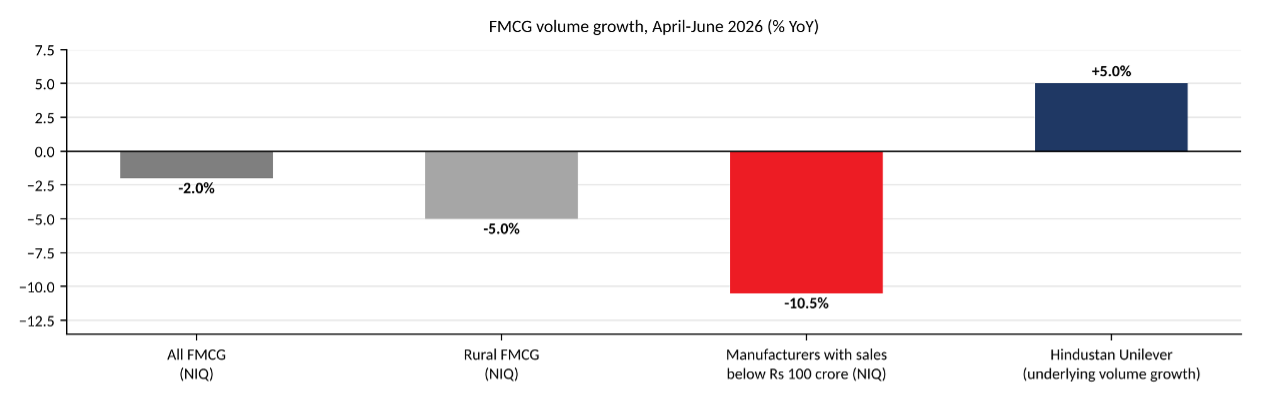
Moats and pricing power. In April-June, 88% of the fall in FMCG volumes came from companies outside the largest manufacturers, while Hindustan Unilever grew volumes 5%. Our 21-year study found that quality companies’ revenue growth beat the Nifty’s by most when CPI was above 6%.
Exhibit 4: The FMCG market is shrinking, but the leaders are still growing volumes
Source: Marcellus Investment Managers; NielsenIQ FMCG Quarterly Snapshot (April-June 2026) via Outlook Business and Upstox; Hindustan Unilever Q1 FY27 results. Mention of these companies is for illustration only and is not a recommendation.
Low input-cost services. IT services, whose key input is graduates, also benefit: TCS’s fresher salary has barely moved from Rs 3.16 lakh in 2007 to Rs 3.36 lakh today, and a weaker rupee lifted its rupee revenue growth to 11.2%. But constant-currency growth was just 2.8%, as AI squeezes Western deal flow, so this is less straightforward.
We at Marcellus seek to keep abreast of a rapidly changing country. If you would like to learn more about our investment approach, which focuses on companies we assess to be clean and well-managed, please visit invest.marcellus.in# or scan the QR code below.

Marcellus Investment Managers Pvt. Ltd. | SEBI PMS Reg. No. INP000006183 |
Click Here for details about our regulatory registration and licensing information.
Nandita Rajhansa and Saurabh Mukherjea work for Marcellus Investment Managers (www.marcellus.in). The views and opinions expressed in this material are those of the authors and do not necessarily reflect official policy. This material is for informational and educational purposes only and should not be considered financial, investment, or other professional advice.
The stocks mentioned above may form part of Marcellus’ portfolio. Marcellus, its clients, and/or its employees may therefore have an interest in the said stock(s).
Note: the above material is neither investment research, nor investment advice. Marcellus Investment Managers Private Limited (“Marcellus”) is regulated by the Securities and Exchange Board of India (“SEBI”) as a provider of Portfolio Management Services. Marcellus is also a US Securities & Exchange Commission (“US SEC”) registered Investment Advisor and is regulated by the International Financial Services Centres Authority (IFSCA) as a Fund Management Entity. No content of this publication including the performance related information is verified by SEBI, IFSCA or US SEC. If any recipient or reader of this material is based outside India and USA, please note that Marcellus may not be regulated in such jurisdiction and this material is not a solicitation to use Marcellus’s services. The PMS strategy, Category III AIF products and IFSCA retail schemes are distinct offerings with different regulatory frameworks, risk profiles, fee structures and investment thresholds. Investors should refer to product-specific documents for details before investing. All recipients of this material must, before dealing and or transacting in any of the products and services referred to in this material, make their own investigation and seek appropriate professional advice. Investments in securities market are subject to market risks. Read all the related documents carefully before investing. Past performance is not indicative of future results. Marcellus and/or its associates, the authors of this material (including their relatives) may have financial interest by way of investments in the companies covered in this material. Marcellus does not receive compensation from the companies for their coverage in this material. This material may contain confidential or proprietary information and user shall take prior written consent from Marcellus before any reproduction in any form. Investments in securities markets are subject to market risks and there is no assurance that any investment objective will be achieved.
As per SEBI Master Circular dated June 07, 2024, clients have an option to be on-boarded directly by the Portfolio Manager without intermediation of persons engaged in distribution services.
# This tool is designed to help users explore products and asset allocation guidance; it does not constitute a formal financial plan or investment advice.