OVERVIEW
POPULAR ARTICLES

A ₹1 lakh investment in the Nifty in November 1995 would be worth roughly ₹36 lakh today, assuming dividends were reinvested. However, 2/3rds of that ₹36 lakh has come in the last 10 years (with the first two decades feeling slow, boring and punctuated by horrific years like 2008). That’s why long-term compounding is easy to understand but hard to deliver. And that is why our Consistent Compounder Portfolio stands the test of time – it delivers when the economy tanks and the going gets tough.
To invest with us, visit invest.marcellus.in
Exhibit 1
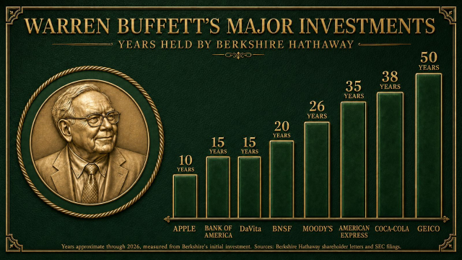
Source: Vatsal Nahata
The Myth of the “Free Lunch”
- Takes away the need for you to forecast the future or chase short term trends & fads;
- Gives you the volatility reduction necessary for you to let time work its magic; and
- Makes long term compounding accessible to you regardless of how much or how little money you have.
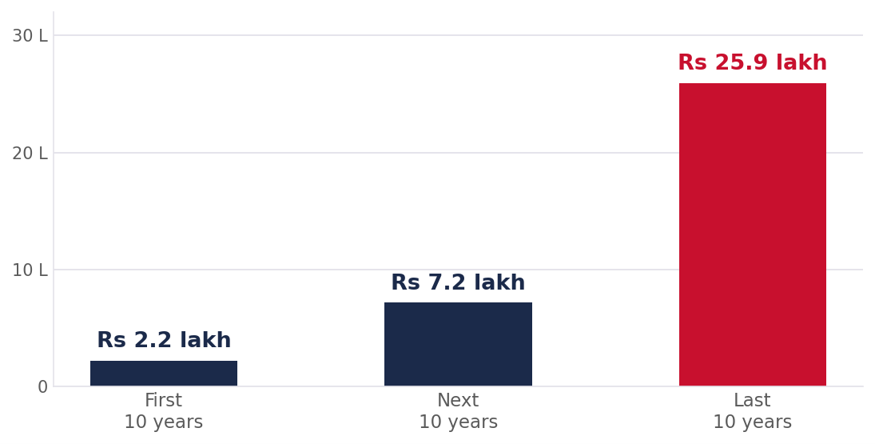
Since inception the Nifty has compounded at 10.9% a year on the index, and 12.4% with dividends reinvested. 12% might sound ordinary but the chart below helps you visualise how 12% ramps over 20 years to turn Rs 1 lakh to Rs 36 lakhs. In the first ten years it adds Rs 2.2 lakh. In the next ten, Rs 7.2 lakh. In the last stretch, Rs 26 lakh.
For twenty years, compounding looks like it is barely working. The numbers are small, your neighbour’s trading account is doing better, and the urge to do something else becomes unbearable. Then the same boring 12%, applied to a much bigger base, starts producing numbers that look made up.
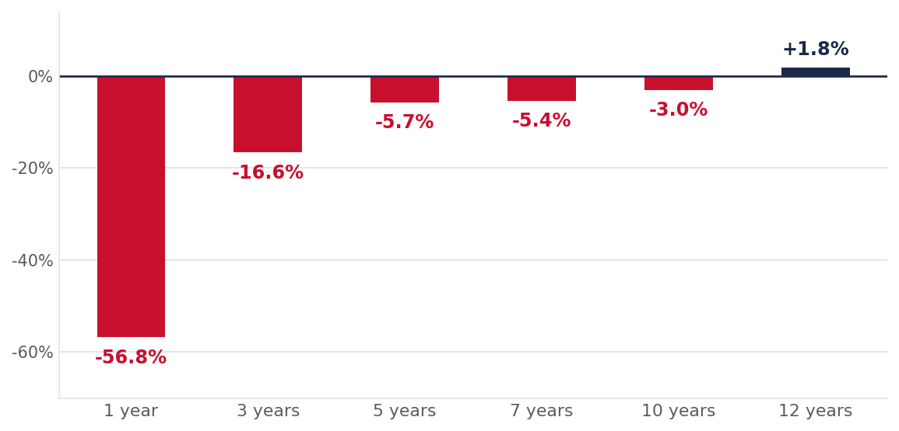
Over any single year the Nifty has been positive about three quarters of the time. Decent odds, but that is a bet, not a plan. Stretch to seven years and the historical record contains no losing windows at all. Time is not making your returns bigger. It is deleting the bad outcomes altogether.
This is why Marcellus exists in the shape it does. When we launched our Consistent Compounders Portfolio in December 2018, we are not trying to trade cleverly or rotate into whatever is working this quarter. We buy a small number of genuinely good businesses and then get out of their way.
Three things have to be true before a company qualifies.
- The accounts have to be clear
- Capital has to be allocated sensibly.
- The moat has to last.
The idea is older than us. In 1984 an American fund manager called Robert Kirby wrote about a client whose late husband had quietly bought every stock Kirby recommended and ignored every instruction to sell. Years later the portfolio he had never touched was worth far more than the one Kirby had been actively managing, carried by one holding he had simply left alone. Kirby called it the coffee can portfolio, after the tin where families once stored valuables and forgot about them. It remains the spine of how we invest.
Where that leaves us today
It would be convenient to publish this in a rising market. We are not in one. The Nifty is roughly a tenth below its January high, crude is climbing, the geopolitics is ugly and foreign investors have been selling steadily.
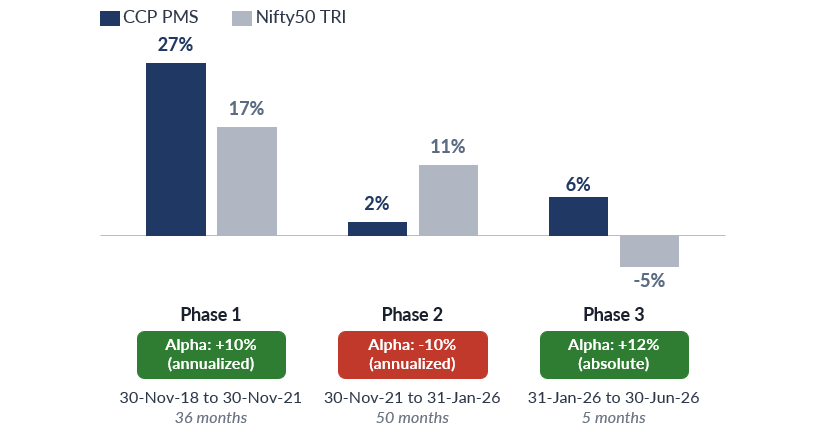
It has also been a difficult few years for our style of investing. From 2021 to 2025 the market paid for momentum, small caps and cyclical recoveries, while Quality compounders looked expensive and slow. That is exactly when investors abandon the free lunch, usually in the last stretch before it is served.
What happens next is the interesting part. When money is easy, every strategy looks intelligent and nobody can tell a good business from a fashionable one. When conditions tighten (i.e. Sankat Kaal arrives), that distinction reappears very quickly. Earnings that were being flattered stop being flattered. The businesses that actually compound carry on compounding and holding them stops looking like laziness and starts looking like an edge.
Which brings us back to where we started. The free lunch has been sitting on the table for thirty years. It was never the clever trade, and it was never the perfectly diversified portfolio. It was owning something worth owning and then leaving it alone. The hard part has always been the same. Most people clear the plate long before the food arrives.
________________________________________________________________________________________________________________________________
If you would like to put this to work
Our Consistent Compounders Portfolio exercises this very principle by buying the Indian businesses described above, with a minimum investment of Rs 50 lakh. Most of our clients invest with us with ZERO fixed fees and we only get to earn fees if our returns exceed a hurdle of 8% p.a. To invest with us, please click on the QR code underneath this chart.
Consistent Compounders Portfolio — CCP PMS vs Nifty50 TRI, annualised returns by phase
Consistent Compounders Portfolio — CCP performance vs Nifty50 TRI, by period (Dec 2018 till June 2026)
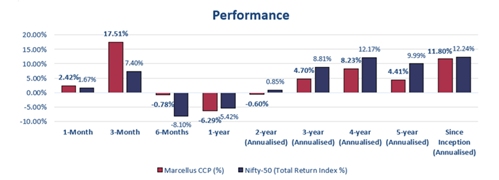
Source: Marcellus Investment Managers; Performance Data shown is net of fixed fees and expenses charged till the last quarter end and is net of Performance fees charged for client accounts, whose account anniversary / performance calculation date falls upto the last date of this performance period; 1 month, 3 months & 6 months returns are absolute; other time period returns are annualized. The calculation or presentation of performance results in this publication has NOT been approved or reviewed by the SEC, SEBI or any other regulatory authority.
*For relative performance of particular Investment Approach to other Portfolio Managers within the selected strategy, please refer https://www.apmiindia.org/apmi/welcomeiaperformance.htm?action=PMSmenu, Under PMS Provider Name please select Marcellus Investment Managers Private Limited and select your Investment Approach Name for viewing the stated disclosure.
Marcellus also provides its clients the option to be directly onboarded, without the intervention or intermediation of any person engaged in distribution services (including distributors/referral partners).
To invest with us, please click on the QR code below
Asset allocation shall not be considered as Investment advice.
The above material is neither investment research, nor investment advice. Marcellus does not seek payment for or business from this material/email in any shape or form. Marcellus Investment Managers Private Limited (“Marcellus”) is regulated by the Securities and Exchange Board of India (“SEBI”) as a provider of Portfolio Management Services. Marcellus is also a US Securities & Exchange Commission (“US SEC”) registered Investment Advisor. No content of this publication including the performance related information is verified by SEBI or US SEC. If any recipient or reader of this material is based outside India and USA, please note that
Marcellus may not be regulated in such jurisdiction and this material is not a solicitation to use Marcellus’s services. This communication is confidential and privileged and is directed to and for the use of the addressee only. The recipient of this material is urged to consult their own legal and tax consultants/advisors before making any investments. The recipient, if not the addressee, should not use this material if erroneously received, and access and use of this material in any manner by anyone other than the addressee is unauthorized. If you are not the intended recipient, please notify the sender by return email and immediately destroy all copies of this message and any attachments and delete it from your computer system, permanently. No liability whatsoever is assumed by Marcellus as a result of the recipient or any other person relying upon the opinion unless otherwise agreed in writing. The recipient acknowledges that Marcellus may be unable to exercise control or ensure or guarantee the integrity of the text of the material/email message and the text is not warranted as to its completeness and accuracy. The material, names and branding of the investment style do not provide any impression or a claim that these products/strategies achieve the respective objectives. Further, past performance is not indicative of future results. Marcellus and/or its associates, the authors of this material (including their relatives) may have financial interest by way of investments in the companies covered in this material. Marcellus does not receive compensation from the companies for their coverage in this material. Marcellus does not provide any market making service to any company covered in this material. In the past 12 months, Marcellus and its associates have never i) managed or co-managed any public offering of securities; ii) have not offered investment banking or merchant banking or brokerage services; or iii) have received any compensation or other benefits from the company or third party in connection with this coverage. Authors of this material have never served the companies in a capacity of a director, officer or an employee. All recipients of this material must before dealing and or transacting in any of the products referred to in this material must make their own investigation, seek appropriate professional advice and carefully read the Private Placement Memorandum/Disclosure Document, Form ADV, Form CRS and any other documents or disclosures provided to them by Marcellus, as applicable.
This material may contain confidential or proprietary information and user shall take prior written consent from Marcellus before any reproduction in any form.