OVERVIEW
POPULAR ARTICLES

Summary: Ray Kurzweil’s Singularity forecast in 2005 — that machine intelligence will so dramatically exceed all human intelligence by 2045 that human life will be irreversibly transformed — was initially dismissed as the speculative musings of an eccentric scientist. However, now that his intermediate forecast for 2029 – that AI will pass the Turing test (i.e., reach human-level general intelligence) – looks increasingly realistic, the world is paying attention to Kurzweil’s extensive body of work. For India, Kurzweil’s point of view implies increasing redundancy of middle-skilled workers and that spells trouble for the Indian economy. Through a set of tax-efficient, cost-efficient global investment products Marcellus has created an escape hatch for the Indian middle class.
Ray Kurzweil’s 2005 prediction
Ray Kurzweil is an American computer scientist, inventor, and futurist. He pioneered optical character recognition (OCR), text-to-speech synthesis, speech recognition technology, and electronic keyboard instruments. Since 2012 he has served as a Director of Engineering at Google. His credibility derives partly from the fact that he actually built many of the technologies he later wrote about.
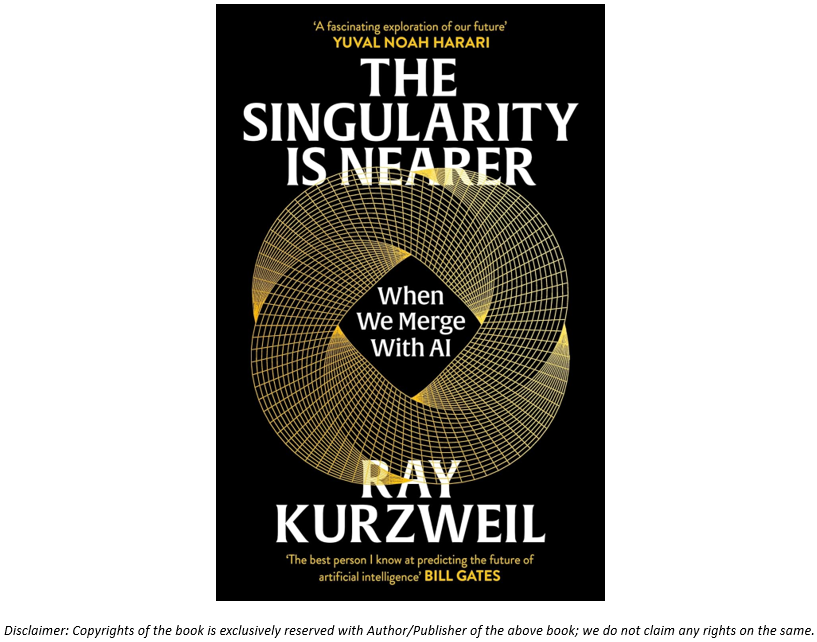
The Singularity forecast was first made by Kurzweil in his book, The Singularity Is Near (2005):
“I set the date for the Singularity—representing a profound and disruptive transformation in human capability—as 2045.”
Kurzweil defined a pre-cursor milestone of 2029, by which AI will pass the Turing test (i.e., reach human-level general intelligence). Kurzweil did not invent the term — Vernor Vinge first used “singularity” in this sense in Omni magazine (January 1983), and gave it its famous formal treatment in his 1993 NASA VISION-21 essay. Kurzweil’s contribution was to fix the date and embed it in a quantitative model.
When Kurzweil first made the forecast in 2005, the majority of experts (and non-experts like Saurabh Mukherjea) dismissed it as speculative and non-serious. Critics compared the buildup towards the singularity with “Judeo-Christian end-of-time scenarios,” with one critic calling it “a Buck Rogers vision of the hypothetical Christian Rapture.”
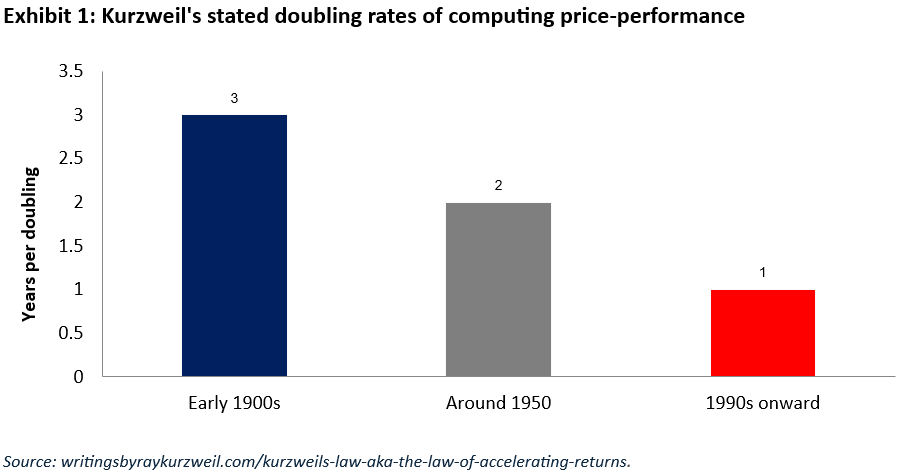
Twenty-one years later, however, Kurzweil’s forecast has moved from fringe curiosity to mainstream debate. Part of the reason for this is that Kurzweil accurately nailed the underlying velocity of technological change. He argued (and continues to argue) that the rate of technological change is itself exponential, not linear, and that this holds across paradigms — electromechanical → relay → vacuum tube → transistor → integrated circuit. From his own primary essay (The Law of Accelerating Returns, 2001):
“It took three years to double the price-performance of computation at the beginning of the twentieth century, two years around 1950, and is now doubling about once a year.”
What Kurzweil seems to have predicted correctly
Kurzweil’s forecast for 2029 that AI will pass the Turing-test looks plausible. The 2045 Singularity looks more credible than it did in 2020, but for narrower reasons than Kurzweil claimed — primarily AI capability gains, not biology or nanotechnology.
METR’s March 2025 study showing AI task-completion ability doubling every ~7 months provides the strongest empirical validation of a Kurzweil-style exponential ever produced. The doubling rate has accelerated to ~4.3 months in the post-2023 era.
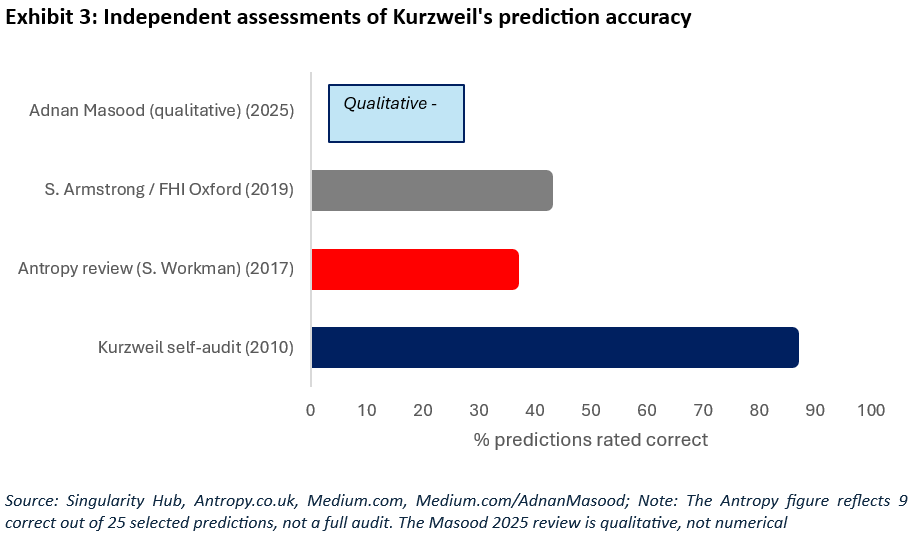
Independent reviews of Kurzweil’s prior predictions place his accuracy at 36–42%, well below his self-claimed 86%. His pattern is “directionally right, timing-optimistic.”
In March 2025, METR (Model Evaluation & Threat Research), a non-profit AI research organisation, published the most rigorous empirical test of a Kurzweil-style exponential ever produced. Their headline finding: the length of software-engineering tasks that frontier AI systems can complete autonomously is doubling approximately every seven months.
The METR paper “Measuring AI Ability to Complete Long Tasks” tested AI agents from 2019 to 2025 on ~230 tasks (mostly coding, some general reasoning), then mapped each model’s task length at 50% reliability against human completion time. The result, in METR’s own words:
“We propose measuring AI performance in terms of the length of tasks AI agents can complete. We show that this metric has been consistently exponentially increasing over the past 6 years, with a doubling time of around 7 months.”
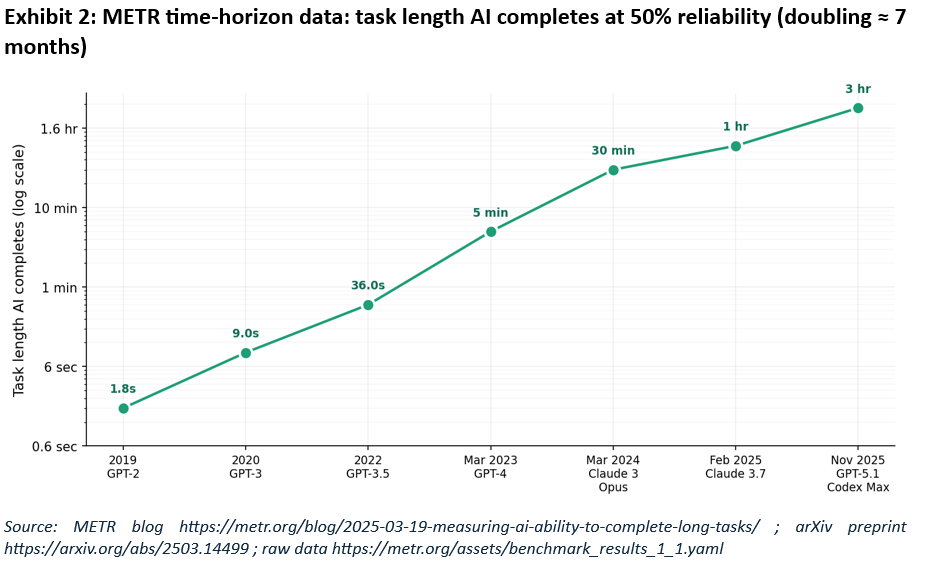
In a January 2026 update (Time Horizon 1.1), METR found the post-2023 doubling rate had accelerated to 130.8 days (4.3 months) — 20% faster than the long-run rate. This is exactly the kind of “second-order acceleration” Kurzweil predicted: the rate of progress itself increases.
Where Kurzweil’s predictions and METR’s findings regarding the progress of AI align:
- Both find a clean exponential trend, both find acceleration. Kurzweil’s curve went from doubling every 3 years to every 1 year i.e. the speed of improvement accelerates. METR’s post-2023 doubling rate is faster than its 6-year average i.e. the same pattern.
- Both converge on similar end-of-decade predictions. Kurzweil’s 2029 milestone maps roughly to METR’s extrapolation: at a 7-month doubling landing around 2032–2033 (not far from Kurzweil’s 2029 forecast). METR’s own paper says that “in under a decade, we will see AI agents that can independently complete a large fraction of software tasks that currently take humans days or weeks.”
- Both are paradigm-independent. Kurzweil’s curve spans five hardware paradigms without breaking. METR’s curve spans GPT-2 base models, RLHF chat models, reasoning models and agentic systems — also without breaking.
Industry leaders have converged toward Kurzweil-like or even earlier timelines. Sam Altman has stated that we are “already past the event horizon.”
A Global Policy Journal review (Feb 2026) confirms that “Ray Kurzweil, Sam Altman, Geoffrey Hinton, and Yoshua Bengio suggest Artificial Superintelligence (ASI) could arrive by 2040” — a clustering that did not exist five years ago.
The last 3–5 years have strengthened the AI/compute portion of Kurzweil’s thesis materially — to the point where his 2029 Turing-test milestone now looks plausibly conservative.
With ChatGPT’s launch in November 2022 and the LLM capability explosion since, Kurzweil’s Singularity forecast moved into mainstream debate. A meta-analysis by AIMultiple of 9,800 expert predictions across 8 surveys now shows the consensus has shifted to the early 2040s — a meaningful move earlier than previous estimates that had placed AGI around 2060.
Where Kurzweil might be overly aggressive
METR’s curve is the most rigorous empirical evidence in 2025 that Kurzweil’s directional thesis on AI capability is correct. What METR does not validate is the rest of Kurzweil’s package: brain emulation, nanobots in bloodstreams, longevity escape velocity, human-machine merger. METR measures coding agents on benchmarks. The leap from “AI can autonomously do a week of software engineering” to “humans merge with machines and become post-biological” is – to put it mildly – large.
The consistent critique across all of Kurzweil’s forecasts that: (a) he is directionally right but overly optimistic on the timing of improvements in AI; and (b) he is directionally wrong or far-too-optimistic on nanotechnology, longevity, and brain emulation.
Implications for India
India’s exposure to the Singularity-adjacent disruption is structurally acute and asymmetric. Specifically, India may have to absorb the labour-market costs of the AI transition before it captures the productivity benefits.
The Government of India’s think tank, NITI Aayog’s October 2025 roadmap warns that the worst-case scenario could shrink the tech-services headcount from 7.5–8 million in 2023 to 6 million by 2031, alongside a doubling of demand for AI professionals from 825,000 to over 1.25 million between 2024 and 2026.
India’s middle-class economic ascent has been built almost entirely on white-collar services — IT services, business process management, and financial back-office work — which are precisely the sectors generative AI targets first. The NITI Aayog Roadmap for Job Creation in the AI Economy (released 10 October 2025) is the primary government source on this. Quoting from the Executive Summary of this report:
“In a business-as-usual case, there will be a downside. In this worst-case scenario, the headcount in the tech services sector could go down from 7.5 to 8 million in 2023 to 6 million by 2031. Similarly, the headcount in the CX sector could go down from 2 to 2.5 million in 2023 to 1.8 million.”
More specifically, as AI rewards highly skilled white collar workers even more and takes rewards away from less-skilled workers, inequality will increase further in the Indian white-collar job market. As we highlighted in our 27th April 2026 blog (AI is Birthing a New Middle-Class Elite: Evidence from the West ), research published by the Financial Times shows that: “Those with skills that complement AI command a 56 percent wage premium over peers in the same role without AI skill.”
The disruption Kurzweil’s 2029 Turing Test forecast is likely to impose on India is non-linear: capital owners benefit unconditionally; AI-complementary workers benefit; the middle-skill knowledge worker loses ground.
Leaving aside how AI could redistribute the spoils in the Indian economy, India is a consumer of frontier AI, not a producer. Frontier model labs sit in the US (OpenAI, Anthropic, Google DeepMind, xAI, Meta) and China (DeepSeek, Alibaba Qwen). If the Singularity trajectory holds, the intelligence underlying it will be controlled by a small group of corporations in two countries — and India’s policy autonomy may diminish accordingly. NITI Aayog’s India AI Mission and the Digital Personal Data Protection Act 2023 are partial responses but appear to be reactive catch-up moves.
Investment Implications
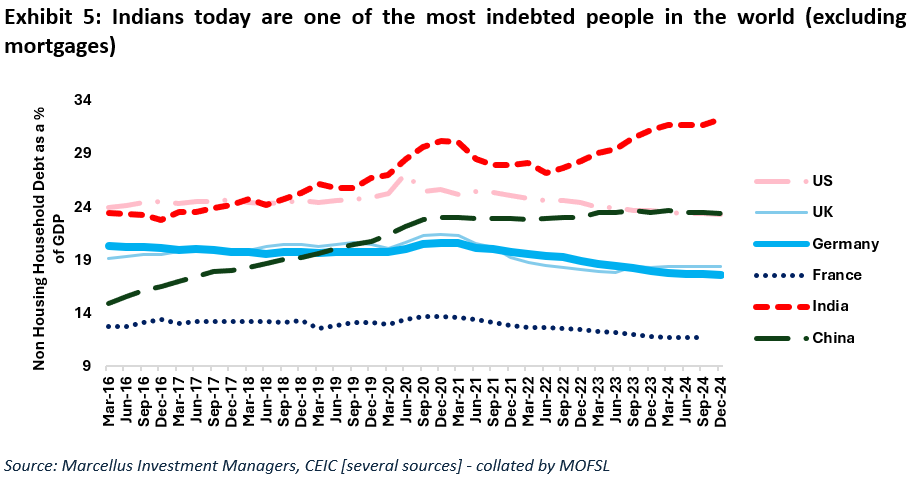
We have highlighted in our bestselling book, “Breakpoint: The Crisis of the Middle Class” that the Indian middle class is: a) more indebted today than it has ever been; b) among the most indebted groups of people anywhere in the world – see chart below; c) has seen white collar job growth evaporate in the past 3 year; and d) is seeing its real wages fall over the past decade. Against this backdrop, the fact Kurzweil’s Singularity forecast seems directionally correct is likely to spell further trouble for the Indian middle class.
In this uncertain environment, we offer two services which could be useful.
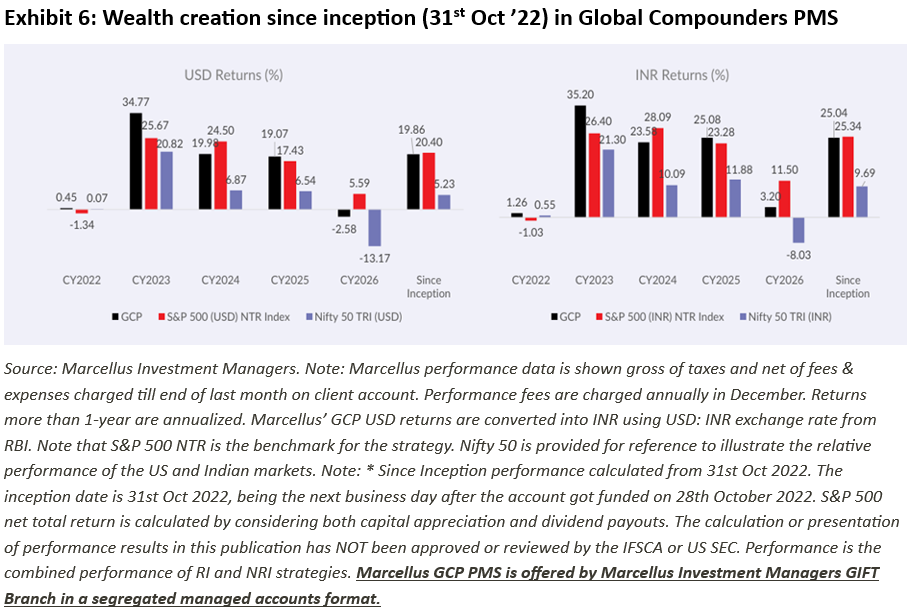
Four years ago, we began investing our clients’ monies globally from GIFT City in Gujarat. We now have tax-efficient and cost-effective US$ based multiple Global funds based out of GIFT City. Amongst other things, these Global funds, including our Global Compounders PMS (see chart below), are invested in, both, the tech hardware and software supply-chains which underpin the AI revolution. If you are interested in global funds, please visit invest.marcellus.in to contact us.
Secondly, Marcellus has a free goal planning and asset allocation service wherein anyone can reach out to us and get a detailed 4-page financial report free of charge.
We work with a three-step approach to help our clients diversify globally:
· Map your life goals to financial goals. How much do you need for near, medium, and long-term goals?
· Allocate your investments across multiple uncorrelated asset classes. Avoid over concentration, illiquidity and disproportionate risk-reward. Get the allocation right based on your needs and your risk tolerance.
· Remain disciplined. Continue to save and channel savings to investments. Review and rebalance regularly.
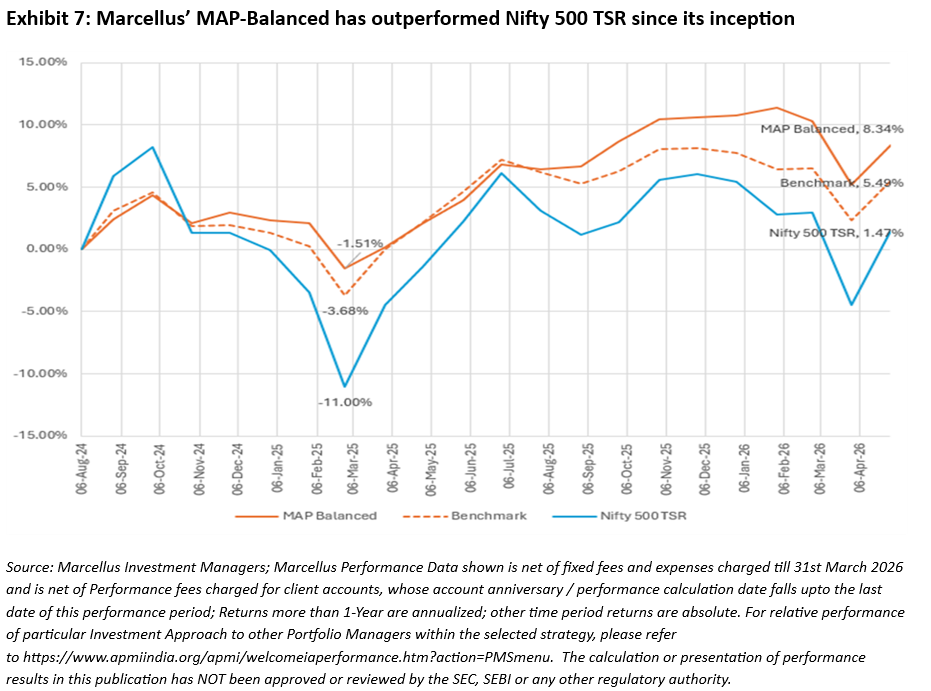
Marcellus’ ‘MAP-Balanced’ which has delivered 8.34% returns since inception in Aug-24 to April-26 net of all fees and costs against 1.47% of Nifty 500 TSR (see the chart below).

We offer our clients a free asset allocation plan. To avail of this, please visit plan.marcellus.in OR scan the QR code shown below into your mobile phone.

Note: This tool provides guidance on asset allocation and does not constitute a financial plan or investment advice.
Saurabh Mukherjea and Nandita Rajhansa work for Marcellus Investment Managers (www.marcellus.in) and are the authors of “ Breakpoint: The Crisis of the Middle Class & The Future of Work”
The views and opinions expressed in this material are those of the writers/authors and do not necessarily reflect the official policy. This material is for informational and educational purposes only and should not be considered as financial, investment, or other professional advice. The inclusion of any book does not imply endorsement or recommendation by the writers or the publisher of this material.
The above material is neither investment research, nor investment advice. Marcellus does not seek payment for or business from this material/email in any shape or form. Alphabet, Apple, Amazon, Microsoft are constituent holdings within the Marcellus Global Compounders Portfolio, a strategy offered by the IFSC branch of Marcellus Investment Managers Private Limited and regulated by the IFSCA. Accordingly, Marcellus, its employees, their immediate relatives, and clients may maintain interests or positions in these securities. Any reference to these companies is intended strictly for informational and educational purposes within the context of this discussion and should not be construed as investment advice. Saurabh, Nandita and Marcellus’ clients may be invested in these. Marcellus Investment Managers Private Limited (“Marcellus”) is regulated by the Securities and Exchange Board of India (“SEBI”) as a provider of Portfolio Management Services. Marcellus is also a US Securities & Exchange Commission (“US SEC”) registered Investment Advisor. No content of this publication including the performance related information is verified by SEBI or US SEC. If any recipient or reader of this material is based outside India and USA, please note that Marcellus may not be regulated in such jurisdiction and this material is not a solicitation to use Marcellus’s services. All recipients of this material must before dealing and or transacting in any of the products and services referred to in this material must make their own investigation, seek appropriate professional advice. This communication is confidential and privileged and is directed to and for the use of the addressee only. The recipient, if not the addressee, should not use this material if erroneously received, and access and use of this material in any manner by anyone other than the addressee is unauthorized. If you are not the intended recipient, please notify the sender by return email and immediately destroy all copies of this message and any attachments and delete it from your computer system, permanently. No liability whatsoever is assumed by Marcellus as a result of the recipient or any other person relying upon the opinion unless otherwise agreed in writing. The recipient acknowledges that Marcellus may be unable to exercise control or ensure or guarantee the integrity of the text of the material/email message and the text is not warranted as to its completeness and accuracy. The material, names and branding of the investment style do not provide any impression or a claim that these products/strategies achieve the respective objectives. Further, past performance is not indicative of future results. Marcellus and/or its associates, the authors of this material (including their relatives) may have financial interest by way of investments in the companies covered in this material. Marcellus does not receive compensation from the companies for their coverage in this material. Marcellus does not provide any market making service to any company covered in this material. In the past 12 months, Marcellus and its associates have never i) managed or co-managed any public offering of securities; ii) have not offered investment banking or merchant banking or brokerage services; or iii) have received any compensation or other benefits from the company or third party in connection with this coverage. Authors of this material have never served the companies in a capacity of a director, officer, or an employee. This material may contain confidential or proprietary information and user shall take prior written consent from Marcellus before any reproduction in any form.