
OVERVIEW
POPULAR ARTICLES

Although India doesn’t have anything to do with the war in the Middle East, over the past month, the Nifty is down 11.7% in $ terms, 3x more than the S&P500 (down 3.6%) and nearly 1.5x more the European index (European Stoxx 600 Index down 8.1%). So, why is India so exposed to events in the Middle East and what can you do reduce your vulnerability? Short answer: Diversify your investments across global markets.
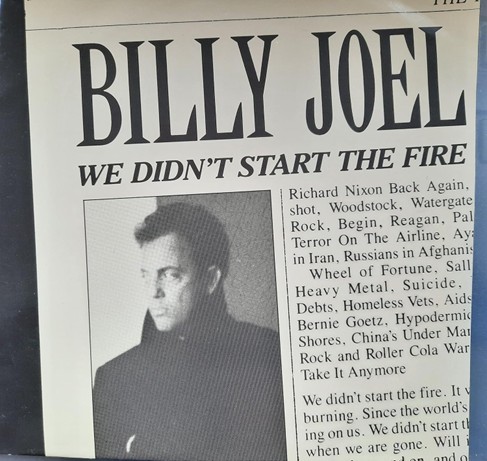
Source: Amazon (i)
“We didn’t start the fire
It was always burning since the world’s been turning
We didn’t start the fire
No, we didn’t light it, but we tried to fight it” (ii)
This popular song from Billy Joel’s 1989 album ‘Storm Front’ is set to become essential humming for Indian investors if the conflict in the Middle East drags on. Because, as expressed on social media, some Indians feel aggrieved that our stock market is being pounded so hard just because:
1. 85% of India’s oil is imported as compared to 35% for USA (iii) (iv);
2. 60% of India’s LPG and LNG is imported as compared to a negligible amount for USA (v); and
3. India has 21 days of natural gas reserves as compared to America’s 80 YEARS of natural gas reserves (vi)
Anyhow, if the conflict ends quickly – and let’s pray that it does – there is likely to be a relief rally in the Nifty and India’s oil & gas fuel vulnerability will soon be forgotten. And that’s why it is important to know the story behind why Mr Joel penned the lyrics for “We Didn’t Start the Fire?”.
In 1989, when Joel turned 40, he had conversation with his friend, Sean Lennon. The friend had just turned 21 and was complaining – like many young investors do – about how crazy it was to be living in his era, therefore undermining any other time before his. “This encouraged Joel to write a song that would prove that every time period is filled with extremes.
Starting from 1949 (the year in which he was born), he chronicled the major events that occurred during that time in a rapid-fire delivery of names, places, and cultural works.” (vii) In fact, Mr Joel prophetically sang:
“…Reagan, Palestine
Terror on the airline
Ayatollahs in Iran
Russians in Afghanistan”
Mr Joel’s clarity of thought (in contrast to his young friend’s naivety) has significant implications for us as investors because if by thanks to decades of experience we know that big, nasty events will happen with unexpected regularity we will diversify our portfolio globally across a range of asset classes (rather than loading up on stocks from a single stock market and then twisting & tossing in bed at night).
Source for the charts: Marcellus Investment Managers using data from ACE Equity & Bloomberg.
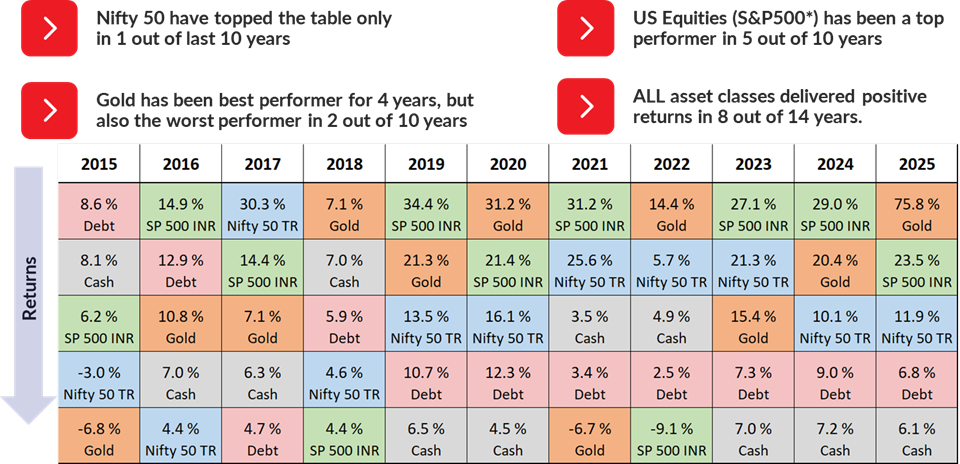
One way to understand the benefits of global diversification is by looking at the table above which lists for each of the past ten years how 5 big assets classes have fared for Indian investors. Beyond the obvious point that no single asset class tops the charts every year, the S&P500 has been the most consistent performer over the past decade followed by gold.
A simple equally weighted average (annually rebalanced to equal weight on 1 Jan each year) of the above 5 assets over the past 10 years would have produced a CAGR of 13.2%. The median return across the ten years from such a strategy would be 13.9% whilst the mean annual return would be 13.3%. All of them are decent outcomes to my mind and speaks to the stability of returns than diversification delivers. [Note: the table shown above is for the purposes of illustration.]
Investment implications for you
While we lack Mr Joel’s musical abilities, we try to make up for it by learning from our experiences in the stock market. In 2022 & 2023 (after a strong run in the preceding years) we experienced meaningful draw downs while managing concentrated portfolios of Indian stocks for our clients. The draw downs that we experienced, the client attrition, the hair loss and the sleepless nights that we suffered convinced us to diversify globally. Thus, was born in Oct 2022 our Global Compounders Portfolio which focuses on 35-40 high quality companies chosen from stock markets in Taiwan, Germany, Sweden, Holland, France, Canada and Mr Joel’s country, America.
Following the launch of Global Compounders and its subsequent implementation within a more tax‑efficient and cost‑effective structure, it became a significant part of my overall asset allocation alongside Marcellus’ Indian portfolios, reinforcing the benefits of diversification.
Thanks to the regulatory reforms expedited by the Indian authorities over the past couple of years (see my 7th Jan blog: https://marcellus.in/blogs/four-mega-reforms-which-opened-up-global-investing-for-indians/ ), you are in an even better position than I was in 2022. Our regulators have ensured that Indians who understand the true significance of Mr Joel’s song are now able to diversify globally in a cost-efficient and tax-efficient manner thereby benefiting from this new age of rage. Our track record in compounding across the world is shown below. Since inception in Oct 2022, the strategy has delivered at ~26% CAGR (net of all fees & expenses in INR).
If you would like more information about our global strategy, please reach out to us.
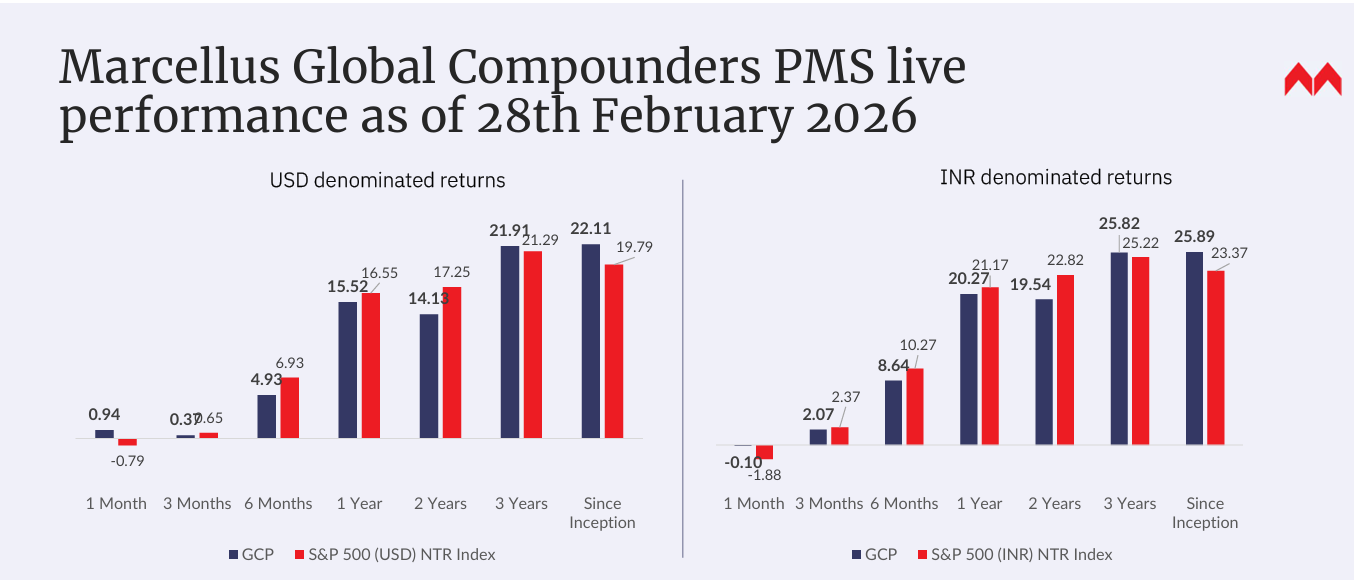
Note: Marcellus performance data is shown gross of taxes and net of fees & expenses charged till end of last month on client account. Performance fees are charged annually in December. Returns more than 1-year are annualized. Marcellus’ GCP USD returns are converted into INR using USD: INR exchange rate from RBI – Link for the reference
Note: * Since Inception performance calculated from 31st Oct 2022. The inception date is 31st Oct 2022, being the next business day after the account got funded on 28th October 2022. S&P 500 net total return is calculated by considering both capital appreciation and dividend payouts. The calculation or presentation of performance results in this publication has NOT been approved or reviewed by the IFSCA or US SEC. Performance is the combined performance of RI and NRI strategies.
Marcellus GCP PMS is offered by Marcellus Investment Managers GIFT Branch in a segregated managed accounts format.
References:
i. https://www.amazon.com/didnt-start-Vinyl-single-Vinyl-Single/dp/B003TGGXMG
ii. https://genius.com/Billy-joel-we-didnt-start-the-fire-lyrics
iii. https://www.moneycontrol.com/news/business/commodities/fuel-prices-are-surging-worldwide-after-the-…
iv. https://elchemy.com/blogs/chemical-market/what-percentage-of-u-s-oil-is-imported-in-2025-the-facts#…
v. https://www.pib.gov.in/PressReleasePage.aspx?PRID=2238525®=3&lang=1
vi. https://news24online.com/business/is-india-heading-for-a-kitchen-crisis-with-21-days-of-lpg-and-74-… ; https://www.eia.gov/energyexplained/natural-gas/how-much-gas-is-left.php#:~:text=According%20to%20U….
vii. https://genius.com/Billy-joel-we-didnt-start-the-fire-lyrics#about
This material is for informational purposes only and does not constitute investment research or advice. Marcellus Investment Managers Private Limited (“Marcellus”) is regulated by the IFSCA as a Fund Management Entity – Retail and is also registered with the U.S. SEC as an Investment Adviser. The contents, including any performance information, are not verified by IFSCA or the U.S. SEC. Past performance is not indicative of future results. Investments involve risk, including loss of principal. Recipients should seek independent legal, tax, and investment advice.