OVERVIEW
POPULAR ARTICLES

Saving for retirement used to be simple. Save through your working years, stop at 60, and live off the corpus. Three forces are now breaking that maths:
- People are living much longer, so the same corpus has to stretch across more years.
- The cost of living is rising much faster than the official number suggests thus inflating the cost of funding the retirement years.
- The professional career funding that corpus is getting shorter, as white collar jobs give way to a more irregular, gig style path.
None of this makes retirement impossible, but it does mean the amount you save, and the amount you retire with, both need to be planned for a wider range of outcomes. To think through your own plan visit plan.marcellus.in
Force 1: You will probably outlive your plan
India’s life expectancy at birth is now about 73 years1, up from just 41 years in 1950. But that average includes infant and midlife mortality, and it understates what matters for retirement planning: how long someone who reaches 60, in reasonable health, with access to modern healthcare, is likely to live. That number has been rising steadily and keeps surprising planners on the upside. To be specific, a 60 year old today has a meaningfully better chance of seeing 85 or 90 than a 60 year old had even a decade ago.
The trouble is that most retirement plans are built around a single, conservative assumption for how long the money needs to last, and that single number is doing a lot of work. Consider someone who aims to retire at age 60 and needs Rs 12 lakh a year in today’s money, from a conservative, low risk post-retirement portfolio invested at the risk free rate (currently about 6.8% on the 10 year government bond)2. The corpus required at the point of retirement for that income to last changes dramatically depending on how long retirement actually lasts:
- Retirement of 10 years, to age 70: about Rs 1.21 crore2.
- Retirement of 20 years, to age 80: about Rs 2.44 crore3, almost double the 10 year figure.
Retirement of 30 years, to age 90: about Rs 3.70 crore4, roughly three times the 10 year figure, for the exact same monthly lifestyle
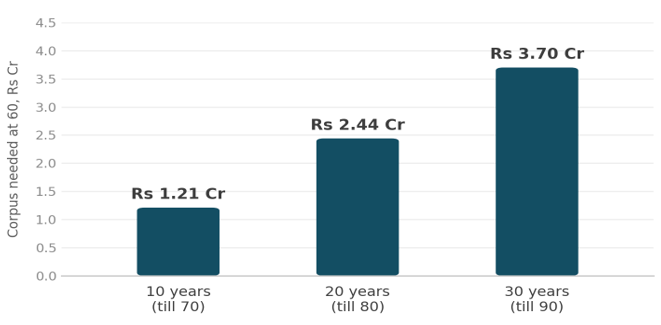
Exhibit 1: Illustrative corpus needed at 60 to sustain Rs 12 lakh a year (in today’s terms) for 10, 20 and 30 years, assuming the corpus earns the 6.8% risk free rate against 7% lifestyle inflation. Source: Marcellus Investment Managers.
Turn the calculation around and the risk is even clearer. A retiree who sets aside Rs 2 crore at 60 and draws Rs 12 lakh a year, rising with inflation, from a portfolio earning that same risk-free rate, runs out of money in roughly 16 years5, that is, by around age 76. Life expectancy at 60 for someone in decent health today is north of 80 years implying that our retiree will run out of money long before he dies.
Force 2: Inflation is running hotter than the headline number
Headline CPI inflation in India was 4.38% in June 20266, and official inflation has generally sat in the 4-5% band for the last few years. But that number is built for the country, not for a middle class household’s actual basket, school fees, rent, healthcare, domestic help, which has tended to run well ahead of it. The 15 year average CPI print is closer to 7.5%7, and financial planners routinely use 7-9% for lifestyle inflation for exactly this reason. That gap between the official 4-5% and the lived 7-9% results in a completely different retirement target.
Take Rohan, an illustrative 35-year old with current household expenses of Rs 1 lakh a month, or Rs 12 lakh a year, who plans to retire at 60, 25 years from now8. Compounding that expense forward for 25 years shows how differently his retirement target moves depending on which inflation number turns out to be real:
- At 5% inflation, his Rs 12 lakh today becomes about Rs 40.6 lakh a year by 60.
- At 7% inflation, it becomes about Rs 65.1 lakh a year.
- At 9% inflation, it becomes about Rs 1.04 crore a year, more than two and a half times the 5% case, on the same starting expense.
The corpus needed at 60 moves even more sharply than the expense number, because higher inflation does not just raise the target, it also erodes the real return on the conservative, debt heavy portfolios many retirees hold. Assuming the corpus is invested at the risk free rate of about 6.8% and a 25 year retirement9:
- At 5% inflation (a 1.7% real return), Rohan needs about Rs 8.4 crore at 60.
- At 7% inflation, his real return is already slightly negative, and he needs about Rs 16.7 crore, roughly double.
- At 9% inflation, his real return is about minus 2%, and he needs about Rs 33.4 crore, four times the 5% case, for the same lifestyle.
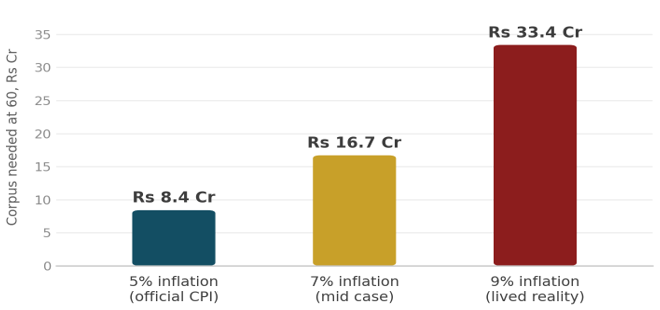
Exhibit 2: Illustrative corpus required at 60 for a 25 year retirement, for a person aged 35 today with Rs 12 lakh of current annual expenses, at three inflation scenarios, assuming the corpus earns the 6.8% risk free rate. Source: Marcellus Investment Managers.
This is the part most retirement calculators understate. A planner who quietly assumes 5% inflation because that is close to the headline CPI print can end up telling a saver they need a quarter of what they will need if their real cost of living runs at 9%.
Force 3: The career funding the corpus is getting shorter
Retirement plans have traditionally assumed a long, steady earning life, roughly 40 years from the mid 20s to 65, with a salary that rises predictably enough to fund a rising SIP. That assumption is under pressure.
Graduate unemployment in India stands at about 29%, nine times the rate among the illiterate, and white collar hiring in sectors like IT services and banking has weakened sharply as automation and AI take over roles that used to be secure10. As we explain in our bestselling book “Breakpoint: The Crisis of the Middle Class & The Future of Work”, the post-1991 model of a steady job, a yearly bonus and a predictable promotion ladder is breaking down, and the world of work is shifting towards gig and freelance style contracts where pay is far less regular.
The financial consequence is a shorter, less certain window in which to build a corpus, not a longer one. If the effective, stable saving years fall from 40 to something closer to 30, because of career breaks, being pushed out of a high paying role earlier, or years spent between gigs, the monthly amount needed to reach the same target rises far more than the shortfall in years would suggest.
Take the Rs 3.70 crore corpus from Force 1, and assume a growth oriented SIP earning 12% a year11:
- Over a 40-year career (age 25 to 65), the SIP needed is about Rs 3,114 a month.
- Over a 30-year career (ages 25 to 55), the SIP needed jumps to about Rs 10,482 a month, roughly 3.4 times higher, for a career that is only 25% shorter.
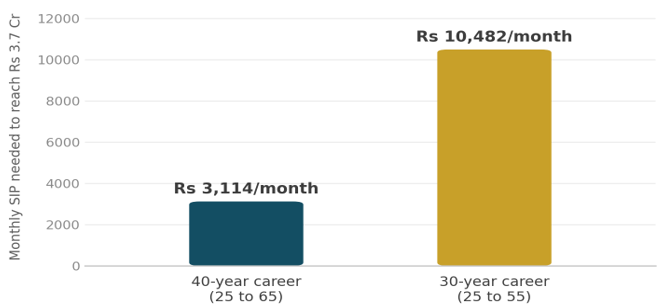
Exhibit 3: Illustrative monthly SIP required to accumulate Rs 3.70 crore at a 12% nominal return, over a 40 year versus a 30-year saving horizon. Source: Marcellus Investment Managers.
That is before accounting for the fact that gig and freelance income is, by its nature, irregular. A saver who cannot commit to the same SIP every single month, because income itself varies, needs an even larger buffer than this calculation implies, on top of an already much higher monthly target.
Plan for the range, not the average
Put the three forces together and a pattern emerges. You do not know exactly how long your retirement will last, you do not know exactly what your real inflation rate will be, and you do not know exactly how many stable, high earning years you will get to save in. Planning around a single, comfortable assumption for each of these, a fixed life expectancy, a 5% inflation number, a 40-year career, is planning for the one outcome least likely to actually happen.
The practical response is twofold.
- The amount you save has to be planned efficiently, sized for a realistic range of inflation and career outcomes rather than the kindest one.
- And the amount you retire with has to be deployed efficiently too, in assets that can earn a real, after tax return meaningfully above inflation, not just parked safely in instruments that quietly lose ground every year.
Combining assets that are uncorrelated, rather than relying on one type of asset, is what allows a retirement portfolio to keep working across all three of these uncertainties at once, rather than being right for only one of them.
To avail of our goal planning service (with no-strings attached) visit plan.marcellus.in or scan QR code below

The tool designed to help user explore products and Asset allocation; shall not be considered as Investment advice.
Click Here for details about our regulatory registration and licensing information.
[1] Office of the Registrar General, Government of India, Sample Registration System; UN Population Division. India life expectancy at birth, about 72.5 years (2025), up from 41 years in 1950.
[2] Illustrative calculation. Assumes an annual withdrawal of Rs 12,00,000 (today’s terms, rising with inflation each year), a portfolio invested at the risk free rate of 6.8% (India 10 year G-Sec, August 2026) and lifestyle inflation of 7%, sustained for 10 years.
[3] Same assumptions as [2], sustained for 20 years.
[4] Same assumptions as [2], sustained for 30 years.
[5] Illustrative calculation. Rs 2 crore corpus, initial withdrawal of Rs 12,00,000 rising with 7% inflation, invested at the 6.8% risk free rate; corpus is exhausted in approximately 16 years.
[6] Ministry of Statistics and Programme Implementation (MoSPI), Consumer Price Index (base 2024), press release for June 2026 (4.38%, provisional).
[7] Bloomberg; 15 year average CPI print of about 7.5%. Range of 7-9% for household lifestyle inflation is a commonly used planning assumption among financial advisors and is illustrative, not an official statistic.
[8] Illustrative example. Hypothetical individual, age 35, current household expense of Rs 12,00,000 a year, retiring at 60. Future values computed by compounding for 25 years at each stated inflation rate.
[9] Illustrative calculation. Corpus required assumes the post-retirement portfolio is invested at the risk free rate of about 6.8% (India 10 year G-Sec yield, August 2026, Bloomberg / CCIL) and a 25 year retirement (to age 85). Real return in each scenario is the risk free rate deflated by the stated inflation rate.
[10] Saurabh Mukherjea, Nandita Rajhansa and Sapana Bhavsar, Breakpoint: The Crisis of the Middle Class and the Future of Work (2026). Graduate unemployment cited at about 29%, against roughly 3% for the illiterate population.
[11] Illustrative calculation. Monthly SIP required to accumulate Rs 3.70 crore, assuming a 12% p.a. nominal return compounded monthly, over a 40 year versus a 30 year saving horizon starting at age 25.
The above material is neither investment research, nor investment advice. Marcellus does not seek payment for or business from this material/email in any shape or form. Marcellus Investment Managers Private Limited (“Marcellus”) is regulated by the Securities and Exchange Board of India (“SEBI”) as a provider of Portfolio Management Services. Marcellus is also a US Securities & Exchange Commission (“US SEC”) registered Investment Advisor. Marcellus Investment Managers Private Limited (“Marcellus”) is regulated by the International Financial Services Centres Authority (IFSCA) as a Fund Management Entity No content of this publication including the performance related information is verified by SEBI or US SEC. If any recipient or reader of this material is based outside India and USA, please note that Marcellus may not be regulated in such jurisdiction and this material is not a solicitation to use Marcellus’s services. All recipients of this material must before dealing and or transacting in any of the products/services referred to in this material must make their own investigation, seek appropriate professional advice. This communication is confidential and privileged and is directed to and for the use of the addressee only. The recipient, if not the addressee, should not use this material if erroneously received, and access and use of this material in any manner by anyone other than the addressee is unauthorized. If you are not the intended recipient, please notify the sender by return email and immediately destroy all copies of this message and any attachments and delete it from your computer system, permanently. No liability whatsoever is assumed by Marcellus as a result of the recipient or any other person relying upon the opinion unless otherwise agreed in writing. The recipient acknowledges that Marcellus may be unable to exercise control or ensure or guarantee the integrity of the text of the material/email message and the text is not warranted as to its completeness and accuracy. The material, names and branding of the investment style do not provide any impression or a claim that these products/strategies achieve the respective objectives. Further, past performance is not indicative of future results. Marcellus and/or its associates, the authors of this material (including their relatives) may have financial interest by way of investments in the companies covered in this material. Marcellus does not receive compensation from the companies for their coverage in this material. Marcellus does not provide any market making service to any company covered in this material. In the past 12 months, Marcellus and its associates have never i) managed or co-managed any public offering of securities; ii) have not offered investment banking or merchant banking or brokerage services; or iii) have received any compensation or other benefits from the company or third party in connection with this coverage. Authors of this material have never served the companies in a capacity of a director, officer or an employee. This material may contain confidential or proprietary information and user shall take prior written consent from Marcellus before any reproduction in any form.