“WASHINGTON, August 1, 2024—More than 100 countries—including China, India, Brazil, and South Africa—face serious obstacles that could hinder their efforts to become high-income countries in the next few decades, according to a new World Bank study that provides the first comprehensive roadmap to enable developing countries to escape the “middle-income trap.”
Drawing on lessons of the past 50 years, the World Development Report 2024 : The Middle Income Trap finds that as countries grow wealthier, they usually hit a “trap” at about 10% of annual U.S. GDP per person—the equivalent of $8,000 today. That’s in the middle of the range of what the World Bank classifies as “middle-income” countries. Since 1990, only 34 middle-income economies have managed to shift to high-income status—and more than a third of them were either beneficiaries of integration into the European Union, or of previously undiscovered oil.” – World Bank Group press release (source: https://www.worldbank.org/en/news/press-release/2024/07/22/-middle-income-trap-hinders-progress-in-108-developing-countries)
Retail Sales Light up Diwali 2025
Friday 17th October 2025 was the day before Dhanteras, the day on which millions of Indian households believe it is auspicious to buy jewellery. Across India’s big cities, traffic almost came to a standstill as shoppers spilled out of their homes and offices and into the streets and shopping malls of India. Such was India’s demand for silver leading up to Dhanteras in 2025 that the bullion markets in Mumbai, London and New York ran out of silver. The worldwide shortage of silver in turn created a price spike which took silver prices to levels never seen before.
MMTC Pamp – a joint venture between Switzerland based bullion specialist Pamp SA, and MMTC Ltd, a Government of India Undertaking – runs the only London Bullion Market accredited silver and gold refinery in India. Silver & gold bars from MMTC Pamp are usually in high demand because of their reputation for purity. However, Dhanteras 2025 was unusual even for MMTC Pamp. Vipin Raina, the Head of Trading at MMTC Pamp said “Most people who are dealing silver and silver coins, they’re literally out of stock because silver is not there….This kind of crazy market — where people are buying at these levels — I have not seen in my 27-year career.”
As the Indian market ran out of silver on the back of record demand, Indian jewellers turned to the London Bullion Market – via global banks like JP Morgan Chase – for supplies. Around a fortnight prior to Dhanteras, JPMorgan Chase & Co. — the largest precious metals trader and an important bullion supplier to the Indian market — told at least one of its clients that it had no more silver available to deliver to India for the month of October, and the soonest it could offer supplies was in November. (source: https://economictimes.indiatimes.com/industry/cons-products/fashion-/-cosmetics-/-jewellery/sold-out-in-india-panic-in-london-how-the-silver-market-broke)
By 9th October – a week prior to Dhanteras “the London silver market would be gripped by the biggest squeeze that any of the multiple traders Bloomberg spoke to had seen in their careers.” As banks like JP Morgan & Co stepped back from the frenzied market, bid-asks spread (the price gap between what sellers want to be paid versus what buyers are willing to pay) soared. As a result, trading became impossible. Effectively, India’s insatiable demand for silver had broken the world silver market.
Interestingly, it wasn’t just silver. Even car sales skyrocketed in the pre-Diwali and post-Navratri festive shopping season in 2025. Major automakers in India, including Maruti Suzuki, Hyundai Motor and Tata Motors, saw record Dhanteras sales. In fact, on Dhanteras (18th October 2025) India’s car showrooms sold over 100,000 passenger vehicles, a single day record for India.
So given the backdrop of stagnant wages, weak job creation and record levels of household indebtedness, what triggered this boom in spending on the eve of Diwali 2025? And how sustainable is this upsurge in spending?
Unwinding the fiscal transfers from the middle class to the elite
Income Tax collections from individuals rose from 2.5% of GDP in FY19 to 3.8% in FY25. GST collections as a % GDP rose from 2.5% in FY19 to 2.8% in FY25. Effectively, by FY25 Indian households were paying 1.6% of GDP more to the Exchequer each year (than they did in FY18). In absolute terms, the amount that Indians were paying as Income Tax went from Rs. 4.73 trillion in FY19 to Rs. 10.45 trillion in FY24, a CAGR of 17%.
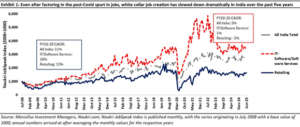
Unfortunately for the Indian consumer, this increased fiscal load that she was bearing coincided with a conk-off in white collar job creation.