OVERVIEW
POPULAR ARTICLES

Football is by far the world’s most popular and most lucrative sport. The Football World Cup has now been played for 96 years. In those 96 years, India has never played a single match in the World Cup. And yet, every World Cup is actively followed and fanatically cheered on by Indian viewers. The parallels of this with equity investing are uncanny. Nearly 50 million Indians are active equity investors [1] . And yet the vast majority of them own ZERO shares in the world’s biggest compounding machines; all of their money is invested in the Indian stock market which is just 4% of the world’s market cap. While you & I cannot do much about India’s absence from the Football World Cup, we can do plenty about Indians’ lack of ownership in the world’s mightiest compounding machines.
Visit connect.marcellus.in and join us in our Global Compounding journey.
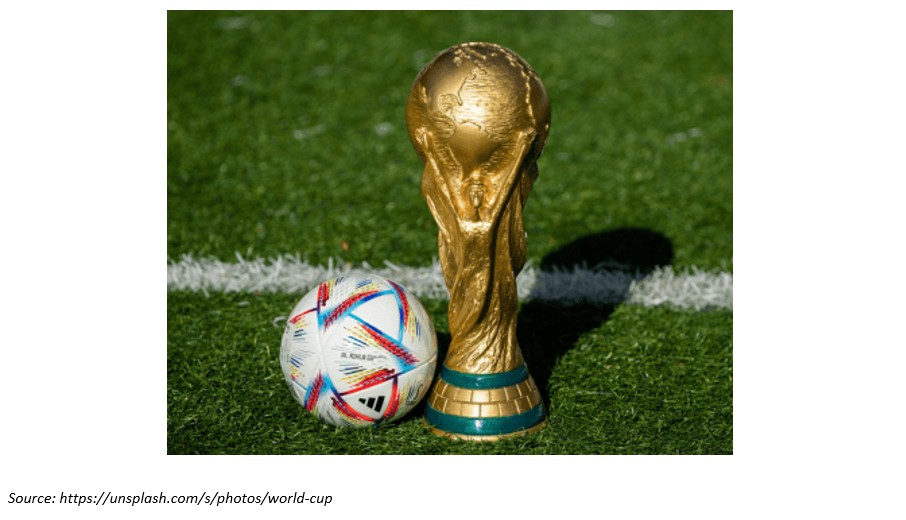
On July 19, you will cheer for a country that is not yours
It is a Sunday night in July. Your neighbour has painted his face. Your WhatsApp groups are exploding. For one month every four years, India, a country that has never kicked a ball at a Football World Cup becomes one of the most football-mad places on earth. But this strange phenomenon contains a valuable lesson for Indian investors. Let us start with the game itself.
The biggest party on earth, because everyone was invited
Football conquered the planet because it asks for nothing. A rubber ball and four stones for goalposts is a fully functioning stadium, whether in a Lagos street, a Rio favela or a Kolkata gully. There is no bat, no racquet, no pads, no turf wicket to prepare, and the rules can be explained to a five-year old in two minutes: put the ball in the other team’s net without using your hands. The cheapest game to play became the easiest game to love, and so it became everyone’s game: FIFA today has 211 member associations, more than the 193 member states of the United Nations.
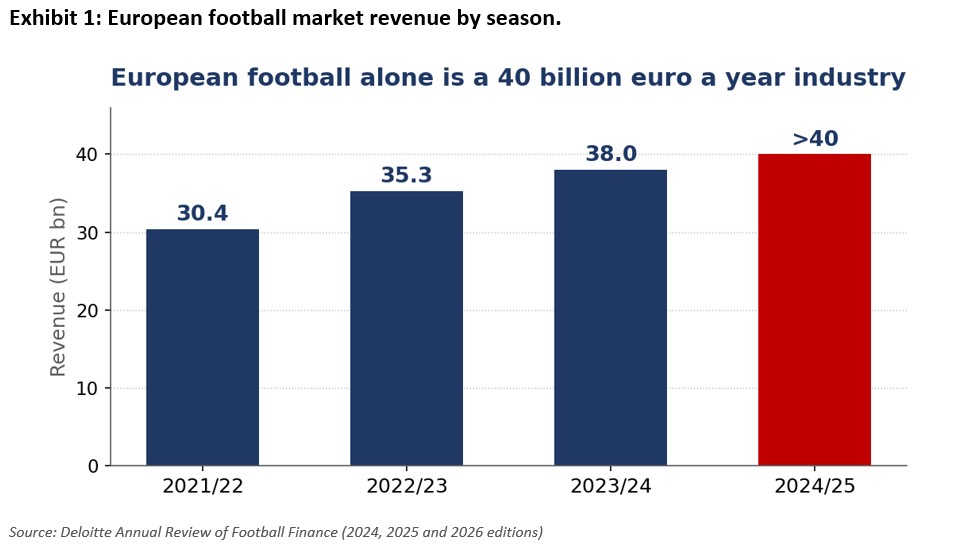
Around 5 billion people, well over half of humanity, engaged with the last World Cup in Qatar, and close to 1.5 billion watched the final [2]. And as you would expect with a sport with viewership numbers running into billions, the money associated with football is proportionately massive. Deloitte’s Annual Review of Football Finance shows that European club football alone now generates over EUR 40 billion of revenue a year, having grown relentlessly through the decade [3] (see exhibit below). Add the World Cup itself, Latin America, sponsorships and transfer fees, and football is comfortably the largest commercial machine in world sport.
When everyone on earth plays the same game, one tournament becomes the ultimate test of a nation’s sporting prowess. Which brings us to the World Cup itself.
The hardest ticket in world sport
Because everybody plays football, qualifying for the World Cup is brutally competitive. 211 nations enter a qualification grind that stretches over two years, fighting for just 48 places. Even footballing royalty gets shown the door: Italy, four times world champions, missed both the 2018 and 2022 editions. There are no invitations, no wildcards and no way to buy your way in. You either earn your place, or you watch from the sofa. India has been on the sofa for 96 years.
The boat India never boarded
In 1950, India actually qualified for the World Cup in Brazil, after the other teams in our qualification group withdrew. Destiny held the door open. And our federation decided not to send a team. The men who ran Indian football looked at the biggest stage on earth and concluded that the trip was not worth it.
After the “no show” in 1950, India has never qualified again to play in the biggest tournament on Planet Earth. Everything that has happened to Indian football since 1950 is, in a sense, a footnote to that one decision, and the scoreboard of the seven decades since makes for grim reading.
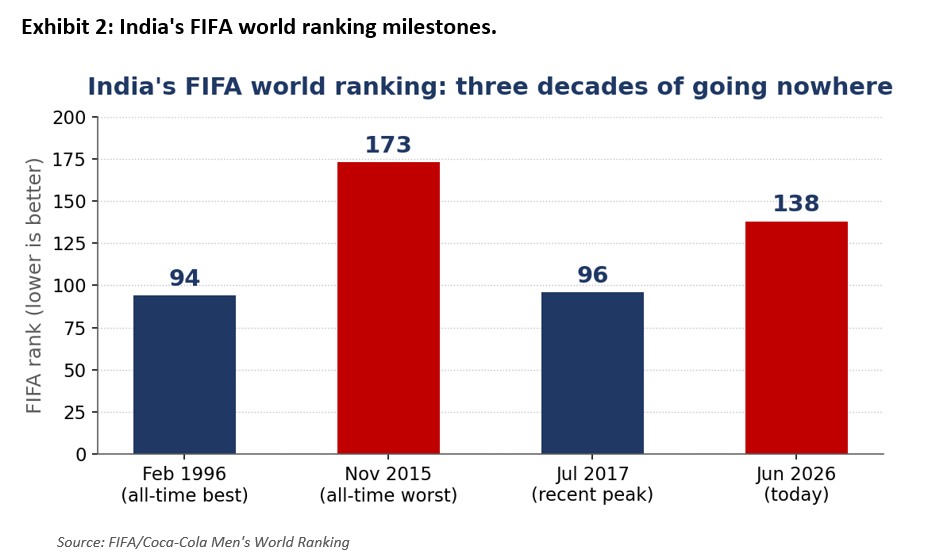
India’s FIFA ranking
- peaked at 94 in February 1996
- collapsed to an all-time low of 173 in 2015,
- briefly recovered to 96 in 2017,
- and stands at 138 today, out of 211[4] (see exhibit below).
The pattern: whenever the world calls, we stay home
Sunil Chhetri 2009: the greatest footballer India has ever produced and one of the highest international goalscorers of all time, signed for England’s Queens Park Rangers, and was denied a UK work permit because work permits required India to be in FIFA’s top 70 and we were nowhere near it [5]. Our best player was, quite literally, not allowed into the world’s labour market for footballers.
Gurpreet Singh Sandhu: To this day, exactly one Indian has ever played top division football in Europe: Gurpreet Singh Sandhu, a goalkeeper with Norway’s Stabæk between 2014 and 2017 [6].
The Indian Super League: launched in 2014 with Bollywood owners and prime time slots, but it was built facing inwards: a closed franchise league with no connection to the global football pyramid. A decade and over Rs 5,000 crore of reported investment later, when the federation invited bids for a new commercial partner, not a single bid came in [7].
Step back and look at the three episodes together: 1950, 2009, 2014-2026. Three different decades, three different sets of administrators, and one identical instinct:
When the world’s biggest stage called, India stayed home.
Now here is the uncomfortable part: that instinct is not confined to our football federation. It lives in your portfolio too, and economists have a name for it.
The instinct has a name: home bias
Home bias is the well documented tendency of investors everywhere to keep their money overwhelmingly in their home market, ignoring the far larger opportunity outside it. Every country suffers from it to a degree.
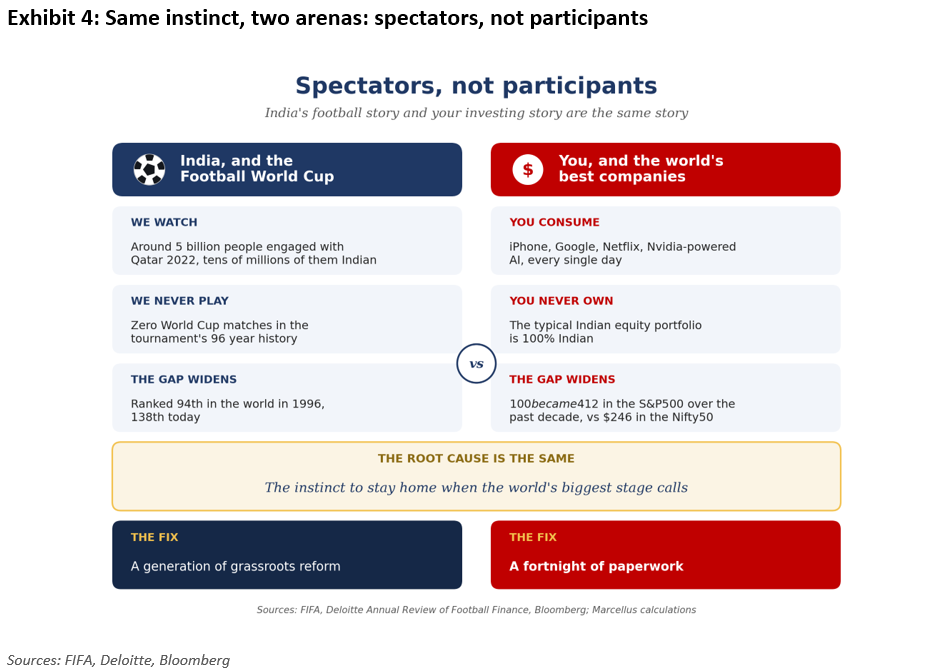
But the Indian investor has turned it into an art form: the typical Indian equity portfolio is not 80% Indian or 90% Indian; it is 100% Indian.
The irony is that our daily lives could not be more global. Think about how you will watch the final on July 19: on a TV or phone made by an international company, checking the score on Google, sharing memes on Instagram, streaming highlights over Youtube.
Every day, you hand your money and your attention to the largest companies ever built; they profit from you at breakfast, lunch and dinner. Yet not one Indian company ranks among the world’s 20 most valuable, and how many shares of those world-beating companies does the typical Indian investor own? Zero.
We are the World Cup fans of global investing. We watch. We admire. We discuss endlessly. We never play.
The scoreboard: what staying home has cost you
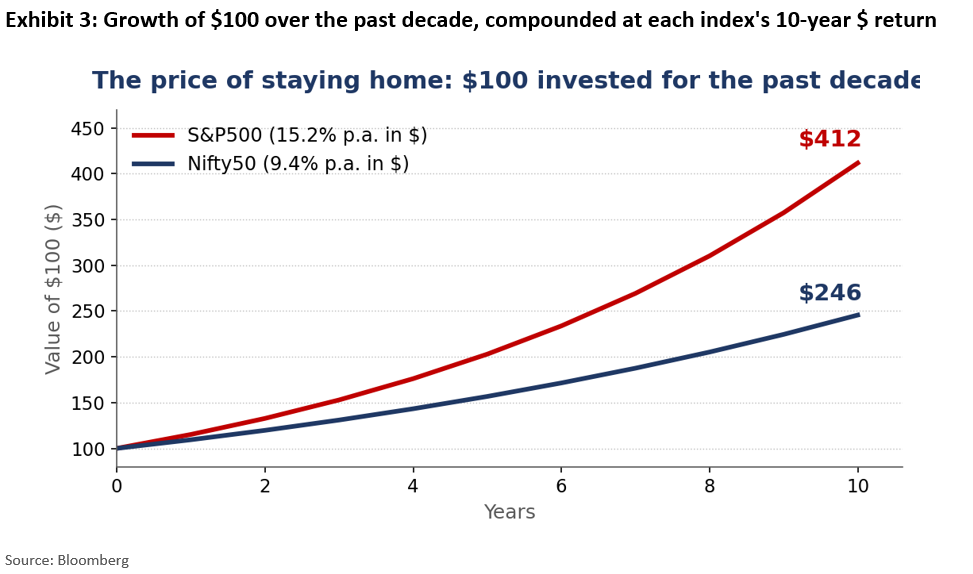
Unlike Indian football’s failures, which cost us only pride, the investor’s home bias has cost money. Over the past decade the S&P500 has delivered 15.2% p.a. in $ terms versus 9.4% p.a. for the Nifty50, and the rupee has lost roughly 4% of its value against the $ every year since 1991.
$100 invested a decade ago at the S&P500’s rate of compounding grew to around $412; the same $100 in the Nifty50 grew to around $246 (see exhibit below). That gap, $166 on every $100, is the ticket to the game that the Indian investor buys every year and never uses.
The parallel is uncanny
Watch the final. Then board the $ compounding boat.
So after you have watched the World Cup final on 19th July, you might want to do the one thing India could not bring itself to do in 1950: board the boat.
Marcellus offers THREE ways in which investors (resident and non-resident) can gain access to the same underlying $ assets in the form of Europe, America and East Asia’s best managed companies:
1. A US$ fund in global stocks in GIFT City with a minimum ticket size of $5000 (Rs 4.5 lakhs).
2. A US$ AIF in global stocks in GIFT City. This is the Alternative Investment Fund version of our Global Compounders Portfolio. Minimum ticket size is $150K. This fund is ideal for RESIDENT Indians.
3. A Cayman Islands domiciled version of our Global Compounders Portfolio. This fund is only for NRIs and provides K-1 to American residents. Minimum ticket size is $100K.
If you would like to invest with us, please click on the QR code underneath this chart.
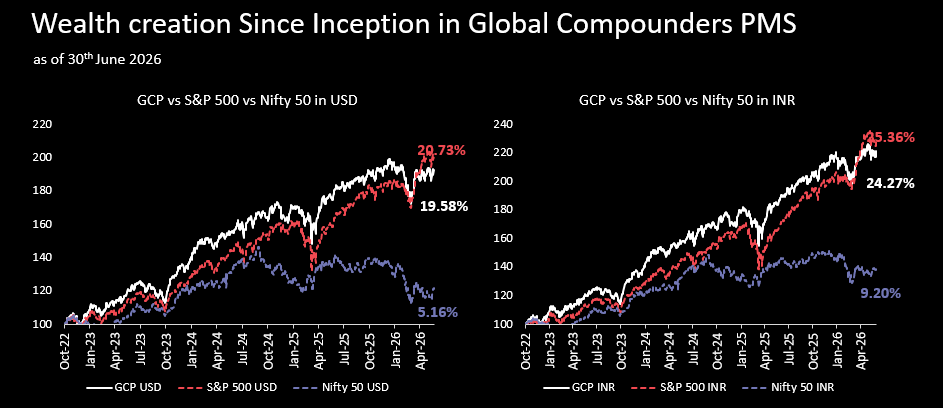
Note: Marcellus performance data is shown gross of taxes and net of fees & expenses charged till end of last month on client account. Performance fees are charged annually in December. Returns more than 1-year are annualized. Marcellus’ GCP USD returns are converted into INR using USD: INR exchange rate from RBI – Link for the reference
Note: *Since Inception performance calculated from 31st Oct 2022. The date of inception is 31st Oct 2022, being the next business day after the account got funded on 28th October 2022. S&P 500 net total return is calculated by considering both capital appreciation and dividend payouts. The calculation or presentation of performance results in this publication has NOT been approved or reviewed by the IFSCA or US SEC. Performance is the combined performance of RI and NRI strategies. S&P 500 NTR is the benchmark for the strategy. Nifty 50 is provided for reference to illustrate the relative performance of the US and Indian markets. Past performance pertains to Marcellus’ GCP PMS strategy, not to this IFSC Retail Scheme and is not indicative of future results.
Marcellus GCP PMS is offered by Marcellus Investment Managers GIFT Branch in a segregated managed accounts format.
If you would like to invest with us, please scan the QR code below.

Thanks,
Saurabh Mukherjea
Click here for details about our regulatory registration and licensing information.
Sources:
[1] Value Research Online, “207 Million Demat Accounts: Are Indians Really Investing?”
[2] FIFA, “One Month On: 5 billion engaged with the FIFA World Cup Qatar 2022”, January 2023
[3] Deloitte Sports Business Group, Annual Review of Football Finance, 2024, 2025 and 2026 editions
[4] FIFA/Coca-Cola Men’s World Ranking, India profile, as of the 11 June 2026 official update
[5] Hindustan Times, reporting on Sunil Chhetri’s Queens Park Rangers contract and the UK work permit refusal, August 2009
[6] India Today, “Indian goalkeeper Gurpreet Sandhu creates history; becomes first Indian to play for top division European club”, January 2015
[7] Sportstar, “ISL fails to attract single bid; AIFF to deliberate on future course of action”, November 2025; ESPN, “Why is ISL not happening”, November 2025
[8] The Quint, “Just 35 Medals in 25 Olympics: Why India is the Worst Olympic Performer Among Major Economies”
This material is for informational purposes only and does not constitute investment advice or research. Marcellus Investment Managers Private Limited (“Marcellus”) is regulated by the International Financial Services Centres Authority (IFSCA) as a Fund Management Entity (Retail) offers Retail and Non-Retail products and is registered with the U.S. Securities and Exchange Commission (SEC) as an Investment Advisor. The PMS strategy, Category III AIF products (non-retail schemes), and IFSCA retail schemes are distinct offerings with different regulatory frameworks, risk profiles, fee structures, and investment thresholds. Minimum investment amounts referenced (e.g., ~US$5K) are applicable to specific IFSCA retail schemes and may not apply to PMS or Category III AIF products. Investors should refer to product-specific documents for details before investing. This communication is not a solicitation in jurisdictions where Marcellus is not regulated. It is confidential and intended solely for the addressed recipient; unauthorized use or distribution is prohibited. carefully read the Disclosure Document, Form ADV, Form CRS and any other documents or disclosures provided to them by Marcellus, as applicable. Actual results may differ materially from those suggested in this note due to risk or uncertainties associated with our expectations with respect to, but not limited to, exposure to market risks, general economic and political conditions globally, inflation, etc. Information provided is based on data available at the time of preparation and may change without notice. Marcellus makes no representation regarding accuracy or completeness and assumes no obligation to update. Recipients should rely on their own judgment and consult independent legal, tax, and financial advisors before making any investment decisions. Investments are subject to market risks and uncertainties. This material may include “forward looking statements”. All forward-looking statements involve risk and uncertainty. Any forward-looking statements contained in this document speak only as of the date on which they are made. While historical data illustrates the potential benefits of geographic diversification, global investing involves risks may not present in domestic portfolios. These include the potential for adverse currency fluctuations—such as an appreciating Indian Rupee offsetting global gains—differing regulatory environments, and exposure to global geopolitical events. Past performance is not indicative of future results, and there is no assurance that investment objectives will be achieved. The calculation or presentation of performance results in this publication has NOT been approved or reviewed by the SEC, SEBI or any other regulatory authority. Marcellus, its affiliates, employees, and authors may have financial interests in securities discussed. To the fullest extent permitted by law, Marcellus disclaims all liability arising from the use of this material.