OVERVIEW
POPULAR ARTICLES

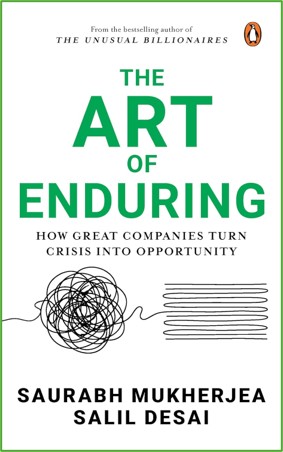
Exactly a decade ago, we published the #1 Business Bestseller, ‘The Unusual Billionaires’. Out of the 7 companies profiled in the book, 6 have beaten the broader stockmarket in the intervening decade. Now, in our new book, ‘The Art of Enduring: How Great Companies Turn Crisis into Opportunity’, we decode the success of 5 more powerful franchises which continue to create multi-generational wealth for shareholders.
To order the book, click here.
To invest with us in outstanding Indian companies, visit https://marcellus.in/invest/
To register for the book launch webinar on Fri 28th Aug at 7pm, click here: https://us06web.zoom.us/webinar/register
The original book which changed investing in India: ‘The Unusual Billionaires’ (2016)
Twenty years ago, when we were rookies in the Indian stockmarket, we were told that investing for long periods in clean, well-managed franchises does not work. Then, between December 2007 to January 2014, the Indian stockmarket gave ZERO returns even as clean, well-managed companies compounded at around 15-20% per annum through this period. Emboldened by this demonstration of compounding muscle, Saurabh published ‘The Unusual Billionaires’ in August 2016. The book decoded the enduring success of seven franchises: Asian Paints, Berger Paints, Marico, Page Industries, Astral Poly, HDFC Bank and Axis Bank. The performance of these seven franchises since the book was published is shown in the table below.
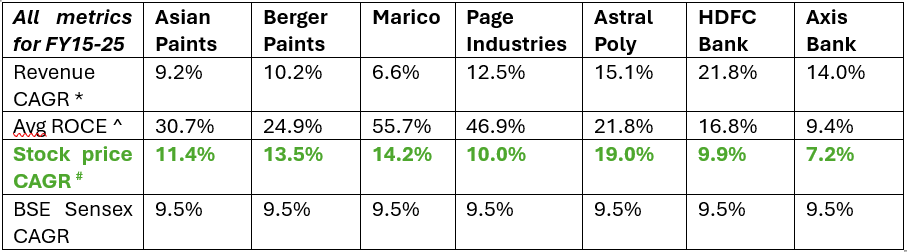
Source: ‘The Art of Enduring’, Annexure 1. * Loan book growth for the 2 banks; ^ ROE for the 2 banks; #stock price CAGR from 31-March-2015 to 31-July-2026
If Rs 100 was equally split in these seven stocks on 31 March 2015, the total value of the portfolio would have risen to Rs 390 by 31st July 2026. The same Rs 100 invested in the BSE Sensex would have been worth Rs 279. The untouched Unusual Billionaires portfolio would have thus outperformed the broader market by a neat 40%.
Given the evident success of the companies profiled in ‘The Unusual Billionaires’, the book went on to become an instant bestseller. TV programs were built around the book. The launch of the book was a “standing room” only event at the Four Seasons in Mumbai. Penguin Random House went on to reprint the book numerous times over the subsequent decade even as the book became mandatory reading for MBA graduates in India.
However, all good things are interrupted sooner rather than later in India. And so it happened to high-quality companies. After compounding shareholder value at around 27% p.a. for five years between 2017-21, “Quality” encountered a tough phase. Between 2022-25, the Nifty 200 Quality 30 index underperformed (the Nifty) every year – see chart below.
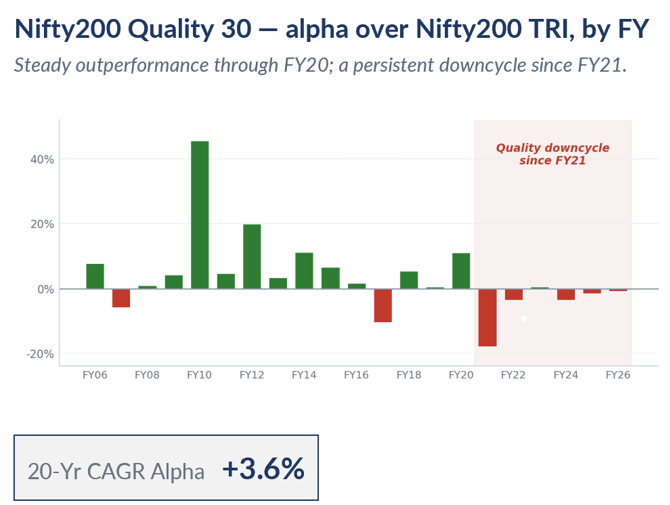
Initially, we too were stunned by this reversal in fortunes for Quality companies. Then, through 2024 and 2025, we sat back and evaluated what had happened. We realised that not only had Quality companies’ valuations been bid up to unsustainable levels during the 18-month Covid-fuelled rally in the stockmarket but also that consumers’ revenge spending and heavy Government capex had created tailwinds for mediocre franchises to rally strongly in the post-Covid era.
Once we had figured out that “revenge spending” was fizzling out (as the Indian consumer loaded up on record sums of household debt) and Government capex growth was fizzling out (as the Exchequer faced revenue collection challenges), we decided to double down on Quality.
More specifically, we decided to celebrate the 10th anniversary of the publication of ‘The Unusual Billionaires’ with a sequel.
The Art of Enduring: How Great Companies Turn Crisis into Opportunity (2026)
Between 2015 and 2025, corporate India confronted an extraordinary succession of disruptions: demonetization, the rollout of GST, COVID-19, trade wars, armed conflicts and global supply-chain upheaval. Yet amid these shocks, a small group of companies did more than survive. They continued to grow, innovate and strengthen the competitive advantages that had made them exceptional in the first place.
In ‘The Art of Enduring’, we looked at India’s 500 largest companies and identified those that had generated returns on capital of more than 15 per cent every year for a decade and a half while growing both revenues and profits faster than India’s GDP. Only five companies made the final cut for a deep dive: Bajaj Finance, Titan, Dr Lal PathLabs, Divi’s Laboratories and Tata Elxsi.
Through the stories of these five institutions, we explore what enables a company not merely to withstand disruption but to turn it into an enduring source of strength. The book examines the systems, cultures, leadership choices, innovation, brands, and strategic assets that allow great businesses to keep compounding while the world around them keeps on changing.
At its heart are also the people who built these institutions: entrepreneurs such as Dr Arvind Lal, and professionals including Bhaskar Bhat, Rajeev Jain and Om Manchanda, whose careers demonstrate the extraordinary impact that professional managers can have on Indian enterprise. Away from the age of celebrity founders, ‘The Art of Enduring’ turns its attention to India’s quiet compounders, businesses whose achievements have been built through decades of hard work, discipline, intellect and institutional strength.
More than an investing book, ‘The Art of Enduring’ is a study of Indian enterprise and the nature of corporate greatness. It asks a deceptively simple question: What do great companies do when the world goes wrong?
The answer lies in the book’s central idea: the greatest companies don’t wait for calm. They learn to befriend time.
If you have read this email so far, we believe you deserve something special. If you would like a complimentary copy of the book autographed by the authors, please respond to this email with your name, address and mobile number (because without the number, the courier refuses to accept parcels for delivery).
Click Here for details about our regulatory registration and licensing information.
The above material is neither investment research, nor investment advice. Marcellus does not seek payment for or business from this material/email in any shape or form. Marcellus Investment Managers Private Limited (“Marcellus”) is regulated by the Securities and Exchange Board of India (“SEBI”) as a provider of Portfolio Management Services. Marcellus is also a US Securities & Exchange Commission (“US SEC”) registered Investment Advisor. No content of this publication including the performance related information is verified by SEBI or US SEC. If any recipient or reader of this material is based outside India and USA, please note that Marcellus may not be regulated in such jurisdiction and this material is not a solicitation to use Marcellus’s services. This communication is confidential and privileged and is directed to and for the use of the addressee only. The recipient of this material is urged to consult their own legal and tax consultants/advisors before making any investments. The recipient, if not the addressee, should not use this material if erroneously received, and access and use of this material in any manner by anyone other than the addressee is unauthorized. If you are not the intended recipient, please notify the sender by return email and immediately destroy all copies of this message and any attachments and delete it from your computer system, permanently. No liability whatsoever is assumed by Marcellus as a result of the recipient or any other person relying upon the opinion unless otherwise agreed in writing. The recipient acknowledges that Marcellus may be unable to exercise control or ensure or guarantee the integrity of the text of the material/email message and the text is not warranted as to its completeness and accuracy. The material, names and branding of the investment style do not provide any impression or a claim that these products/strategies achieve the respective objectives. Further, past performance is not indicative of future results. Marcellus and/or its associates, the authors of this material (including their relatives) may have financial interest by way of investments in the companies covered in this material. Marcellus does not receive compensation from the companies for their coverage in this material. Marcellus does not provide any market making service to any company covered in this material. In the past 12 months, Marcellus and its associates have never i) managed or co-managed any public offering of securities; ii) have not offered investment banking or merchant banking or brokerage services; or iii) have received any compensation or other benefits from the company or third party in connection with this coverage. Authors of this material have never served the companies in a capacity of a director, officer or an employee. All recipients of this material must before dealing and or transacting in any of the products referred to in this material must make their own investigation, seek appropriate professional advice and carefully read the Private Placement Memorandum/Disclosure Document, Form ADV, Form CRS and any other documents or disclosures provided to them by Marcellus, as applicable.This material may contain confidential or proprietary information and user shall take prior written consent from Marcellus before any reproduction in any form.
Copyrights and intellectual property for the referred books remain with the original publisher and author. No challenge to their ownership is intended.
The stocks mentioned above may form part of Marcellus’ portfolio. Marcellus, its clients, and/or its employees may therefore have an interest in the said stock(s)