
OVERVIEW
POPULAR ARTICLES

Thanks to a remarkable surge in power demand, the world needs an extra 400 gigawatts of electricity each year. For supply to keep up with this demand surge means $600 billion per year of capex for the next five years. This explains why major industrial firms across the world are currently experiencing record or multi-year high order backlogs stretching from 5-8 years. Our Global team has made several investments in USA and Europe over the past few years to help our clients gain exposure to the emerging ‘Age of Electricity’
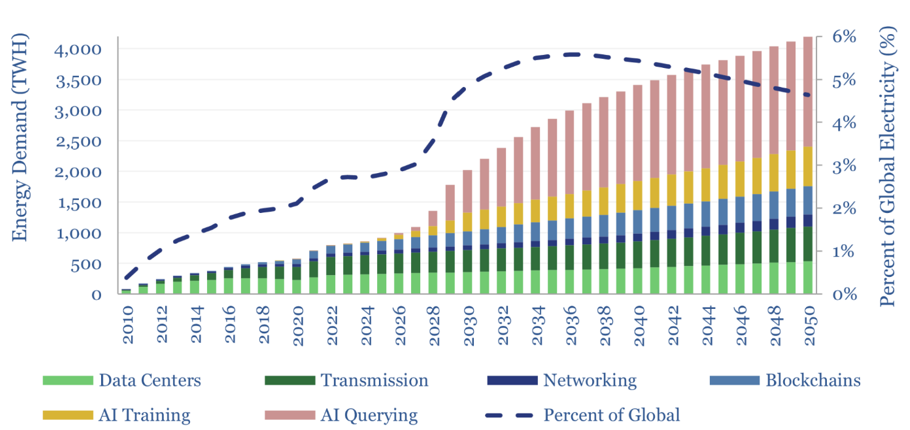
In the chart above you can see the initial upshift in demand for electricity begins with the arrival of AI as a mainstream technology to be used on a routine basis. The reason for this is well known – AI is extremely energy intensive. A single ChatGPT query typically consumes about 0.3 watt-hours of electricity, which is roughly equivalent to running a high-efficiency LED lightbulb for a couple of minutes. It uses 10–15 times more energy than a standard Google search, highlighting the high cost of generating, rather than just finding, information. In fact, if 200 million people asked one complex question a day, the incremental energy consumption could approach that of a small country. (2) (3)
The macro implications of you & me using AI on a daily basis is earth shaking. In the decade prior to the arrival of arrival of ChatGPT in 2022, global electricity demand grew at an average rate of 2.7% per year. In the last three years however global electricity demand has been growing at nearly 4% per year. (4) Between now and 2030, the IEA projects that global electricity demand may continue growing at this elevated rate approaching 4%. In fact, as per the IEA we have now entered “the age of electricity”. (5)
To understand why this surge in electricity demand is a multi-trillion $ business opportunity, consider the following numbers:
· Installed power generation capacity globally is around 9000 gigawatts. (6)
· In 2025 around 700 gigawatts of fresh power generation capacity was added. (7) (8)
· Creating power generation capacity costs a lot of money. Whilst these sums of money vary depending on the underlying source of fuel eg. solar costs around $ 1bn / gigawatt, gas costs a similar amount whereas coal costs $2-3 bn and nuclear costs $10 bn, assuming an average cost of $1.5 bn per gigawatt to put install power generation capacity and assuming 400 gigawatts are installed each year, the planet is set up spend ~$600 billion per year for the next five years on new generation capacity. (9)
Furthermore, due to recent policy changes in the USA with Trump as POTUS, the green agenda has been deprioritised by most Fortune 500 companies. A combination AI, Trump and a massive upsurge in electricity demand explains why major industrial firms across the world are currently experiencing record or multi-year high order backlogs stretching from 5-8 years. (10)
Heavy capacity installation is resulting in soaring demand for electrical equipment—generators (alternators), transformers, switchgear, and control systems—plus fuel-specific machinery (boilers/turbines for thermal, panels/inverters for solar). In addition, new generation capacity will also entail new investment transmission & distribution infrastructure. (11)
Most of the global industrial giants who are ideally placed to capitalise on this electricity boom are listed in Europe, USA, Japan and China. Our Global team has made several investments in USA and Europe over the past years to help our clients gain exposure to themes related to the emerging ‘Age of Electricity’. Here are a couple of examples.
In 2020, the 170-year old German manufacturing giant, Siemens, spun off Siemens Energy which is now listed separately on the Frankfurt Stock Exchange. Based in Munich, Siemens Energy covers (almost) the entire energy value chain – from power generation to transmission and storage. It is best known for producing gas and steam turbines, high-voltage equipment. The firm’s technology powering roughly one-sixth of the world’s electricity generation. Siemens Energy leads with proprietary technologies, particularly in hydrogen production electrolyzers and hydrogen-ready gas turbines. Its significant R&D investment fuels innovation in low-emission power generation and efficient energy transmission. Through its subsidiary Siemens Gamesa, it is a global leader in renewable energy, particularly offshore wind turbines. (12) Since its listing in 2020, Siemens Energy’s share price has risen ~9x in INR terms.
Listed in New York and headquartered in Irving, Texas, Caterpillar Inc. is the world’s leading manufacturer of construction and mining equipment, diesel-electric locomotives, industrial gas turbines, and diesel/natural gas engines. (13) This 100-year old firm’s primary competitive advantages lie in its unmatched global dealer network, dominant brand reputation for quality and durability, and a comprehensive, high-margin after-sales service portfolio. With over 2,700 locations across 191 countries and with more than 50 large manufacturing facilities spread across the world, the firm seeks to ensure rapid service and parts availability thus reducing the total cost of ownership for customers. (14) (15) Over the past decade, Caterpillar’s stock has navigated economic cycles and delivered roughly 18x in INR terms.
Investment implications for you
Our Global team has made several investments over the past year to help our clients achieve global diversification through allocation to this new Age of Electricity. Thanks to the regulatory reforms expedited by the Indian authorities over the past couple of years (see our 7th January ‘26 blog: https://marcellus.in/blogs/four-mega-reforms-which-opened-up-global-investing-for-indians/ ), we (Indians) are now able to diversify globally in a cost-efficient and tax-efficient manner and benefit from this new age of rage. Our track record in compounding across the world is shown below.
Since inception in Oct 2022, the strategy has delivered at ~27% CAGR (net of all fees & expenses in INR).
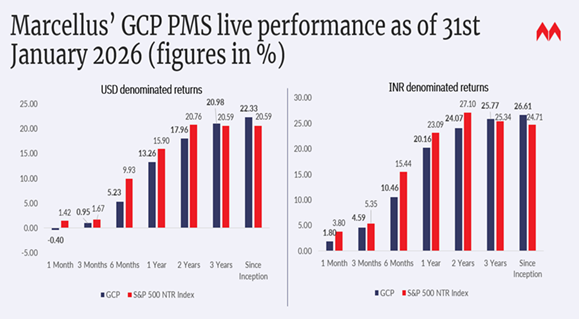
Source: Marcellus performance data is shown gross of taxes and net of fees & expenses charged till end of last month on client account. Performance fees are charged annually in December. Returns more than 1-year are annualized. Marcellus’ GCP USD returns are converted into INR using USD: INR exchange rate from RBI – Link for the reference
Sources:
(1) https://thundersaidenergy.com/downloads/internet-energy-consumpion-data-models-forecasts/
(2) https://www.heise.de/en/news/ChatGPT-s-power-consumption-ten-times-more-than-Google-s
(3) https://epoch.ai/gradient-updates/how-much-energy-does-chatgpt-use
(4) https://www.iea.org/reports/global-energy-review-2025
(5) https://www.downtoearth.org.in/energy/global-electricity-demand-set-to-surge-through-2030
(6) https://www.statista.com/statistics/267358/world-installed-power-capacity/
(7) https://ember-energy.org/latest-updates/global-solar-installations-surge-64-in-first-half-of-2025/
(8) https://ember-energy.org/latest-insights/highlights-of-the-global-energy-transition-in-2025
(9) https://gcamcapital.com/articles/thermal-energy/coal-fired-power-plant-construction-costs/index;
https://en.wikipedia.org/wiki/Economics_of_nuclear_power_plants
(10) https://www.alstom.com/press-releases-news/2026/1/alstoms-third-quarter-202526
(11) https://testbook.com/electrical-engineering/thermal-power-plant-diagram-and-working
(12) https://matrixbcg.com/blogs/competitors/siemens-energy ; ( https://matrixbcg.com/blogs/how-it-works/siemens-energy
(13) https://www.caterpillar.com/en/company.html
(14) https://www.scribd.com/document/607060694/Caterpillar-compititor
(15) https://finance.yahoo.com/news/bnb-chain-news-ai-tokens-180338570.html
This material is for informational purposes only and does not constitute investment advice, an offer, or a solicitation to buy or sell any securities. Past performance is not indicative of future results. All company references are for illustrative purposes only and do not represent recommendations. Projections are based on third‑party sources and may change. Investors should consult their financial advisor before making investment decisions.