OVERVIEW
POPULAR ARTICLES

In our 21st October blog (India’s New Kings & Queens Are Flourishing in Small Town India) we showed how a new class of business families is flourishing in small town India. Since then we have written about two routes into this class: auto dealerships and mutual fund distribution. This week we look at a route that is open to far more Indians, particularly women: beauty & wellness. Indians spend Rs 59,000 crore a year on salons, grooming, spas and skin treatments. This spend seems likely to grow at 9-10%/yr to around Rs 93,000 crore by FY30. Yet the average Indian salon is a one-person shop with a turnover of under Rs 3 lakh a year, and some of the best-known salon chains have been losing money for years. The money in this industry is being made by brands which franchise out their salons, by the companies that supply salons with products, by operators in smaller towns where rents are lower, and by beauticians who back their skills with a franchise or an app. The most successful salon franchising chains now make around Rs. 15-20 crore of PAT. To see what this looks like on the ground, we met two beauticians in Mumbai. Please visit invest.marcellus.in if you would like to invest with us in a rapidly changing India.
“Beauty begins the moment you decide to be yourself.” – Coco Chanel, French fashion designer
Where we left off: the new Kings & Queens of small-town India
In *India’s New Kings & Queens Are Flourishing in Small Towns*, we showed that the number of Indians declaring more than Rs 1 crore of income has risen about seven-fold in the last twelve years, and that this growth has been fastest away from the big metros. We then followed the money into two businesses. In *New Kings & Queens: India’s Auto Dealers*, we estimated that India’s ~18,000 auto dealers earn about Rs 14,000 crore of PAT a year. In *New Kings & Queens: India’s Mutual Fund Distributors*, we showed that India’s independent MF distributors generate revenues of ~Rs. 12,000 crores per year.
A car dealership ties up Rs 25-30 crore of capital, and a mutual distributor needs a licence and, more importantly, a book of clients built over years. In contrast, a salon needs a chair, a mirror and a skill, and many start in a spare room at home. That makes beauty and wellness one of the most widely spread small businesses in India, and one of the few where women increasingly own the business rather than just work in it.
A Rs 59,000 crore industry growing at 9-10% a year Redseer’s industry report puts Indian spending on beauty and wellness services at Rs 57,500-60,000 crore in FY25, up from about Rs 50,500 crore two years earlier. [Source: in Urban Company’s prospectus (2025)] Redseer expects figure this to grow at 9-10% a year to Rs 92,000-94,000 crore by FY30. Hair and skin care for women and grooming for men make up most of this; spas and treatments such as laser hair removal make up the rest.
The Government’s survey data back this up. India’s small, unincorporated salons and parlours alone had a turnover of Rs 56,800 crore in 2023-24, double the Rs 27,600 crore of 2015-16.
Exhibit 1: Indians spend about Rs 59,000 crore a year on beauty and wellness services
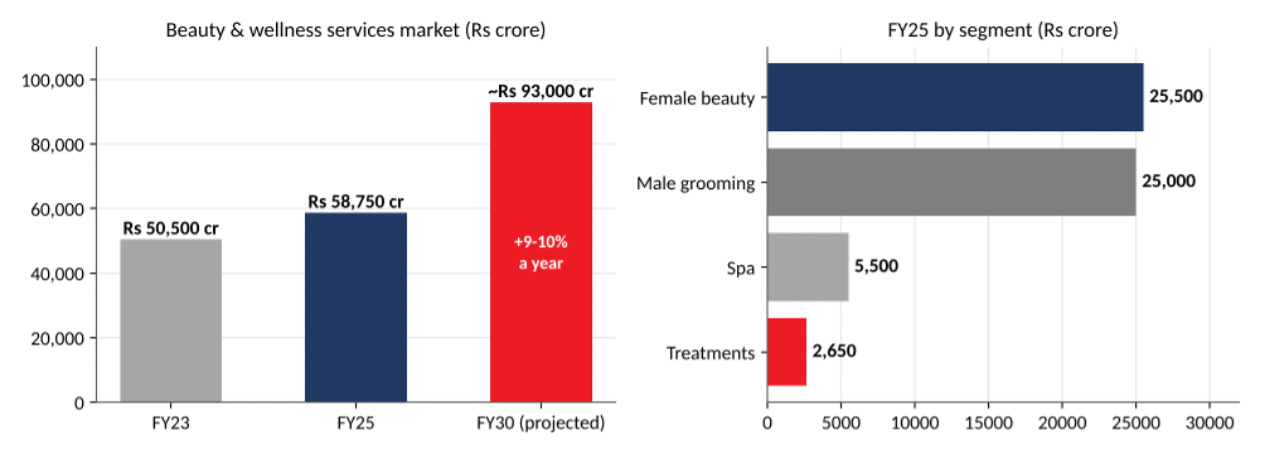
Source: Marcellus Investment Managers; Redseer industry report in Urban Company’s prospectus (2025). FY23 and FY25 shown at the mid-points of Redseer’s ranges (Rs 50,000-51,000 crore and Rs 57,500-60,000 crore); FY30 projected at Rs 92,000-94,000 crore. Segment split is the FY25 mid-point.
Interestingly, the products that salons use are growing faster than the salons themselves. Based on Kline & Company’s data, we estimate that sales of professional hair products in India have grown from around Rs. 825 crore in FY16 to Rs. 3,160 crore in FY26, or about 14% a year. Adjusted for personal care inflation (excluding gold and silver, which distort the official index), volumes have grown at around 10% a year. We come back to why this matters later.
Nearly 20 lakh salons, most of them run by one person
Using the unit-level data from the Government’s surveys of unincorporated enterprises (NSS 73rd round for 2015-16 and ASUSE for 2023-24), we count 19.7 lakh salons and parlours in India in 2023-24, up from 16.6 lakh in 2015-16. They employ about 27.5 lakh people, and around 85% of them are run by just one person.
The average salon has a turnover of about Rs 2.9 lakh a year, up from Rs 1.7 lakh in 2015-16. An urban salon with hired staff generates revenues about Rs 8.3 lakh. At the other end, a salon run by a premium chain like Enrich has revenues of about Rs 2.6 crore.
Exhibit 2: Salon numbers grew 2% a year, but turnover per salon grew faster
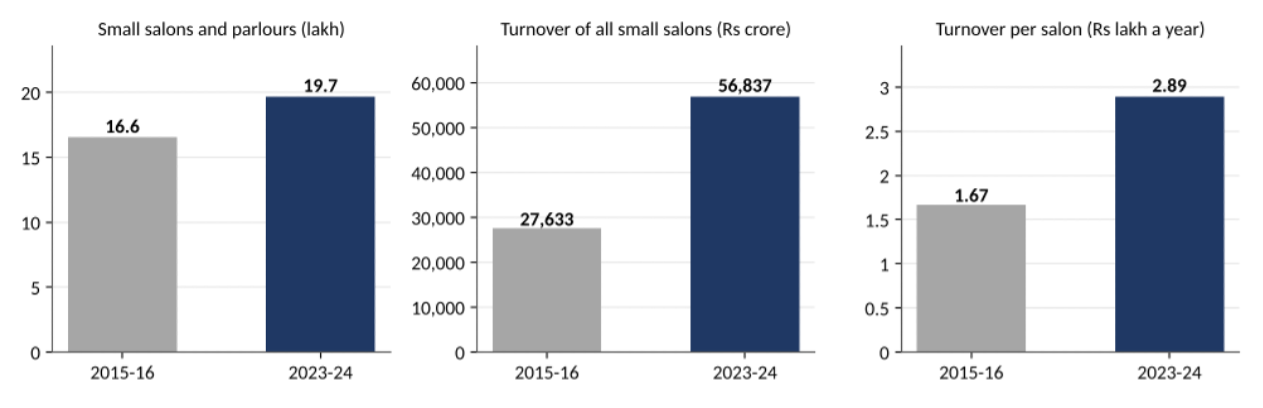
Source: Marcellus Investment Managers; MoSPI unit-level data, NSS 73rd round (July 2015-June 2016) and ASUSE 2023-24 (October 2023-September 2024), NIC 2008 code 96020 (hairdressing and other beauty treatment). Covers unincorporated enterprises only; company-run chains are excluded. Totals reconcile with MoSPI’s published aggregates.
How does a salon make money?
A salon is essentially selling the time of skilled people in a rented chair. For the average small salon, products, electricity and other inputs take up about 36% of turnover, or around Rs 1 lakh a year. That leaves a gross margin of about 64%, i.e. about Rs 1.85 lakh per salon. As most salons are run by the owner alone, salaries to staff take up only about 12% of turnover on average (in an urban salon with staff, this is closer to 29%). What is left, around Rs 1.5 lakh a year or about half of the turnover. That what the owner takes home, and this has to pay for her own time.
The chains look very different. At Geetanjali Salon, one of the few salon chains that is profitable, products take up 27% of revenue (i.e. a gross margin of 73%), staff 29%, rent 20% and other costs 11%. That leaves an EBITDA margin of about 13% and a net profit (PAT) margin of about 9% in FY25. But a chain that runs all its salons itself in big cities can lose money. Enrich’s salons have a turnover of about Rs 2.6 crore each, yet each lost around Rs 16 lakh in FY25.
Exhibit 3: Where the money goes in a neighbourhood salon and in a profitable chain
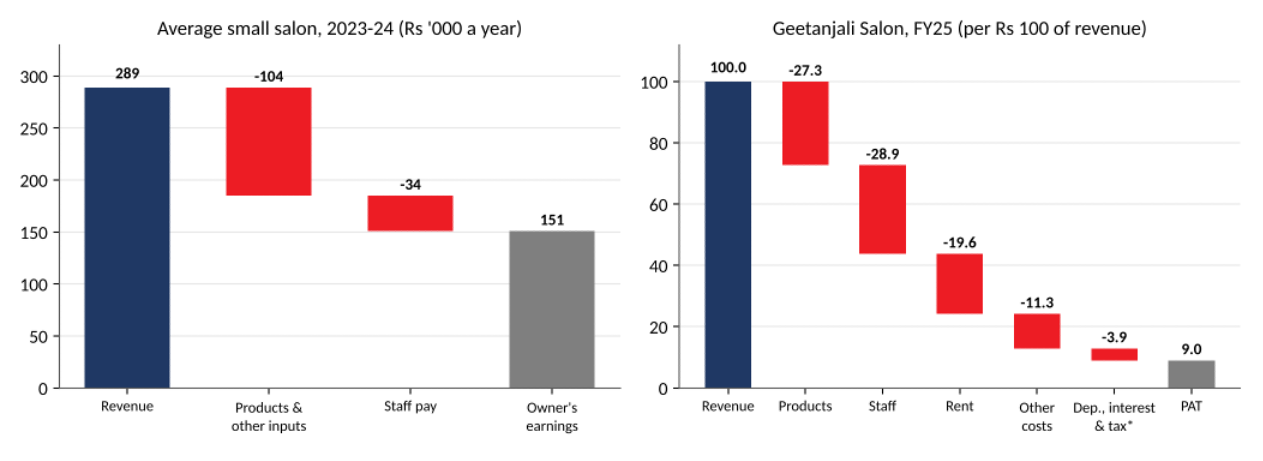
Source: Marcellus Investment Managers; MoSPI ASUSE 2023-24 unit-level data (average NIC 96020 enterprise); Geetanjali Salon Pvt Ltd audited accounts for FY25 (Indian GAAP; rent within operating costs). Owner’s earnings = value added less staff pay, before the owner’s own labour, interest and depreciation. *Depreciation, interest and tax net of other income.
Exhibit 4: Salon unit economics at a glance
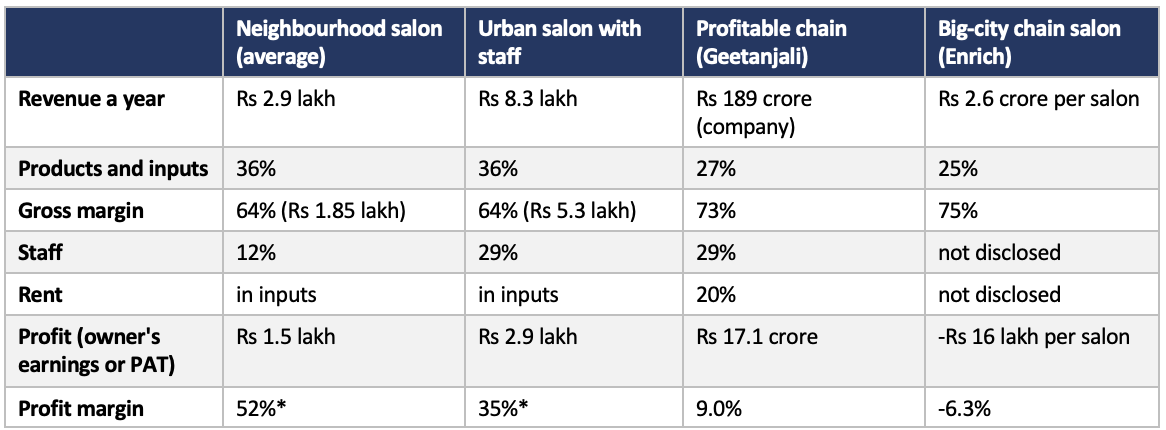
Source: Marcellus Investment Managers; MoSPI ASUSE 2023-24 unit-level data; Geetanjali Salon Pvt Ltd audited accounts (FY25); Enrich Hair & Skin Solutions standalone financials (FY25, ACE Equity) and company website (115 salons). *Owner’s earnings before the owner’s own pay, interest and depreciation; not comparable with PAT. Mention of these companies is for illustration only and is not a recommendation.
Not everyone is getting rich
In our auto dealers blog, the average dealer earned around Rs 76 lakh a year, about seven times what the average middle-class taxpayer earns. The average salon owner takes home around Rs 1.5 lakh, about one-seventh of what that taxpayer earns. The freelancers we spoke to told us that their rates have not gone up for a decade, ever since app-based home services arrived.
Being big doesn’t necessarily help either. Enrich, a reputed chain with 115 salons across seven cities, all of which it runs itself, has reported a net loss every year since FY13. Since FY16 alone it has lost about Rs 147 crore, funded by Rs 268 crore of fresh equity. Kaya, the listed chain of skin clinics, lost Rs 33 crore in FY25 and has a negative net worth. On the other hand, Geetanjali and Lakmé Lever (HUL’s salon business) made around Rs 17-18 crore of PAT each.
Exhibit 5: Two chains make money; two have lost money for years
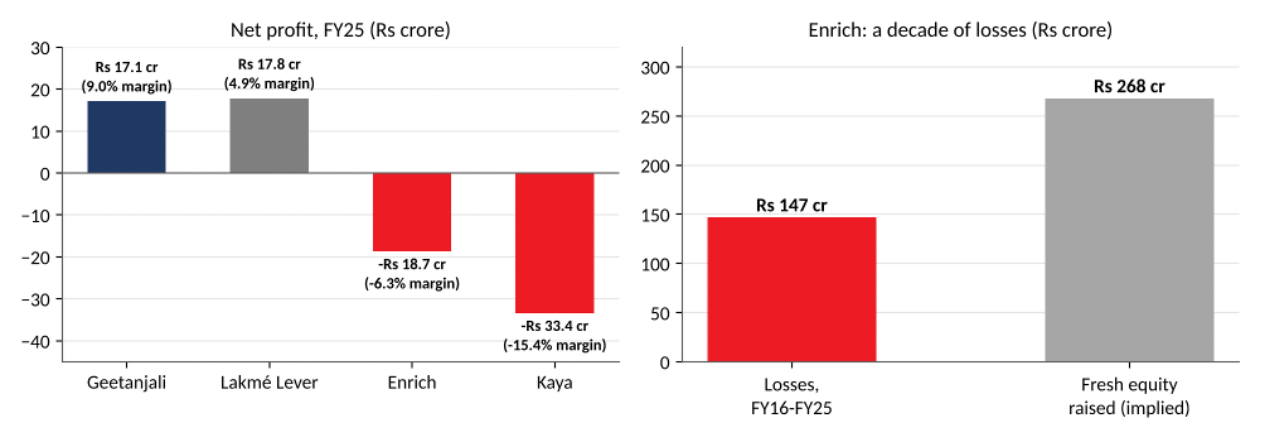
Source: Marcellus Investment Managers; ACE Equity standalone financials (Enrich, Lakmé Lever), consolidated (Kaya); Geetanjali Salon Pvt Ltd audited accounts. FY25. Enrich equity raised is implied from the change in net worth plus cumulative losses. Mention of these companies is for illustration only and is not a recommendation.
So, who is making money?
If a growing market isn’t enough, then who is making money in this industry? What do they look like? What does it take to succeed, and where do you need to be? Putting together the survey data, company filings and our conversations with beauticians in Mumbai, we see three answers.
- Franchise the salon and sell the product
The most profitable salon brands don’t bear the full cost of every salon. Geetanjali started with a single salon in Delhi in 1989 and now has more than 200 salons in over 50 cities, many of them run by franchisees who put up the money for new salons. Its revenue has grown nearly four-fold from Rs 48 crore in FY22 to Rs 189 crore in FY25, and it has funded this growth from its own cash flows. Once we put all four chains on the same accounting basis (Ind AS 116, which treats rent as a financing cost), Geetanjali’s operating margin is about 17% and its pre-tax RoCE about 21% i.e. Geetanjali’s PAT is around Rs 17 cr. Lakmé Lever earns about 12% operating margin and 10% pre-tax ROCE respectively.
The companies that supply salons with products are doing even better. Hair salon chains spend 18-27% of their revenue on products. Geetanjali alone pays its suppliers around Rs 50 crore a year, and in FY25 the brands gave it about Rs 3.2 crore of products for free to keep its business. L’Oréal’s Professional Products division, the market leader in India, made an operating margin of 22.9% globally in 2025, higher than any of the Indian salon chains we looked at.
Exhibit 6: The product supplier earns more than any chain, and chains spend a quarter of their revenue on its products
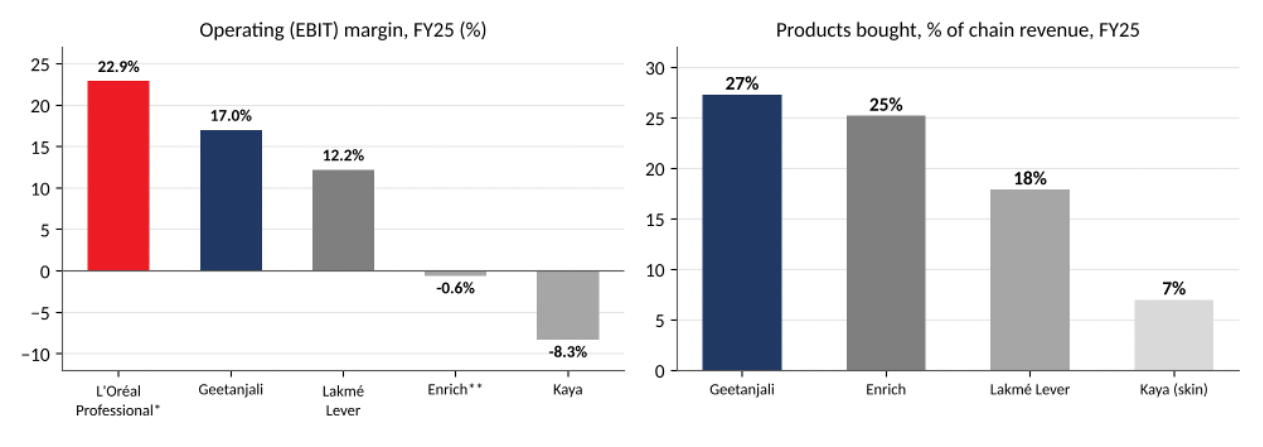
Source: Marcellus Investment Managers; L’Oréal 2025 annual results (*global Professional Products division; India not disclosed separately); company accounts for FY25. Chain margins on an Ind AS 116 basis: Geetanjali and Enrich adjusted by capitalising rent (5-year remaining lease term, 10% discount rate); **Enrich rent estimated at 20% of revenue as it is not disclosed. Mention of these companies is for illustration only and is not a recommendation.
- Go where rents are low and demand is rising
As with auto dealers, location matters. Turnover of small salons grew fastest in Punjab (16% a year), followed by Maharashtra, Rajasthan, Gujarat and Madhya Pradesh (around 12% each). In contrast in the megacity of Delhi, turnover barely grew. Turnover per salon grew faster in rural India (8.1% a year) than in urban India (6.0%).
Rural salons with staff also keep about 41% of every rupee as the owner’s earnings, against 35% in cities. Rents are much lower in smaller towns, whereas prices are NOT proportionately lower.
The chains tell the same story. Geetanjali and Lakmé, both profitable, are expanding into tier-2 and tier-3 cities through franchisees; Geetanjali’s recent openings include Ludhiana, Chandigarh and Bhubaneswar. Enrich and Kaya run their own outlets in big cities, where high rents and the cost of premium staff have eaten into their margins.
Exhibit 7: Western and central India are booming, and small-town salons keep more of each rupee
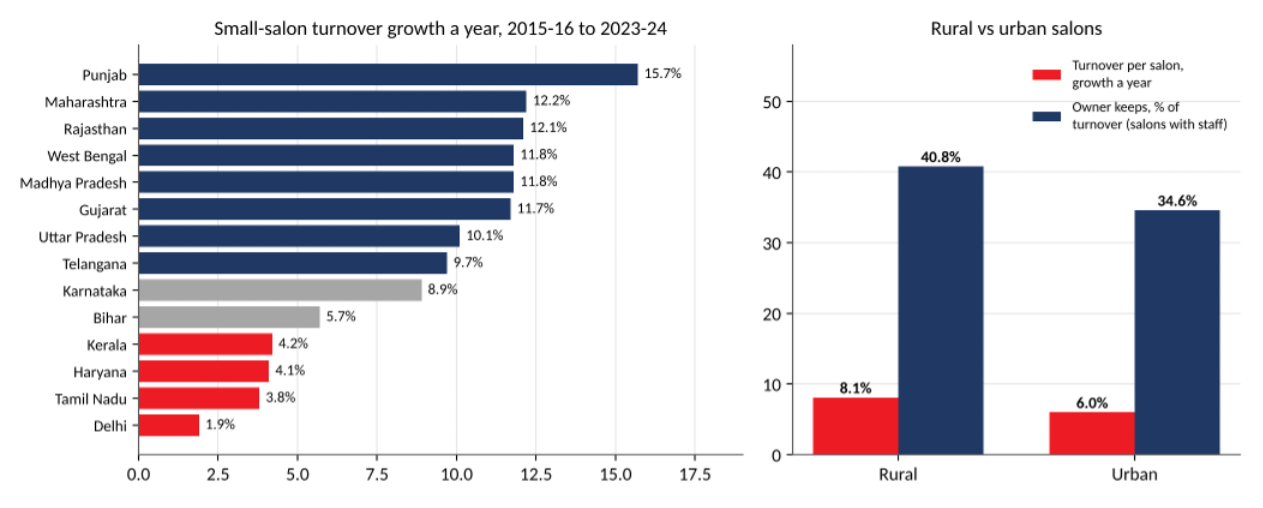
Source: Marcellus Investment Managers; MoSPI unit-level data, NSS 73rd round (2015-16) and ASUSE 2023-24, NIC 96020. Nominal turnover growth over the 8.25 years between survey mid-points; states with the largest small-salon turnover shown. State estimates rest on 250-2,000 survey records each.
- Back your skills with a franchise or an app, which is what women are doing
The fastest growing set of salon owners in India are women. The number of women-owned salons nearly doubled from 3.4 lakh in 2015-16 to 6.5 lakh in 2023-24, and their turnover grew at 13% a year, against 8% for salons owned by men. More than half of women-owned salons are run from home, and nearly four in five were started in 2016 or later. Women now make up 32% of the people working in salons, up from 22%. Salons run by a single person, most of them women, account for about half of the increase in the industry’s turnover.
Skills matter, but they are not enough on their own. A recognised qualification lets a beautician charge more. A franchise brand, or an app like Urban Company (which has about 59,000 service partners active every month across all its categories), gets her a steady stream of customers, along with training and pricing. Without that, a skilled freelancer ends up competing on price with the apps. The two women we met in Mumbai show both sides of this.
Exhibit 8: Women are setting up salons faster than men
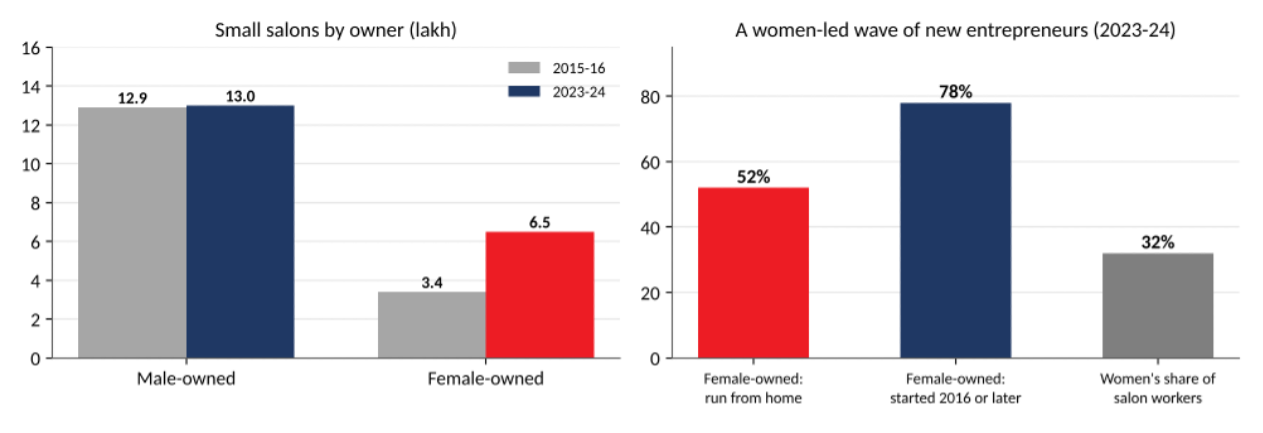
Source: Marcellus Investment Managers; MoSPI unit-level data, NSS 73rd round (2015-16) and ASUSE 2023-24, NIC 96020. Sole proprietorships (about 99% of small salons). 2015-16 sex split of workers inferred from survey column order.
We met two beauticians in Mumbai
Neepa Rawat: skilled, certified, and stuck
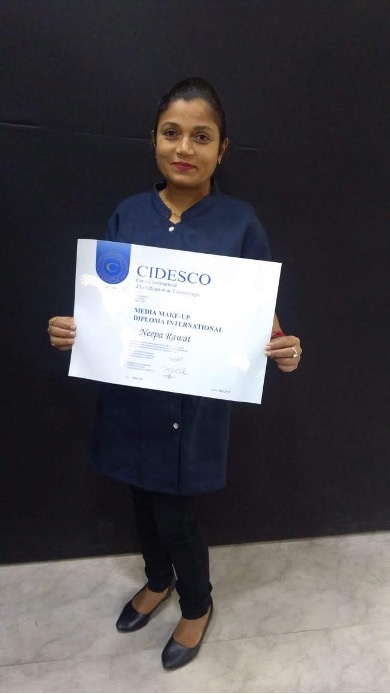
Neepa Rawat learnt beauty treatments at a neighbourhood parlour in 2006 and worked there until 2012, doing home appointments on the side. Her clients liked her work so much that they pushed her to go out on her own, and by 2011-12 she was freelancing full time. When her clients started asking for advanced make-up, she went back to studying. A course at a celebrity make-up artist’s academy taught her very little, so she kept looking, and in 2019 she earned an international CIDESCO media make-up diploma.
Exhibit 9: Neepa Rawat with her CIDESCO media make-up diploma
Source: Marcellus Investment Managers channel checks (2026).
Neepa now has around 250 clients and charges at least Rs 1,000 a visit. She sees 15-20 clients in a typical month and up to 50 in the wedding season. She has spent about Rs 2 lakh setting up a small parlour at home and owns make-up worth Rs 3.5-4 lakh. After travel and materials, she says she keeps about 25% of what she bills as gross margin and about 10% as profit. That puts her revenue at roughly Rs 2-3 lakh a year, close to the national average for a small salon. She had to stop working during Covid, and when she restarted the market had changed. Her rates, she told us, have barely moved in ten years as Urban Company and other competitors have come in. She lives in Goregaon, in a chawl that is being redeveloped, and will move into a 1BHK flat once it is done. Neepa’s story is a reminder that skills and certificates on their own don’t give a beautician the power to raise her prices.
Priya Singh: from despair to Rs 1 lakh a month
Priya Singh (name changed) was 15 when she lost her father in tragic circumstances in 2005. Home became a cruel place after that, and with nowhere else to go, she married young. Her husband (we will call him Ramesh) beat her, and her in-laws treated her badly. Priya had not been able to clear class 10, but she had learnt beauty work at a salon in 2008-09. After her marriage, her in-laws didn’t allow her to work. For the next decade she put up with the abuse and with her husband’s affairs, hoping that a second child would make things better. It didn’t. Around 2018-19, while she was still nursing their second son, he left her for another woman.
By 2021 she had had enough. Her in-laws still wouldn’t let her work, so she quietly put aside around Rs 1 lakh from the family’s milk distribution business and left home to stay with a friend. She had decided that she would start working whether or not her family found her. They did find her, and brought her back because of the two boys, but this time she didn’t back down. She got 5,000 pamphlets printed advertising her services. Only one client called. A friend who worked on Urban Company told her that customers now book beauticians through the app. So Priya cleared the interview, spent Rs 30,000 on a month of training and started working.
The first thing she bought was a gold chain worth Rs 60,000. Then came a bed and an almirah worth Rs 25,000, then a pair of gold earrings worth Rs 80,000, and last Diwali a gold ring worth Rs 1.6 lakh. As she listed these, her voice got louder and more confident. Today she makes about Rs 3,500 a day after costs and works especially hard on weekends, which takes her close to Rs 1 lakh a month, or about Rs 12 lakh a year. That is around eight times what the average small salon owner makes, and more than the average middle-class taxpayer. Some of her customers have helped her start investing in mutual funds. Her sons wear clothes from Zara, and last Diwali they burst crackers worth tens of thousands of rupees; she had tears in her eyes as she told us this. Priya says her struggle isn’t over yet. Her goal now is to own a house.
Her message to young women everywhere is blunt: “Once a bad apple, always a bad apple. He won’t become better after kids. Run away immediately. Don’t settle for less, and if you’re hardworking there’s a whole world out there and a way out for you.”
India: a parlour in every lane, a queen in every parlour
India’s beauty and wellness market, around Rs 59,000 crore and growing at 9-10% a year, is spread across nearly 20 lakh salons, which makes it one of the most widely owned businesses in the country. But as we have seen, a growing market does not make everyone rich. The money is going to brands that franchise their salons and to the companies that supply them, to salons in towns where rents are low and demand is rising, and to beauticians who have paired their skills with a franchise or an app. A salon brand that spreads across districts through franchisees is another tentacle of the small-town ‘Octopus’ we described in Behold the Leviathan. And women like Priya, building a business one client at a time, are among the newest of India’s new Kings & Queens. Through extensive travel and meetings with entrepreneurs, bankers, local businesses and listed companies, we at Marcellus seek to keep abreast of a rapidly changing country. You could benefit from our endeavour by investing with us. If you would like to learn more about our investment approach, which focuses on companies we assess to be clean and well-managed, please visit invest.marcellus.in# or scan the QR code below.

Click Here for details about our regulatory registration and licensing information.
Nandita Rajhansa and Saurabh Mukherjea work for Marcellus Investment Managers (www.marcellus.in). The views and opinions expressed in this material are those of the authors and do not necessarily reflect official policy. This material is for informational and educational purposes only and should not be considered financial, investment, or other professional advice.
The stocks mentioned above may form part of Marcellus’ portfolio. Marcellus, its clients, and/or its employees may therefore have an interest in the said stock(s).
Note: the above material is neither investment research, nor investment advice. Marcellus does not seek payment for or business from this material/email in any shape or form. Marcellus Investment Managers Private Limited (“Marcellus”) is regulated by the Securities and Exchange Board of India (“SEBI”) as a provider of Portfolio Management Services. Marcellus is also a US Securities & Exchange Commission (“US SEC”) registered Investment Advisor and is regulated by the International Financial Services Centres Authority (IFSCA) as a Fund Management Entity. No content of this publication including the performance related information is verified by SEBI, IFSCA or US SEC. If any recipient or reader of this material is based outside India and USA, please note that Marcellus may not be regulated in such jurisdiction and this material is not a solicitation to use Marcellus’s services. The PMS strategy, Category III AIF products and IFSCA retail schemes are distinct offerings with different regulatory frameworks, risk profiles, fee structures and investment thresholds. Investors should refer to product-specific documents for details before investing. All recipients of this material must, before dealing and or transacting in any of the products and services referred to in this material, make their own investigation and seek appropriate professional advice. Investments in securities market are subject to market risks. Read all the related documents carefully before investing. Past performance is not indicative of future results. Marcellus and/or its associates, the authors of this material (including their relatives) may have financial interest by way of investments in the companies covered in this material. Marcellus does not receive compensation from the companies for their coverage in this material. This material may contain confidential or proprietary information and user shall take prior written consent from Marcellus before any reproduction in any form. Clients have an option to be on-boarded directly by the Portfolio Manager without intermediation of persons engaged in distribution services. Investments in securities markets are subject to market risks and there is no assurance that any investment objective will be achieved.
As per SEBI Master Circular dated June 07, 2024, clients have an option to be on-boarded directly by the Portfolio Manager without intermediation of persons engaged in distribution services.
# This tool is designed to help users explore products and asset allocation guidance; it does not constitute a formal financial plan or investment advice.