OVERVIEW
POPULAR ARTICLES

At a very early stage in its development, India is tracing the same path that the richer economies did i.e., Indians are marrying later in life & having fewer children. Specifically, these shifts are taking place far more rapidly in the better educated, more employable parts of the Indian economy. As a result, the data points to shrinkage in India’s overall population and rapid population shrinkage in the most developed, better educated segments of the economy. This in turn implies the end of the “demographic dividend” i.e. the generation or so of higher economic growth that India enjoyed due to a surplus of young, employable workers. The investment implications of this are profound including slower consumption growth. If you want a portfolio which can compound for you in these conditions, contact us on invest.marcellus.in
Exhibit 1: The never married share of 15-29 year-olds rose ~6pp in eight years in Indi
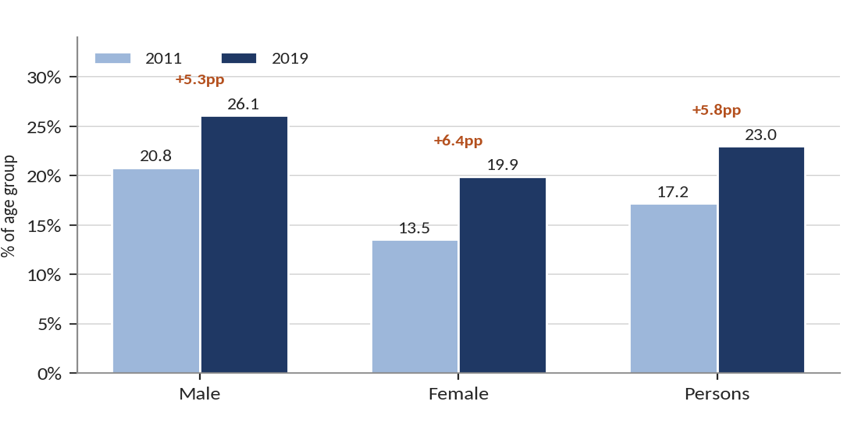
Source: MoSPI / National Statistical Office, ‘Youth in India 2022’. Reference years 2011 and 2019.
“According to the Hindu way of thinking, marriage is a duty rather than a privilege.”— Swami Vivekananda (source: https://vivekavani.com/people-india-swami-vivekananda/)
The Economic Theory on marriage is well established
Gary Becker’s economics of the family, for which he received the Nobel Prize, treated the household as a small firm. The gain from marriage came from specialisation: one spouse specialising in market work, the other in domestic production, with the division of labour producing more than either could alone. Becker called these production complementarities, and they generate a specific prediction — that people will sort into couples on the basis of difference rather than similarity, because complementary skills are worth more than duplicated ones. Opposites should attract. (Source: https://www.jstor.org/stable/1831130)
Betsey Stevenson and Justin Wolfers argued in a 2007 NBER paper that this model has been overtaken. Household technology reduced the time cost of domestic production; the service economy made it purchasable; women’s education raised the opportunity cost of staying home. What remains, in their account, is consumption complementarities — activities that are simply more enjoyable shared. They call the result hedonic marriage, and it inverts Becker’s prediction: if the gain comes from shared enjoyment rather than divided labour, similarity beats difference, and sorting should become positively assortative on education, age and outlook. That is what the data shows for the developed economies. (Source: https://users.nber.org/~jwolfers/Papers/MarriageandDivorce(NBER).pdf)
Stevenson-Wolfers’ work also implies that the specialised, production-based marriage is genuinely obsolete in rich countries. Specifically, what is doomed is the marriage in which one person specialises in the home.
The two papers highlighted above effectively provided the underlying theory to explain what the developed world has seen over the past half century. Across the OECD countries marriage rates have fallen by roughly half since 1970: in 1970 most member countries recorded crude marriage rates between 7 and 10 per 1,000 people; by 1995 most were between 5 and 7; most are now between 3 and 5. The OECD Family Database records the mean age at first marriage rising by almost six years between 1990 and 2017, reaching close to 32 for women and 34 for men by 2021.
India is following the path laid out by richer countries
Although basis overall per capita incomes, India remains one of the poorest 40 nations in the world, India’s marriage and fertility behaviour is following the pattern laid out above.
The National Statistical Office’s Youth in India 2022 compendium records the never-married share of the 15–29 population rising from 17.2% in 2011 to 23.0% in 2019, with the male share moving from 20.8% to 26.1% and the female share from 13.5% to 19.9%. Both moved roughly six percentage points in eight years, which for a nuptiality series is a fast shift – see the opening chart in this note.
On timing, NFHS-5 records the median age at first marriage for women aged 20–49 rising from 17.2 years in 2005-06 to 19.2 in 2019-21, and for men aged 25–29 from 22.6 to 24.9. MoSPI’s Women and Men in India 2025 reports the mean age at effective marriage for women reaching 24.3 in 2023. The share of women aged 25–29 first married by age 20 fell from 72.4% to 52.8% over the same fifteen years, and the share of women aged 20–24 married before 18 halved, from about 47% to 23%.
Exhibit 2: India is marrying later – and schooling, not income, is the visible driver
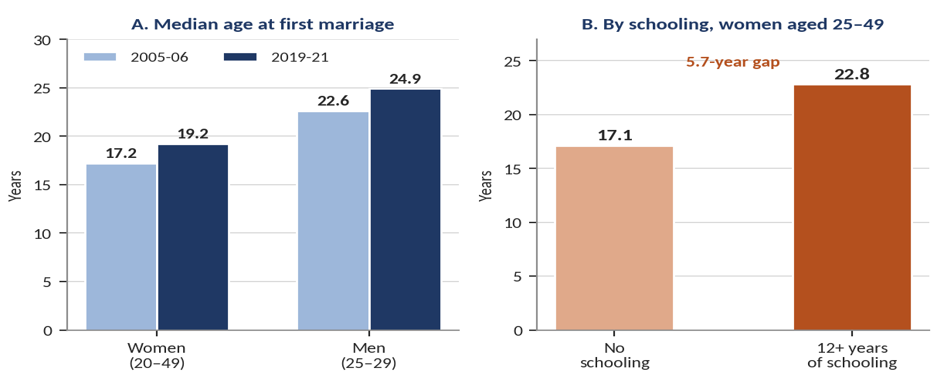
Source: IIPS, NFHS-5 (2019-21). Panel A compares NFHS-3 and NFHS-5. Panel B covers women aged 25–49.
The education gradient is the sharpest observable dividing line. Median age at first marriage among women aged 25–49 runs from 17.1 years for those with no schooling to 22.8 years for those with twelve or more years — a gap of 5.7 years. Each additional year of a girl’s education raises age at marriage by 0.36 years after controlling for wealth and residence. (Source: UNFPA’s regression on the NFHS-5 unit-level data)
India’s median age at first marriage for women is 19.2. The OECD mean is about 32. Korea’s is 31.6.
Exhibit 3: However fast India is moving, it is starting from a very different level
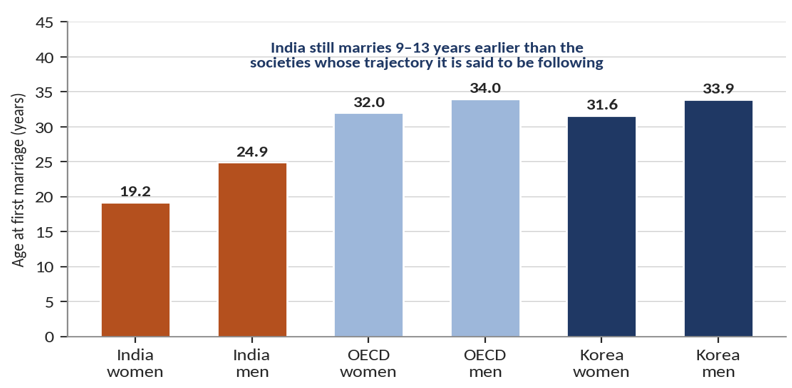
Sources: India – IIPS, NFHS-5 (2019-21), median age at first marriage, women 20-49 and men 25-29, OECD – Society at a Glance 2024, mean age, 2021, Korea – Ministry of Data and Statistics, average age at first marriage, 2025. Median and mean are not identical measures and the reference years differ; the comparison is indicative of level, not a like for like series.
Indians are marrying later and having fewer children
According to the Sample Registration System (SRS) Statistical Report — India’s largest demographic survey – India’s fertility rate has for the first time fallen below the level needed to stop the population from shrinking, raising concerns about future labour shortages and an ageing society. (Source: https://www.aljazeera.com/news/2026/6/9/indias-fertility-rate-falls-below-replacement-level-why-it-matters)
The latest SRS report released in May 2026 said that India’s Total Fertility Rate (TFR) had dropped to 1.9 children per woman – lower than the benchmark replacement level of 2.1 needed to keep the population stable in the long run. TFR is the average number of children that a woman is expected to have in her lifetime. In the 2000s, India’s TFR was around 3.3 births per woman.
More specifically, fertility rates are falling the fastest in the best educated, most affluent parts of the country. Bihar in northern India with the lowest levels of education and high infant mortality rates, also recorded the highest fertility rate in the country at 2.9, followed by 2.6 in Uttar Pradesh.
By contrast, India’s capital New Delhi — with among the highest levels of education and lowest infant mortality rates — registered the lowest fertility rate, with an average of 1.2 births per woman. Southern states such as Tamil Nadu and Kerala, with among the best health and education systems in India, recorded a rate of 1.3. In these better developed parts of the Indian economy, it is highly likely that for middle class Indian, fertility rates are now well below 1 i.e. far below the replacement rate of 2.1.
So not only is India’s overall population already shrinking (with the fertility rate now below replacement rate), it is shrinking the fastest in the most prosperous parts of the Indian economy thus implying that the demographic dividend that India is supposed to have enjoyed over the past generation is now likely coming to an end.
- The fact that fertility rates are falling far more rapidly in the better educated, better developed southern states is bound to create a high voltage political flashpoint as we approach “Delimitation”. India’s politicians are unlikely to find a neat solution to south India’s rising economic importance alongside its rapidly shrinking population.
- As India’s population shrinks, consumption growth – which has tanked steadily over the past 15 years (see chapter 7 of our book, “Breakpoint: The Crisis of the Middle Class & The Future of Work”) – is likely to decline further even if the household debt bubble sustains in India for a few more quarters.
- As well-educated affluent Indian families move towards retirement with few or no children, savings rates are likely to rise. Furthermore, as we increasingly see Indian professionals having no kids, their spending on aspirational and luxury items is likely to rise.
- Social scientists have found that lack of children seems to impact mental health adversely in India. “Childlessness is associated with higher depressive symptoms among both men and women in mid- and later adulthood, and with greater life dissatisfaction among women.” (Source: https://www.sciencedirect.com/science/article/abs/pii/S0277953625011207)
The investment implications for you are significant
Multiple forces – tech in the form of AI, demographics in the form of a shrinking population, economics in the form of high household indebtedness, geopolitics in the form of China+1 – are working together to rapidly change the structure of the Indian economy:
- Away from consumption and towards higher household savings (Three Personal Finance Principles for Sankat Kaal, August 4, 2026);
- Away from IT Services exports and towards manufacturing exports (An Economic ‘Sagar Manthan’ Beckons for India, March 9, 2026);
- Away from reliance on the government for public services towards relying on the private sector for health, education and security (Profiting From a Fading State & Rising Inequality, July 15, 2026).
Marcellus’ Consistent Compounders Portfolio (CCP) invests in 20 Indian companies with clean accounts, strong balance sheets and well-managed franchises. Most of these companies either provide essential goods & services to Indian households (e.g., tea, salt, hospital care, medical diagnostics) or to citizens in other countries (medicines, hospital care). After a blockbuster in the five years ending Diwali 2021, this portfolio struggled from 2022-25. However, with the Indian economy entering Sankat Kaal, CCP is outperforming again in 2026. CCP is available to both Indians and NRIs as PMS product with a minimum investment of Rs 50 lakh.
Consistent Compounders Portfolio — CCP PMS vs Nifty50 TRI, annualised returns by phase
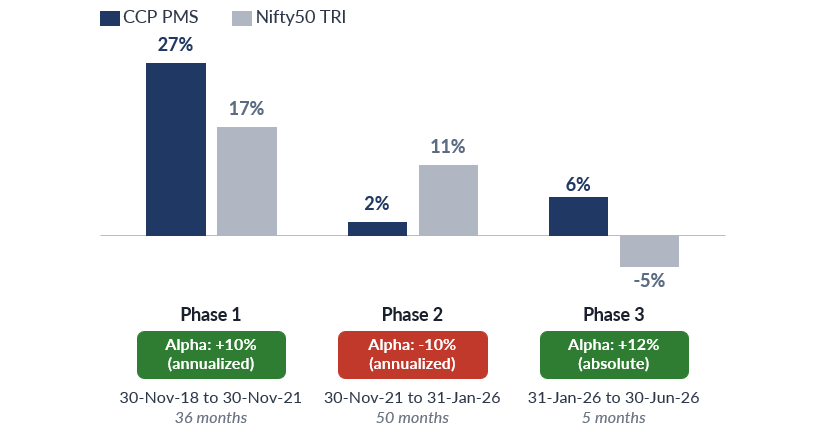
Note: Performance data for the domestic portfolio is shown net of fixed fees and expenses, and net of performance fees, charged till the last quarter end for client accounts. Short-period returns are absolute; longer-period returns are annualized. The calculation or presentation of performance results has NOT been approved or reviewed by the SEC, SEBI or any other regulatory authority. Past performance is not indicative of future results.
Note: Marcellus performance data is shown gross of taxes and net of fees & expenses charged as of the end of July.
If you would like to invest with us, please scan the QR code below:

Click Here for details about our regulatory registration and licensing information.
The above material is neither investment research, nor investment advice. Marcellus does not seek payment for or business from this material/email in any shape or form. Marcellus Investment Managers Private Limited (“Marcellus”) is regulated by the Securities and Exchange Board of India (“SEBI”) as a provider of Portfolio Management Services. Marcellus is also a US Securities & Exchange Commission (“US SEC”) registered Investment Advisor. No content of this publication including the performance related information is verified by SEBI or US SEC. If any recipient or reader of this material is based outside India and USA, please note that Marcellus may not be regulated in such jurisdiction and this material is not a solicitation to use Marcellus’s services. This communication is confidential and privileged and is directed to and for the use of the addressee only. The recipient of this material is urged to consult their own legal and tax consultants/advisors before making any investments. The recipient, if not the addressee, should not use this material if erroneously received, and access and use of this material in any manner by anyone other than the addressee is unauthorized. If you are not the intended recipient, please notify the sender by return email and immediately destroy all copies of this message and any attachments and delete it from your computer system, permanently. No liability whatsoever is assumed by Marcellus as a result of the recipient or any other person relying upon the opinion unless otherwise agreed in writing. The recipient acknowledges that Marcellus may be unable to exercise control or ensure or guarantee the integrity of the text of the material/email message and the text is not warranted as to its completeness and accuracy. The material, names and branding of the investment style do not provide any impression or a claim that these products/strategies achieve the respective objectives. Further, past performance is not indicative of future results. Marcellus and/or its associates, the authors of this material (including their relatives) may have financial interest by way of investments in the companies covered in this material. Marcellus does not receive compensation from the companies for their coverage in this material. Marcellus does not provide any market making service to any company covered in this material. In the past 12 months, Marcellus and its associates have never i) managed or co-managed any public offering of securities; ii) have not offered investment banking or merchant banking or brokerage services; or iii) have received any compensation or other benefits from the company or third party in connection with this coverage. Authors of this material have never served the companies in a capacity of a director, officer or an employee. All recipients of this material must before dealing and or transacting in any of the products referred to in this material must make their own investigation, seek appropriate professional advice and carefully read the Private Placement Memorandum/Disclosure Document, Form ADV, Form CRS and any other documents or disclosures provided to them by Marcellus, as applicable.This material may contain confidential or proprietary information and user shall take prior written consent from Marcellus before any reproduction in any form.
Note: the above material is neither investment research, nor investment advice. Marcellus does not seek payment for or business from this material/email in any shape or form. Marcellus Investment Managers Private Limited (“Marcellus”) is regulated by the Securities and Exchange Board of India (“SEBI”) as a provider of Portfolio Management Services. Marcellus is also a US Securities & Exchange Commission (“US SEC”) registered Investment Advisor. No content of this publication including the performance related information is verified by SEBI or US SEC. If any recipient or reader of this material is based outside India and USA, please note that Marcellus may not be regulated in such jurisdiction and this material is not a solicitation to use Marcellus’s services. All recipients of this material must before dealing and or transacting in any of the products and services referred to in this material must make their own investigation, seek appropriate professional advice. Past performance is not indicative of future results. Marcellus and/or its associates, the authors of this material (including their relatives) may have financial interest by way of investments in the companies covered in this material. Marcellus does not receive compensation from the companies for their coverage in this material. This material may contain confidential or proprietary information and user shall take prior written consent from Marcellus before any reproduction in any form.