OVERVIEW
POPULAR ARTICLES

Like our favourite cricketer, Rahul Dravid, the 7 companies decoded by us a decade ago in ‘The Unusual Billionaires’ delivered market beating performance by focusing on 3 principles which are simple to understand but hard to deliver on: (a) stick to the core and expand only into adjacencies; (b) focus on deepening your existing moats; and (c) allocate capital with discipline and resist the flavour of the season. For a detailed review of these 7 companies and in-depth drilldowns into 5 more such franchises, please refer to our new book “The Art of Enduring”.
To order the book, click here
To invest with us in clean Indian companies, visit marcellus.in
To register for the book launch webinar on Fri 28th Aug at 7pm, click here
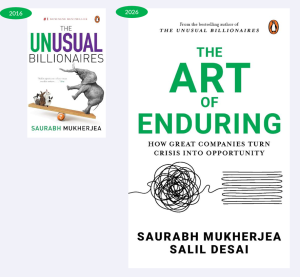
Copyrights and intellectual property for the referenced book “Breakpoint” remain with the original publisher and author. No challenge to their ownership is intended.
Sticking our necks out in 2016
When we published ‘The Unusual Billionaires’ (UB) in 2016, we did something that, in hindsight, was rather brave: we labelled seven Indian companies as “great” and put that judgement in print. Greatness, though, is a claim about the future, not the past. Even as we wrote the book in 2016, we were aware that almost every business book which claims to have identified the recipe for greatness suffers the indignity of seeing its champions devalued by the ravages of time.
We knew that the only honest test of our judgement would come with time. The decadal anniversary of the UB seems like the right time to review our judgement. The outcome matters all the more because the intervening years were brutal: demonetization in 2016, the GST rollout in 2017, the pandemic in 2020, wars in Europe and West Asia, snarled supply chains, a trade war and the sharpest interest-rate swings in a generation.
In spite of these disruptions, the UB companies have beaten the broader benchmark by a significant margin. The performance of these seven franchises since the book was published is shown in the table below.
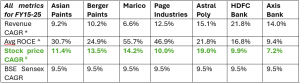
Source: ‘The Art of Enduring’, Annexure 1. * Loan book growth for the 2 banks; ^ ROE for the 2 banks; #stock price CAGR from 31-March-2015 to 31-July-2026
If Rs 100 was equally split in these seven stocks on 31 March 2015, the total value of the portfolio would have risen to Rs 390 by 31st July 2026. The same Rs 100 invested in the BSE Sensex would have been worth Rs 279. The untouched Unusual Billionaires portfolio would have thus outperformed the broader market by 40%.
Even we were surprised by the extent of the outperformance of the UB companies especially since we are regularly berated by commentators for investing in boring, old-fashioned companies whose valuations are supposedly so high that they can’t climb higher. That’s when we decided we will double down on “boring, old-fashioned” companies in the sequel to the UB, “The Art of Enduring”.
Investing in boring, old-fashioned companies that allocate capital sensibly
What separates these companies from the index, is not luck or a benign environment. It is the stubborn repetition of three habits. (1) Each stayed close to its core, expanding only into sensible adjacencies rather than chasing unrelated growth. (2) Each kept deepening its competitive moat, whether through supply chains, brands, manufacturing or underwriting. (3) And each allocated capital with discipline, investing where returns were defensible and resisting the fashion of the season. Even Axis, the laggard, ultimately leaned on precisely these principles to rebuild.
That consistency is the whole point. Great companies are NOT the ones that avoid difficult decades. They are the ones that keep compounding their advantages through the disruption, so that when the dust settles they stand stronger. A decade of demonetization, a pandemic, wars and rate shocks were about as stringent a test as any Indian business could be subjected to. Six of seven Unusual Billionaires passed it. And they rewarded their shareholders with healthy returns for the patience.
A brief assessment of each of the UB companies
Asian Paints: Asian Paints faced its stiffest challenge in years with the Aditya Birla Group’s Rs 10,000-crore entry through Birla Opus, arriving just as building-material demand slumped. Margins fell to a decade low (bar one Covid year) and it ceded a little market share. Its response was characteristic — deepen the moat. It kept investing in the supply-chain and demand-forecasting systems that dealers still rate as the industry’s best, and committed roughly Rs 3,250 crore to backward integration to lower costs. Over FY15-25, the company’s revenue compounded at CAGR of 9.2% and ROCE averaged a solid 30.7%. The stock returned 11.4% from 31-March-15 to 31-July-2026, comfortably ahead of the market.
Berger Paints: Berger also continued to do what it does best – focusing on differentiated products and distribution. It rolled out an O9 supply-chain platform, accelerated tinting-machine installations from about 3,000 to over 7,000 a year, and doubled down on niche brands such as Anti-Dust and Weathercoat Long Life. These initiatives reflected in market share gains, from around 18.9% in FY22 to 21.2% in FY25. And this was despite ferocious competition and weak demand. The company’s revenue grew 10.2% with average ROCE over the decade near 25%. The stock compounded at 13.5%, a full 4 percentage points ahead of the Sensex, from March 2015 to July 2026.
Marico: Marico’s story was one of reinvention. Its legacy engines slowed as competition intensified in value-added hair oils and edible oils. Yet the company managed to grow Parachute’s coconut-oil market share from 57% to 63% and, more importantly, built new engines of growth. The Saffola brand was extended from oil into foods and now accounts for around 13% of revenue, with Masala Oats alone a Rs 500-crore-plus brand. Marico acquired the direct-to-consumer names Plix and True Elements to enter fast-growing categories. Headline revenue growth over FY15-25 was a muted 6.6%, but ROCE averaged an exceptional 55.7%. Over 31-March-15 to 31-July-2026 the stock compounded at 14.2%; a solid 4.7 percentage points beat to the BSE Sensex.
Page Industries: Page showed what operational discipline looks like. Revenue roughly tripled to about Rs 4,900 crore while headcount held near 18,000, reflecting massive gains in manufacturing efficiency. The company added a greenfield plant in Odisha to lower costs further. Growth did slow, from around 30% a year before 2016 to roughly 11% more recently, as the innerwear category cooled and Page’s own premium dominance (a 70–75% share) left little room to run. Even so, ROCE averaged about 47% through FY15-25. The stock compounded at 10.0% over March 2015 to July 2026, slightly better than the 9.5% the Sensex returned over the same period.
Astral: Astral was the standout. It kept allocating capital with discipline in its core pipes business – expanding installed capacity at a 14% CAGR and expanding from four plants to eleven, while moving into fittings, sanitaryware and paints without once diluting returns. ROCE averaged at 21.8% through the decade-long period. Astral brought long-standing pipe distributors along into the new businesses, in a continued demonstration of strengthening the company’s Architecture, a key pillar of its competitive advantages. These initiatives led to a 19% stock price CAGR from 31-March-2015 to 31-July-2026, almost double the market’s annual rate.
HDFC Bank: HDFC Bank navigated two eras and a mega-merger. Under Aditya Puri (up to FY21) it grew loans and deposits at about 20% a year, well ahead of the industry, and held gross NPAs below 1.5%. The fact that NPAs were maintained at these levels is the truest test of a lender’s risk management. The handover to Sashidhar Jagdishan and the 2022 merger with HDFC Ltd created a roughly $200-billion balance sheet. ROE moderated towards 15% as the merged entity absorbed increased liability costs from higher statutory liquidity ratio and priority sector lending requirements. The merger, however, gives the bank an unmatched cross-sell opportunity and a low-cost structure at a massive scale, which becomes a long-term defensible moat. The company’s stock, over March 2015 to July 2026 compounded at 9.9%, a slight beat to the broader market.
Axis Bank: Axis is the one that trailed. And its story is the most instructive. A heavy corporate-loan book unravelled between FY16 and FY18, with gross NPAs spiking from 1.7% to 6.8% and ROE falling below 7%. The turnaround came under Amitabh Chaudhry from 2019 – an aggressive clean-up, tighter underwriting and a decisive pivot to retail, which rose to 71% of loans. The 2023 acquisition of Citi’s India consumer business and a permanent Max Life partnership sharpened its franchise. By FY25, ROE was back near 16% and NPAs down to about 1.3%. The stock returned only around 7.2% over the eleven-odd years ending 31-July-2026, dragged by the early stress.
Investing with us in old in boring, well-managed capital allocators
If you like the idea of investing in such companies, you should consider investing in our Consistent Compounders Portfolio (CCP as well call it). CCP consists of 20 clean, well-managed franchises with ‘Unusual Billionaire style’ moats.
Three phases of CCP’s performance since inception
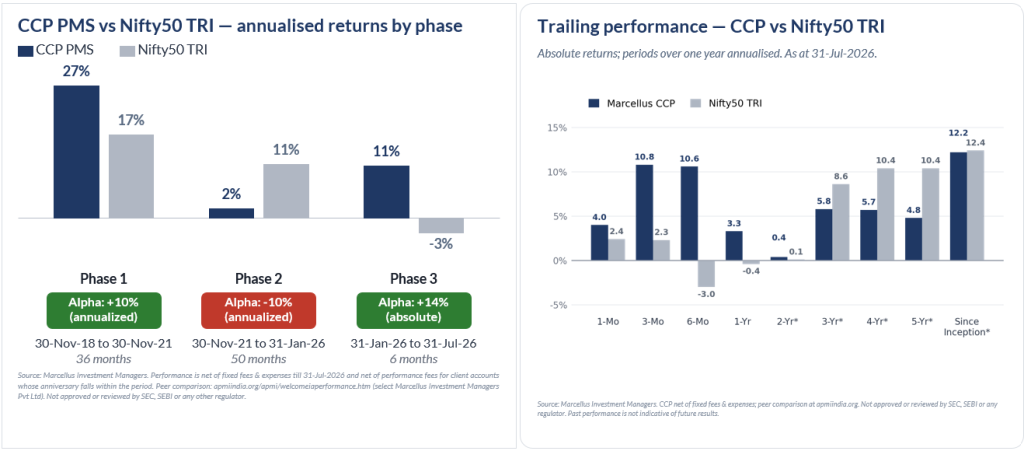
Indeed some of the UB companies are sitting inside CCP and making us richer as we speak. After 5 blockbuster years ending Diwali 2021 when portfolio compounded at 27% p.a., CCP ran into rough weather for the next 4 years as Quality itself got hammered in India. In 2026 however Quality is back with a bang as you can see on the charts above.
CCP is available as a PMS offering from Marcellus. Indians and NRIs can invest in it with a minimum investment amount (as per SEBI’s regulations) being Rs 50 lakhs.
To invest with us, please visit Invest.Marcellus.in OR click on the QR code shown below.

Click Here for details about our regulatory registration and licensing information.
“Stocks discussed/mentioned above may form the part of our PMS portfolio/s.
Accordingly, Marcellus, its employees, their immediate relatives, and clients may maintain interests or positions in these securities.
Any reference to these companies is intended strictly for informational and educational purposes within the context of this discussion and should not be construed as investment advice.”
The above material is neither investment research, nor investment advice. Marcellus does not seek payment for or business from this material/email in any shape or form. Marcellus Investment Managers Private Limited (“Marcellus”) is regulated by the Securities and Exchange Board of India (“SEBI”) as a provider of Portfolio Management Services. Marcellus is also a US Securities & Exchange Commission (“US SEC”) registered Investment Advisor. No content of this publication including the performance related information is verified by SEBI or US SEC. If any recipient or reader of this material is based outside India and USA, please note that Marcellus may not be regulated in such jurisdiction and this material is not a solicitation to use Marcellus’s services. This communication is confidential and privileged and is directed to and for the use of the addressee only. The recipient of this material is urged to consult their own legal and tax consultants/advisors before making any investments. The recipient, if not the addressee, should not use this material if erroneously received, and access and use of this material in any manner by anyone other than the addressee is unauthorized. If you are not the intended recipient, please notify the sender by return email and immediately destroy all copies of this message and any attachments and delete it from your computer system, permanently. No liability whatsoever is assumed by Marcellus as a result of the recipient or any other person relying upon the opinion unless otherwise agreed in writing. The recipient acknowledges that Marcellus may be unable to exercise control or ensure or guarantee the integrity of the text of the material/email message and the text is not warranted as to its completeness and accuracy. The material, names and branding of the investment style do not provide any impression or a claim that these products/strategies achieve the respective objectives. Further, past performance is not indicative of future results. Marcellus and/or its associates, the authors of this material (including their relatives) may have financial interest by way of investments in the companies covered in this material. Marcellus does not receive compensation from the companies for their coverage in this material. Marcellus does not provide any market making service to any company covered in this material. In the past 12 months, Marcellus and its associates have never i) managed or co-managed any public offering of securities; ii) have not offered investment banking or merchant banking or brokerage services; or iii) have received any compensation or other benefits from the company or third party in connection with this coverage. Authors of this material have never served the companies in a capacity of a director, officer or an employee. All recipients of this material must before dealing and or transacting in any of the products referred to in this material must make their own investigation, seek appropriate professional advice and carefully read the Private Placement Memorandum/Disclosure Document, Form ADV, Form CRS and any other documents or disclosures provided to them by Marcellus, as applicable.This material may contain confidential or proprietary information and user shall take prior written consent from Marcellus before any reproduction in any form.