OVERVIEW
POPULAR ARTICLES

So far AI has for the most part augmented the efforts of human workers rather than replacing them outright. Agentic AI is different – it promises to replace human workers entirely and perform roles independently. Actual use of Agentic AI has so far been limited by its unreliability and by the high cost of compute. The exponential surge in the hyperscalers’ revenues and the corresponding ramp-up in their investments in Agentic AI increases the odds of job losses. India is particularly vulnerable due to the well-defined nature of tech and Customer Experience jobs. Our Global funds and goal-based planning services can offer relief to Indians looking to benefit from the AI revolution.
Hyperscalers’ exponential capex rise is on account of development of AI capabilities
Hyperscalers – Alphabet, Anthropic, Amazon, Microsoft, etc – have invested exponentially in capex to scale their AI capabilities. We know this because it gets reflected in AI providers’ exponential rise in revenues. Anthropic alone is now generating $30bn of revenues from selling AI to enterprises, up 30x in the space of 15 months! Since most of its revenues are through enterprise solution that Anthropic offers, this reflects the massive surge in capex of hyperscalers.
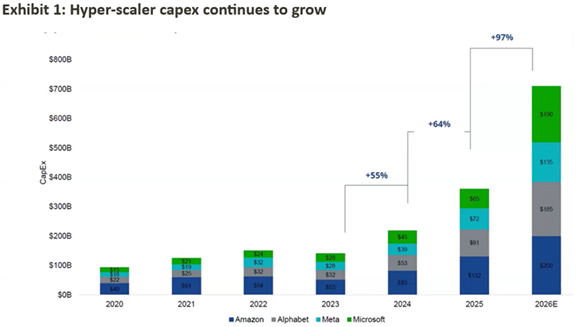
Source: Amazon, Meta, Alphabet, Microsoft as of 2026. Not intended as a recommendation to buy or sell any names referenced herein. Fund holdings will vary. Visit vaneck.com/smhx for most recent fund holdings data. Past performance is no guarantee of future results (sourced from VanEck’s podcast )
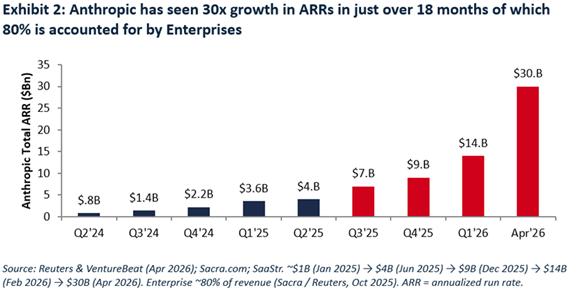
So far, most of the revenues earned by the hyperscalers has come from selling AI which augments human workers (as opposed to selling Agentic AI which can replace human workers). We know this because Anthropic itself publishes fairly comprehensive data on this subject – see the exhibit below.
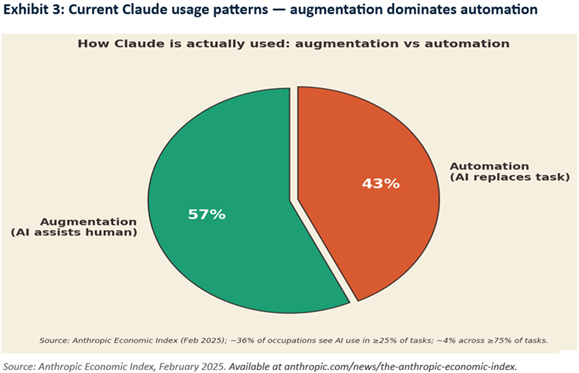
Given that Anthropic is saying that so far AI use leans more toward augmentation (57%), where AI collaborates with and enhances human capabilities rather than automation (43%), where AI directly performs tasks, should we really be worried about AI taking away jobs? The answer is “yes” for two distinct reasons.
Firstly, we have already seen AI taking away entry-level roles across the world. US employment for software developers aged 22-25 has fallen nearly 20% from its 2024 peak.
For the US market, Stanford’s 2026 AI Index provides the most comprehensive data on AI’s labour-market impact: (1)
- Employment for software developers ages 22 to 25 has fallen nearly 20% from its 2024 peak
- Employer surveys point to further change ahead, with one-third of respondents expecting workforce reductions over the coming year (see exhibit 4)
- Global data on layoffs show that they have picked up pace especially post the launch of Chat GPT (see exhibit 5 below)
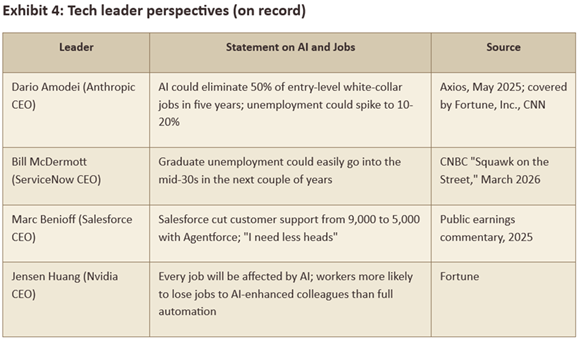
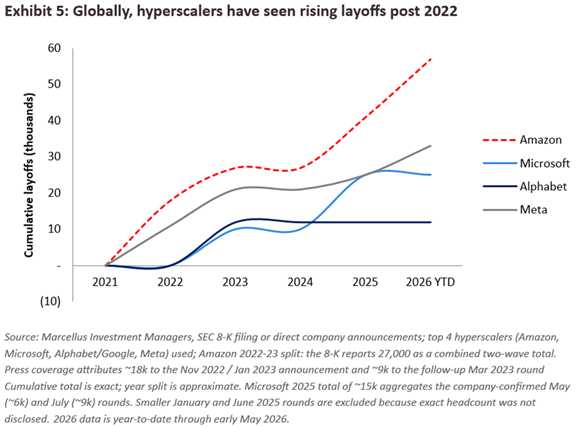
In India, Tata Consultancy Services confirmed cutting 12,000 positions by FY26 in July 2025; actual FY26 workforce reduction was 23,460 employees per TCS disclosures.
For FY26, for the Indian IT Services sector as a whole, NASSCOM (the IT industry’s trade body says), revenue grew 6.1% while headcount grew only 2.3%. Productivity gains, partly driven by AI and automation, are constraining the headcount elasticity of revenue growth. NASSCOM explicitly framed FY26 as the sector’s third inflection point — moving “from FTE delivery to outcome-based, risk-sharing constructs.”
Secondly, the real threat to AI jobs is likely to come from Agentic AI i.e. AI that is capable of doing the role performed by a skilled human worker without any supervision. The simplest example of this is an autonomous car. Visitors to San Francisco who have taken taxi rides in autonomous cars will understand the potential for Agentic AI to gobble up millions of jobs across the world.
The rise of Agentic AI
We can see that the hyperscalers’ colossal investments in AI are bearing fruit as Amazon like players integrate it with their business model in such a way that augments their long standing competitive advantages even further, leaving any credible competitor miles behind as explained by Angus Shillington of VanEck, which runs SMH, world’s largest semiconductor ETF. We are likely to see both incremental capex by Amazon itself which keeps their AI-productivity-cost flywheel turning as well as other hyperscalers emulating and doing similar things in their own domains only rise hereon.
Agentic AI capability — measured as the human-time-equivalent length of tasks that frontier AI models can complete with 50% reliability — has been doubling approximately every seven months for the past six years, per METR’s peer-reviewed methodology. (2)
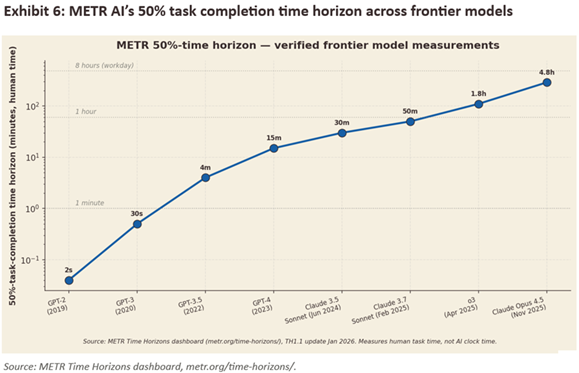
However, so far despite the rapid improvement in the capabilities of AI, Stanford’s 2026 AI Index found that AI agent deployment was in the single digits across nearly all business functions. In fact, Gartner predicts that over 40% of agentic AI projects will be cancelled by the end of 2027, citing escalating costs, unclear business value, and inadequate risk controls. (3)
In other words, so far Agentic AI has not been reliable enough to encourage large scale corporate usage. Companies are still NOT confident enough regarding the capabilities of their AI Agents to let them operate independently of humans. The reliability of these AI Agents is still a binding constraint.
Leaving aside the current capabilities of Agentic AI, there is another reason why its use has not taken off as yet – it is too expensive to use. Thanks to the shortage of Nvidia’s GPUs and due to a shortage of data centre capacity, the cost of compute is currently too high to make Agentic AI cost-effective even in the American context.
In April 2026, Fortune reported on a growing acknowledgement that the headline cost case for agentic AI is more contested than vendor marketing suggests, citing Nvidia’s vice president of applied deep learning:
“For my team, the cost of compute is far beyond the costs of the employees.” — Bryan Catanzaro, VP Applied Deep Learning, Nvidia (via Fortune / Axios, April 2026)
Fortune’s reporting cited an MIT study that found AI automation was economically viable in only 23% of roles where vision is a primary part of the work — meaning humans were cheaper in 77% of those roles. The MIT study is the source of the much-quoted finding that AI cost-effectiveness is highly task-dependent.
Source: Fortune, “The cost of compute is far beyond the costs of the employees,” April 2026. MIT study cited: 2024 analysis of technical requirements for AI to perform vision-related tasks at a human level.
However, as the hyperscalers, the semiconductor manufacturers and the datacentre operators invest more in chip manufacturing and datacentre capacity, the cost of compute is likely to fall. As that happens, the cost issues around the adoption of Agentic AI are likely to be mitigated.
India is a peculiarly vulnerable to Agentic AI
The Anthropic Economic Index data suggests that even where AI is currently augmenting rather than automating, software development and technical writing are the most heavily affected occupational categories — exactly the categories that dominate India’s formal-sector employment.
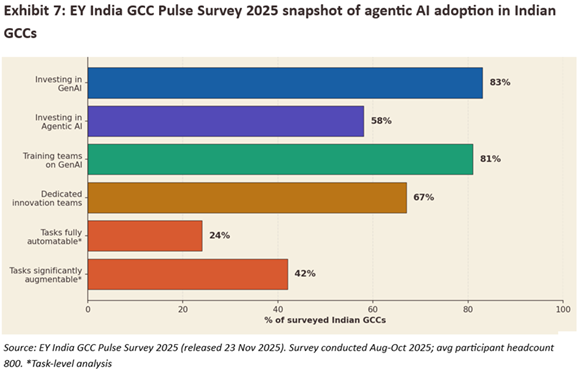
India’s IT and BPM workforce built itself on exactly the codified, English-language, knowledge-process task profile that current AI handles best. Unsurprisingly therefore, in Indian GCCs, 58% are investing in Agentic AI and 83% in GenAI, as per EY India’s GCC Pulse Survey 2025 (published in Nov ’25). EY’s task-level analysis finds 24% of enterprise tasks are fully automatable and another 42% can be significantly augmented (see exhibit below). Furthermore, as per the EY survey of GCCs, 58% of India-based GCCs are currently investing in Agentic AI and another 29% plan to scale Agentic AI within the next year. In simple terms, around 90% of GCCs in India are aiming to use Agentic AI implying that the threat to jobs is real if Agentic AI is indeed found capable of autonomously doing jobs that skilled workers currently perform.
ServiceNow’s July 2025 India report projects 1.8 crore (18 million) jobs across manufacturing, retail, and education to be impacted by 2030, against 30 lakh (3 million) new technology jobs to be created.
Investment Implications
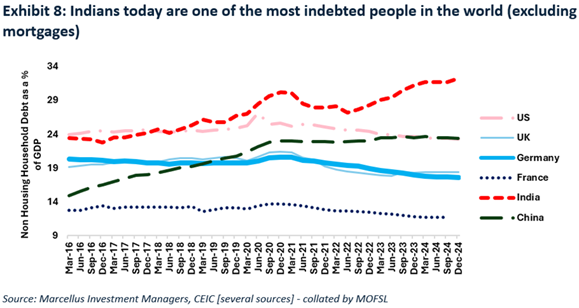
We have highlighted in our bestselling book, “Breakpoint: The Crisis of the Middle Class” that the Indian middle class is: a) more indebted today than it has ever been; b) among the most indebted groups of people anywhere in the world – see chart below; c) has seen white collar job growth evaporate in the past 3 year; and d) is seeing its real wages fall over the past decade. Against this backdrop, the rise of Agentic AI is likely to spell further trouble for the Indian middle class.
In this uncertain environment, we offer two services which could be useful.
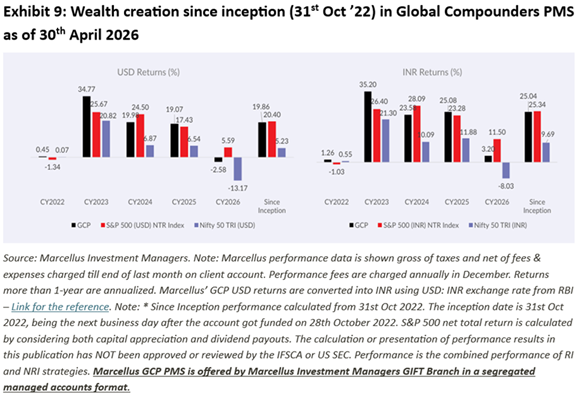
Four years ago, we began investing our clients’ monies globally from GIFT City in Gujarat. We now have multiple tax-efficient and cost-effective US$ based Global funds based out of GIFT City. Amongst other things, these Global funds, including our Global Compounders PMS (see chart below), are invested in, both, the tech hardware and software supply-chains which underpin the AI revolution.
Secondly, Marcellus has a free goal planning and asset allocation service wherein anyone can reach out to us and get a detailed 4-page financial report free of charge.
We work with a three-step approach to help our clients diversify globally:
- Map your life goals to financial goals. How much do you need for near, medium, and long-term goals
- Allocate your investments across multiple uncorrelated asset classes. Avoid over concentration, illiquidity and disproportionate risk-reward. Get the allocation right based on your needs and your risk tolerance.
- Remain disciplined. Continue to save and channel savings to investments. Review and rebalance regularly.
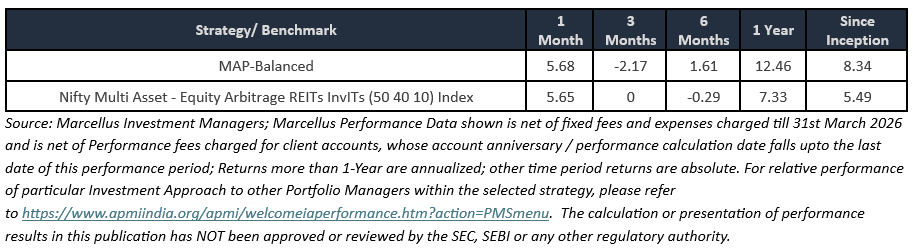
Marcellus’s ‘MAP-Balanced’ which has delivered 8.34% returns since inception in Aug-24 to April-26 net of all fees and costs against 1.47% of Nifty 500 TSR (see the chart below).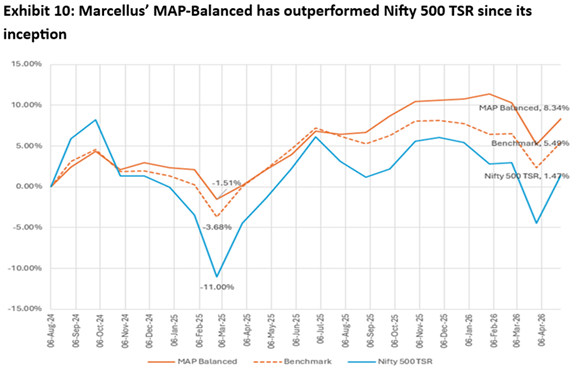
Our colleagues at Marcellus offer our clients a free asset allocation plan. To avail of this, please visit plan.marcellus.in OR scan the QR code shown below into your mobile phone.

|
Note: This tool provides guidance on asset allocation and does not constitute a financial plan or investment advice. |
|
(1) Stanford HAI 2026 AI Index Report, Chapter 4 (Economy), April 2026. (https://hai.stanford.edu/assets/files/ai_index_report_2026.pdf) (2) METR. “Time Horizon 1.1” update, 29 January 2026. metr.org/blog/2026-1-29-time-horizon-1-1/ (3) “Gartner Predicts Over 40% of Agentic AI Projects Will Be Cancelled by End of 2027,” press release, 25 June 2025. (https://www.gartner.com/en/newsroom/press-releases/2025-06-25-gartner-predicts-over-40-percent-of-agentic-ai-projects-will-be-canceled-by-end-of-2027) |