OVERVIEW
POPULAR ARTICLES

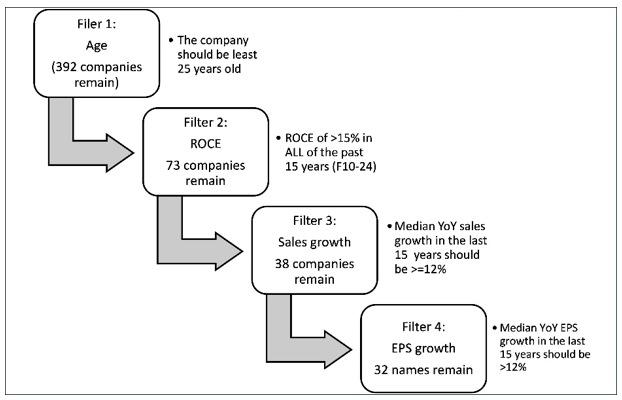
In “The Art of Enduring” we applied a set of brutal filters (see chart below) to identity the 51 best franchises in the BSE500. Reassuringly, 5 of the 7 companies from our 2016 bestseller ‘The Unusual Billionaires’ made the cut. So did 5 more franchises around whom we built the “The Art of Enduring” and most of who are a part of our portfolios. Analysing Bajaj Finance, Divi’s Labs, Dr Lals Pathlabs, Tata Elxsi and Titan in great detail over the past 3 years gave us a whole new layer of understanding regarding why a handful of exceptional franchises create enormous wealth (400-1000x) over the course of 30-50 years.
To order ‘The Art of Enduring’, click here.
To invest with us in outstanding Indian companies, visit ccp.marcellus.in
Exhibit 1: The screening process for The Art of Enduring
Source: Marcellus Investment Managers
Excellence is a better teacher than is mediocrity. The lessons of the ordinary are everywhere. Truly profound and original insights are to be found only in studying the exemplary.
—Warren Bennis, “Organizing Genius: The Secrets of Creative Collaboration”
Navratilova is the real GOAT
If you ask someone who the GOAT in tennis is, chances are you’ll hear the name of a male player. Djokovic, Federer, Sampras, Agassi or something like that. But what if the GOAT is actually amongst the women? And in our opinion that woman is Martina Navratilova.
In the Open Era in tennis, NO player, male or female, has won more singles tournaments (167), doubles titles (177) or matches (2,189) than Navratilova. But what makes her the GOAT is not that she peaked higher than others, but that she stayed at the peak the longest. She won her first grand slam in 1974 when she was about 17 years old. Her last was in 2006 a couple of months before her 50th birthday. Most athletes retire between 30 and 35. Navratilova spent almost that long winning elite titles.
So, when we set out to write a sequel to The Unusual Billionaires, first published in 2016, we aimed to find companies that matched Navratilova’s career arc. We wanted to find companies not just with the best financial performance, but the ones that sustained it for a long period of time. And out of this search came “The Art of Enduring – How Great Companies Turn Crisis into Opportunity”.
The filters, and the logic behind them
We began our search with the BSE 500 index, – the broadest, most representative cross-section of Indian businesses, from banks to chemicals to consumer goods. If greatness exists in corporate India, it should be findable here. We put these companies through a 4-step filter to find the best of the best. Since we were aiming for longevity, we set a 15-year track record of strong financial performance as the minimum threshold.
Filter one: age. We first removed every company younger than 25 years. You cannot have a fifteen-year track record if you have not been around for at least twenty-five. That single cut took the list from 500 to 392.
Filter two: profitability, every single year. Next, the heart of the test – return on capital employed (ROCE) above 15%. Not on average. Not in most years. In every single one over a fifteen-year period (FY10–FY24). Why 15%? Because a company only creates value when it earns more than its cost of capital. In India, the risk-free rate sits around 6.5% and the cost of debt around 8.5-9% using is SBI’s three-year lending rate as the proxy. The cost of equity can be inferred from long-run returns from the broader market as represented by different indices. This ranges between 12% (the 10-year CAGR on the Nifty Total Return Index) to 15% (the 20-year CAGR for the BSE500 Total Return Index) 1.. Depending on a firm’s debt-equity mix, its weighted cost of capital can run all the way up to ~14.6%. A 15% hurdle clears every one of those scenarios. Demanding it in each of fifteen years, rather than on average, is what separates the truly great from the occasionally excellent. This filter sharply narrowed down our list. The 392 survivors of the age filter included 332 companies in the non-financial sector to which the ROCE filter was applied. Only 73 survived.
Filter three: growing faster than India
A great company should outgrow the economy it operates in. So, we measured each firm’s year-on-year revenue growth across all fifteen years and took the median. This approach eliminates the distortion caused by FY21, when lockdowns pushed the median revenue growth of the non-financial companies close to zero and made roughly 40% of them shrink. The threshold, 12%, is the median growth rate of India’s nominal GDP over the same fifteen years. A company that cannot even keep pace with the economy is, by definition, losing relative ground. That narrowed 73 to 38.
Filter four: profitable growth, not growth for its own sake
Finally, we asked whether profits grew faster than revenues – that is, whether earnings per share compounded at more than the 12% revenue bar. Growth is easy to manufacture by throwing capital at the top line; growth that shows up in the bottom line, with margins widening rather than thinning, is the mark of a genuinely advantaged business. That final cut left 32 non-financial names.
For banks and other financial companies, where ROCE is the wrong yardstick, we applied a twin test using the same philosophy: return on equity above 15% in every one of the fifteen years, plus median EPS growth above 12%. Nineteen financial companies cleared it.
Why we made it more brutal
Add those together and you get 51 survivors – 32 non-financial and 19 financial – spread across seven sectors, from materials and healthcare to industrials, IT and consumer names. Fifty-one out of five hundred. Roughly one in ten of India’s biggest companies could clear the bar.
And the bar was, by design, higher than what we had set in The Unusual Billionaires. If we were going to call a company “great”, the definition of greatness had to be more stringent. The Unusual Billionaires screened over a ten-year record; here the track record demanded was fifteen years. There we set fixed growth thresholds; here we tied the growth hurdle to India’s own GDP, so the test toughens automatically as the economy grows. And, crucially, we added the profitable-growth filter – EPS outpacing revenue – that did not exist in the earlier book. One thing we pointedly did not screen on was share price – so the share price performance these companies later delivered is a genuine result, not a number we selected for.
The old guard held the line
When we reviewed the list of 51 names that cleared our 4-step filters, we found something highly reassuring. Of the seven companies we had written about in The Unusual Billionaires, back in 2016, five cleared this tougher, longer, stricter test all over again: Asian Paints, Berger Paints, Astral, Page Industries and HDFC Bank. And they cleared the bar in what was one of the toughest decade for corporate India, marked by demonetisation, GST roll out, Covid, trade wars, armed conflict and more. That is about as close to a validation of the whole method as one could hope for.
And the five new stories
From the 51 survivors, we chose five to study in depth. Diversity drove the selection: where The Unusual Billionaires had ended up entirely consumer-facing, this time we wanted B2B businesses in the mix too. Where there was more than one company from the same sector, we chose the oldest, the largest or the ROCE/ ROE leaders. And above all, we preferred to study those built on multiple sources of competitive advantage rather than a single licence or lucky niche.
The final five that made the cut are: Bajaj Finance, the consumer-lending powerhouse; Titan, which built trust into gold and watches; Dr Lal PathLabs, the quiet pioneer of Indian diagnostics; Divi’s Laboratories, an indispensable cog in the global pharma supply chain; and Tata Elxsi, the design-and-technology house that has turned near-death into reinvention more than once.
Five companies. Five very different worlds. But one common trait – compounding through decades of crisis and chaos.
Investing with us in old in boring, well-managed capital allocators
If you like the idea of investing in such companies, you should consider investing in our Consistent Compounders Portfolio (CCP as well call it). CCP consists of 20 clean, well-managed franchises with ‘Unusual Billionaire style’ moats.
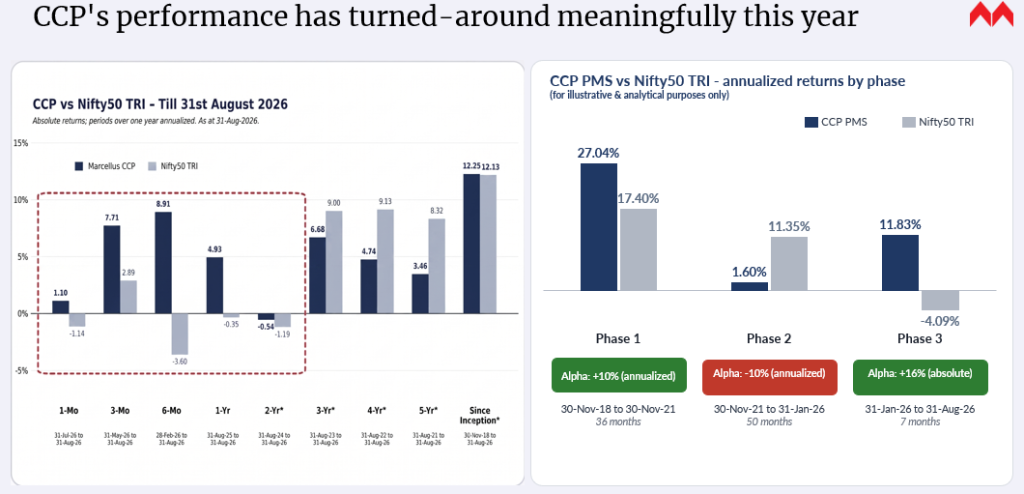
Source: Marcellus Investment Managers; Marcellus Performance Data shown is net of fixed fees and expenses charged till latest quarter and is net of Performance fees charged for client accounts, whose account anniversary / performance calculation date falls up to the last date of this performance period; since inception & 3 years returns are annualized; other time period returns are absolute. For relative performance of particular Investment Approach to other Portfolio Managers within the selected strategy, please refer https://www.apmiindia.org/apmi/welcomeiaperformance.htm?action=PMSmenu, Under PMS Provider Name please select Marcellus Investment Managers Private Limited and select your Investment Approach Name for viewing the stated disclosure. The calculation or presentation of performance results in this publication has NOT been approved or reviewed by the SEC, SEBI or any other regulatory authority.
Indeed, some of the UB companies are sitting inside CCP and compounding our wealth as we speak. After 5 blockbuster years ending Diwali 2021 when portfolio compounded at 27% p.a., CCP ran into rough weather for the next 4 years as Quality itself got hammered in India. In 2026 however Quality is back with a bang as you can see on the charts above.
CCP is available as a PMS offering from Marcellus. Indians and NRIs can invest in it with a minimum investment amount (as per SEBI’s rules) being Rs 50 lakhs.
If you would like to invest with us, please scan the QR code below or visit ccp.marcellus.in

Click Here for details about our regulatory registration and licensing information.
Disclaimer:
The above material is neither investment research, nor investment advice. Marcellus does not seek payment for or business from this material/email in any shape or form. Marcellus Investment Managers Private Limited (“Marcellus”) is regulated by the Securities and Exchange Board of India (“SEBI”) as a provider of Portfolio Management Services. Marcellus is also a US Securities & Exchange Commission (“US SEC”) registered Investment Advisor. No content of this publication including the performance related information is verified by SEBI or US SEC. If any recipient or reader of this material is based outside India and USA, please note that Marcellus may not be regulated in such jurisdiction and this material is not a solicitation to use Marcellus’s services. This communication is confidential and privileged and is directed to and for the use of the addressee only. The recipient of this material is urged to consult their own legal and tax consultants/advisors before making any investments. The recipient, if not the addressee, should not use this material if erroneously received, and access and use of this material in any manner by anyone other than the addressee is unauthorized. If you are not the intended recipient, please notify the sender by return email and immediately destroy all copies of this message and any attachments and delete it from your computer system, permanently. No liability whatsoever is assumed by Marcellus as a result of the recipient or any other person relying upon the opinion unless otherwise agreed in writing. The recipient acknowledges that Marcellus may be unable to exercise control or ensure or guarantee the integrity of the text of the material/email message and the text is not warranted as to its completeness and accuracy. The material, names and branding of the investment style do not provide any impression or a claim that these products/strategies achieve the respective objectives. Further, past performance is not indicative of future results. Marcellus and/or its associates, the authors of this material (including their relatives) may have financial interest by way of investments in the companies covered in this material. Marcellus does not receive compensation from the companies for their coverage in this material. Marcellus does not provide any market making service to any company covered in this material. In the past 12 months, Marcellus and its associates have never i) managed or co-managed any public offering of securities; ii) have not offered investment banking or merchant banking or brokerage services; or iii) have received any compensation or other benefits from the company or third party in connection with this coverage. Authors of this material have never served the companies in a capacity of a director, officer or an employee. All recipients of this material must before dealing and or transacting in any of the products referred to in this material must make their own investigation, seek appropriate professional advice and carefully read the Private Placement Memorandum/Disclosure Document, Form ADV, Form CRS and any other documents or disclosures provided to them by Marcellus, as applicable.This material may contain confidential or proprietary information and user shall take prior written consent from Marcellus before any reproduction in any form.
Note: the above material is neither investment research, nor investment advice. Marcellus does not seek payment for or business from this material/email in any shape or form. Marcellus Investment Managers Private Limited (“Marcellus”) is regulated by the Securities and Exchange Board of India (“SEBI”) as a provider of Portfolio Management Services. Marcellus is also a US Securities & Exchange Commission (“US SEC”) registered Investment Advisor. No content of this publication including the performance related information is verified by SEBI or US SEC. If any recipient or reader of this material is based outside India and USA, please note that Marcellus may not be regulated in such jurisdiction and this material is not a solicitation to use Marcellus’s services. All recipients of this material must before dealing and or transacting in any of the products and services referred to in this material must make their own investigation, seek appropriate professional advice. Past performance is not indicative of future results. Marcellus and/or its associates, the authors of this material (including their relatives) may have financial interest by way of investments in the companies covered in this material. Marcellus does not receive compensation from the companies for their coverage in this material. This material may contain confidential or proprietary information and user shall take prior written consent from Marcellus before any reproduction in any form. As per SEBI Master Circular dated June 07, 2024, clients have an option to be on-boarded directly by the Portfolio Manager without intermediation of persons engaged in distribution services. The stocks mentioned above may form part of Marcellus’ portfolio. Marcellus, its clients, and/or its employees may therefore have an interest in the said stock(s).