OVERVIEW
POPULAR ARTICLES

Google DeepMind’s success in using AI to crack protein folding (one of the hardest problems in science) has revolutionized medical research. Research that used to take decades now takes a few years. This makes it likely that the speed of new drug discovery will increase. To gain exposure to this combination of AI & medicine, other than our tech investments across the world, we have also allocated capital to American companies in the medical supply chain who are using AI adoption to drive growth.
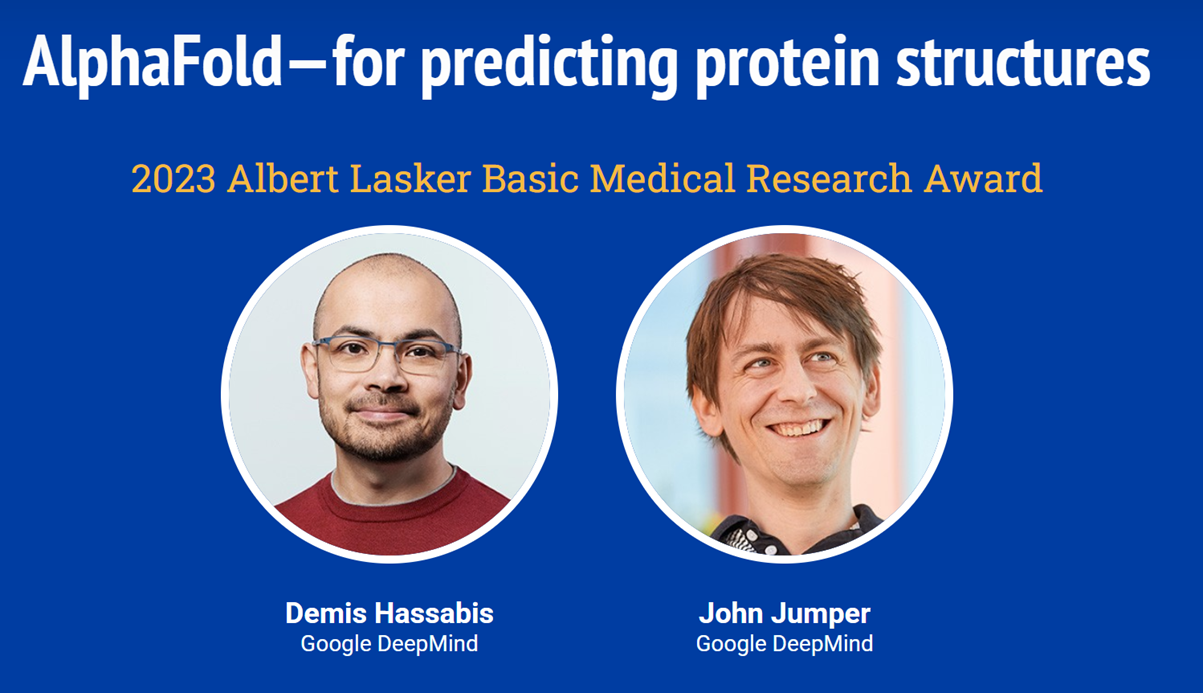
Source: Lasker Foundation
“The 2023 Albert Lasker Basic Medical Research Award honors two scientists for the invention of AlphaFold, the artificial intelligence (AI) system that solved the long-standing challenge of predicting the three-dimensional structure of proteins from the one-dimensional sequence of their amino acids. With brilliant ideas, intensive efforts, and supreme engineering, Demis Hassabis and John Jumper (both of Google DeepMind, London) led the AlphaFold team and propelled structure prediction to an unprecedented level of accuracy and speed. This transformational method is rapidly advancing our understanding of fundamental biological processes and facilitating drug design.” – Citation for DeepMind’s Nobel Prize.
Scientists estimate there are over 20,000 different proteins encoded by the human genome. Each of these proteins is in a unique linear sequence of amino acids which then fold into a functional three-dimensional shape. The task of figuring out the unique linear sequence and then the structure of the folding is known as ‘protein folding’.
Historically, protein folding was seen as one of the trickiest problems in science because a single protein chain can adopt an astronomical number of configurations, making it impossible to compute via brute force, often taking years of lab work to determine one structure. In fact, usually figuring out the structure of a single protein would be enough to get PhD in Biology. However, given that there are 20,000 different proteins, progress in figuring out protein folding was slow. In fact, this problem was given a name – Levinthal’s Paradox which posited that since a protein chain can take more shapes than there are atoms in the universe, calculating every possibility would take longer than the age of the universe.
Into this minefield, stepped in a nerd from North London who from his childhood had enjoyed solving tricky problems. Demis Hassabis was the founder of Deep Mind (a firm acquired by Google in 2014). Between 2016-20, Hassabis, his colleagues John Jumper, David Baker and Deep Mind used AI to crack the protein folding problem. How they did it is explained in this beautifully written long article complete with video interviews of the key protagonists involved in this revolutionary endeavour: How AI Revolutionized Protein Science, but Didn’t End It. Here is a summary – appropriately from Google – for those who don’t have time to read such articles:
- Deep Learning & Training Data: AlphaFold 2 was trained on public database structures of proteins (the PDB). The AI learned the fundamental physical and evolutionary principles that govern how a protein folds.
- Multiple Sequence Alignment (MSA): AlphaFold analyses the input sequence against genetic databases to find similar sequences. It interprets how the protein evolved to find structural constraints.
- Transformer Neural Networks: AlphaFold 2 uses a sophisticated AI architecture that predicts the spatial relationships (distances and angles) between pairs of amino acids.
- Iterative Refinement: Instead of simulating the physical process, the network iterates and refines its 3D predictions, improving the structure until it is highly accurate.
The average lifecycle of drug development from discovery to approval is about 10 to 12 years. And even after spending all that time and the best part of $1-2 billion on developing a single drug, there is only a 10% chance that the drug progresses from the lab to become an FDA approved marketable product.
Alpha Fold2’s success in solving protein folding meant that over the past six years AI has become central drug discovery & development. Research that used to take decades now takes years. This makes it likely that the speed of new drug discovery will increase with obvious ramifications for human well-being. Specifically, here are a couple areas where AI is transforming medical research.
Avner Schlessinge heads the AI Small Molecule Drug Discovery Center at Icahn School of Medicine at Mount Sinai. “In Schlessinger’s Mount Sinai lab, the researchers are…after new proteins involved in hard-to-treat maladies….
One of Schlessinger’s postdocs recently used a handful of ML techniques to scan the existing literature plus years of anonymous patient data from Mount Sinai to find new classes of malfunctioning proteins that are involved in diseases but have yet to be targeted….
For example, the search found a set of proteins implicated in Alzheimer’s disease, one of the hardest neurodegenerative diseases to treat because researchers don’t understand what causes it. The team eventually narrowed the list down to one very “interesting” protein to go after. “Most protein targets today belong to families called kinases or GPCRs, or G-protein coupled receptors,” Schlessinger says. “This one was a solute carrier, a class of emerging drug targets. So, you don’t see a lot of those.”
In the years to come we can expect AI to play an even more integral role in drug discovery, potentially leading to the development of personalized medicines tailored to individual patients’ genetic profiles and health conditions.
(Click https://www.youtube.com/watch?v=Ada10rHjMFU to watch our podcast on Idexx)
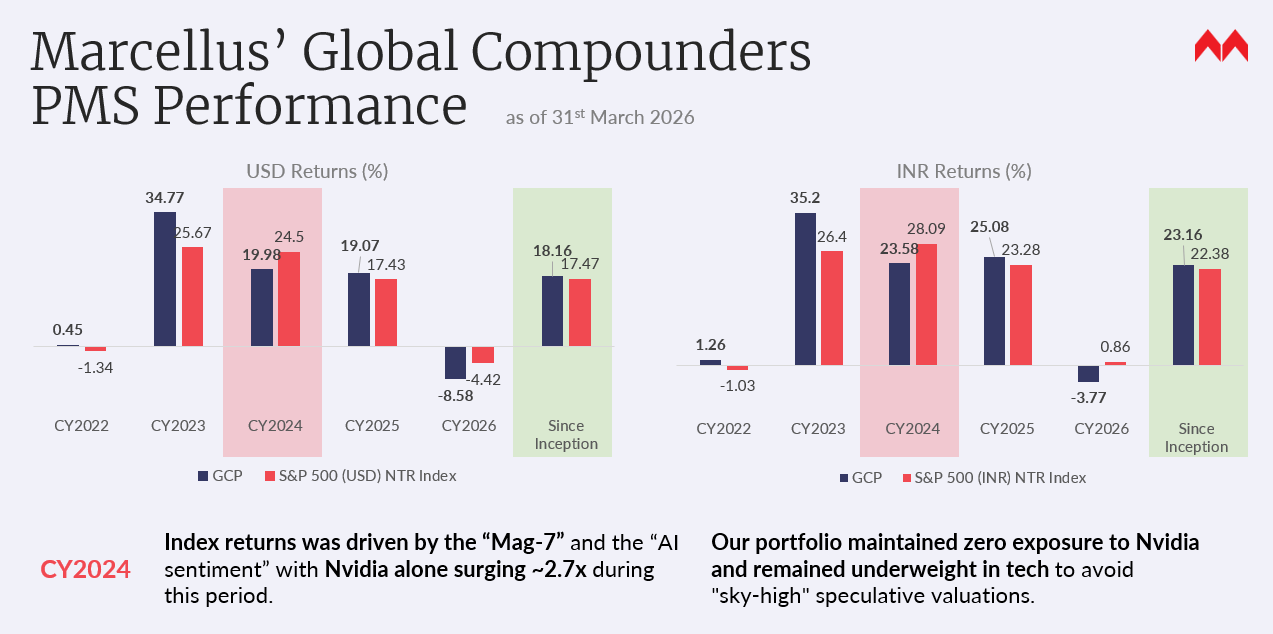
Note: * Since Inception performance calculated from 31st Oct 2022. The inception date is 31st Oct 2022, being the next business day after the account got funded on 28th October 2022. S&P 500 net total return is calculated by considering both capital appreciation and dividend payouts. The calculation or presentation of performance results in this publication has NOT been approved or reviewed by the IFSCA or US SEC. Performance is the combined performance of RI and NRI strategies.
Marcellus GCP PMS is offered by Marcellus Investment Managers GIFT Branch in a segregated managed accounts format.
Thanks
Saurabh Mukherjea
The stocks Thermo Fisher, IDEXX Laboratories, ASML, TSMC, Microsoft, Amazon, and Alphabet are part of the Global Compounders Strategy managed from GIFT City by Marcellus and regulated by IFSCA. Marcellus, its employees, their relatives, and clients have an interest in these stocks.
This material is for informational purposes only and does not constitute investment advice, an offer, or a solicitation to buy or sell any securities. Past performance is not indicative of future results. All company references are for illustrative purposes only and do not represent recommendations. Projections are based on third‑party sources and may change. Investors should consult their financial advisor before making investment decisions.