OVERVIEW
POPULAR ARTICLES

In January 2025, an AI model built by the research arm of a Chinese hedge fund, for a total compute bill of around $6mn, wiped $600bn off Nvidia’s market value in a single trading day. 18 months on, Chinese AI models have overtaken their American rivals in usage on the world’s largest open AI marketplace, whilst selling intelligence at a tenth to a hundredth of American prices. The biggest casualty of this global collapse in the price of intelligence is likely to be the labour arbitrage underpinning India’s $300bn per annum IT services industry. The biggest winners will be the businesses around the world that consume cheap computing power.
Visit connect.marcellus.in and join us in our Global Compounding journey.
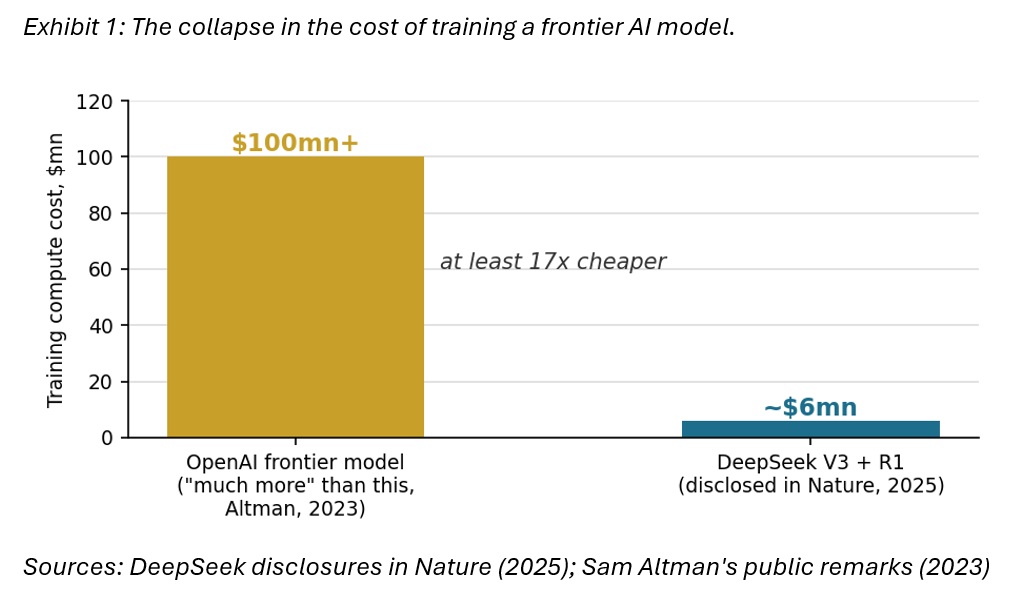
The $6mn model that humbled Silicon Valley
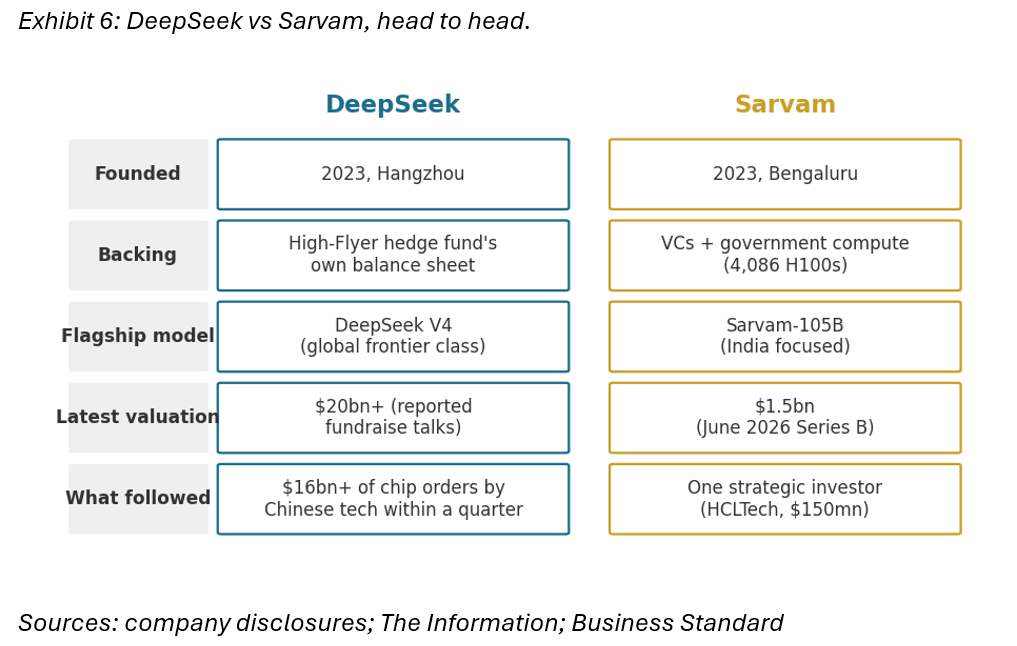
DeepSeek is a Hangzhou based AI lab spun out of High-Flyer, a quantitative hedge fund run by Liang Wenfeng. High-Flyer set up an artificial general intelligence lab in April 2023 and incorporated it as DeepSeek three months later, with the fund as its primary backer. The lab operated in near total obscurity until January 2025, when it released R1, a reasoning model that matched OpenAI’s o1 on several benchmarks and was given away as open weights for any member of the public anywhere in the world to download.[1]
What shocked the world was the bill. In a peer reviewed paper in the renowned journal, Nature, DeepSeek disclosed that the reinforcement learning stage which turned its base model into R1 cost $294,000, run on 512 of Nvidia’s H800 chips, the deliberately weakened processors Nvidia designed for China after Washington banned exports of its best hardware. Even adding the $6mn spent training the underlying base model, the total came to about $6mn.[2] Sam Altman had said in 2023 that training OpenAI’s frontier models cost “much more” than $100mn.[3] Markets drew the obvious conclusion about how much capital spending was truly necessary, and Nvidia suffered the largest one day loss of market value in stock market history [4] (see exhibit above).
Did the Chinese steal the reinforcement learning tech? OpenAI has told the US Congress that DeepSeek “distilled” its models, i.e. trained on ChatGPT’s outputs at scale, using obfuscated third-party routers to evade access restrictions.[5]
DeepSeek denies wrongdoing, and legal scholars point out that OpenAI itself trained on the open internet without asking anybody’s permission. But the deeper point stands regardless of who copied whose homework: DeepSeek’s genuine innovations in cost-efficient training, published openly for anyone to replicate, proved that the cost of AI could collapse by two orders of magnitude.
The arms race DeepSeek ignited inside China
Within a quarter of DeepSeek’s R1 launch, ByteDance, Alibaba and Tencent had placed over $16bn of orders for Nvidia’s China legal H20 chips.[6] Alibaba committed roughly $53bn of AI capex over three years and has since signalled it will overshoot that target; Tencent’s quarterly capex jumped 63% sequentially in early 2026.[7]
DeepSeek itself, having refused outside money for years, is now reportedly raising capital at valuations that climbed from $10bn to above $20bn within weeks, with Tencent, Alibaba and a state semiconductor fund circling.[8]
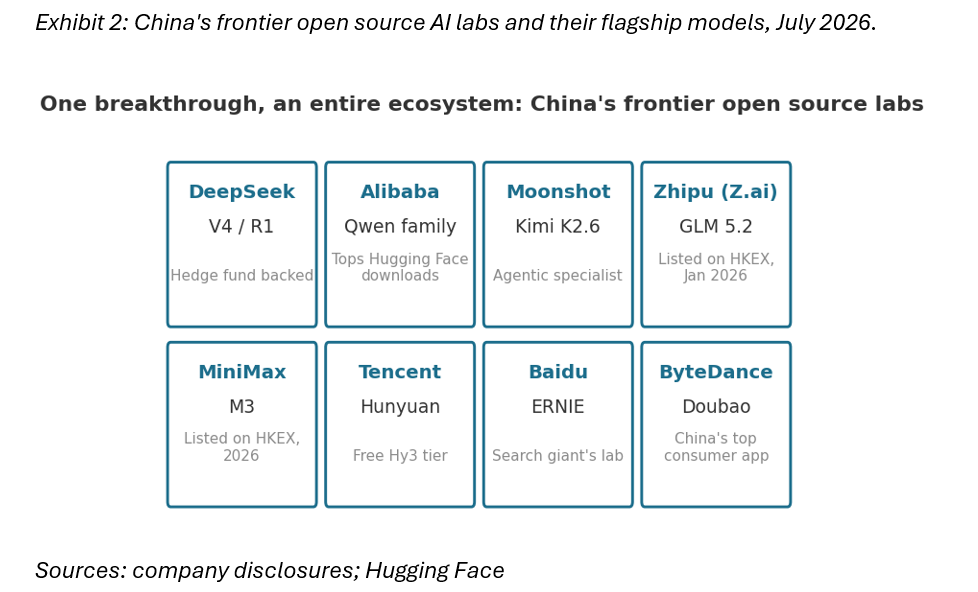
The result – roughly ten Chinese labs now ship frontier or near frontier open weight models on a quarterly cadence: DeepSeek, Alibaba’s Qwen, Moonshot’s Kimi, Zhipu’s GLM, MiniMax, Tencent’s Hunyuan, Baidu’s ERNIE and ByteDance’s Doubao among them. Two of them, Zhipu and MiniMax, listed on the Hong Kong stock exchange in 2026, becoming the world’s first publicly traded pure play AI labs. Alibaba’s Qwen family has overtaken Meta’s Llama in cumulative Hugging Face downloads, and Chinese models now account for 30% of all open model downloads globally (see exhibit below). [9]
On OpenRouter, a marketplace through which developers worldwide route their demand across hundreds of AI models, Chinese models overtook their American counterparts in usage this year.
By July 2026, the top Chinese models were processing around 23 trillion tokens a week on the platform, against roughly 4 trillion for the top American models[10] (see exhibit below).
OpenRouter’s data is a proxy for open developer demand rather than total global usage (the American giants serve most of their traffic through their own channels), but the direction of travel is unmistakable: when developers are free to choose on price and performance, they are increasingly choosing Chinese.
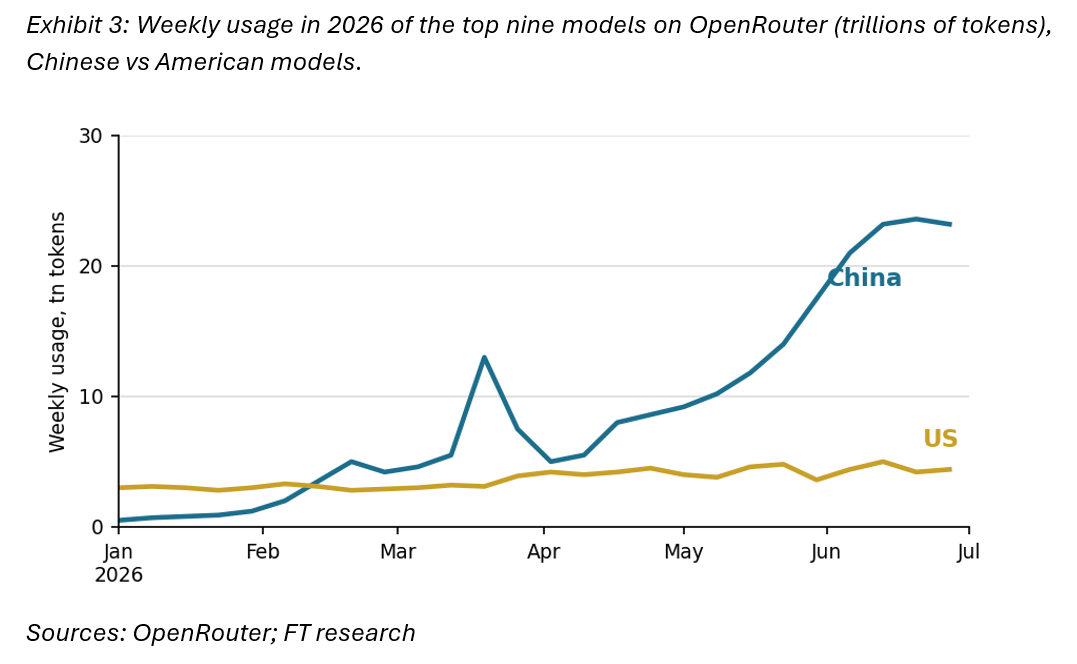
Exhibit 03: Weekly usage in 2026 of the top 9 models on OpenRouter (trillions of tokens), Chinese vs American modelsTokens at kirana store prices
AI models are priced per million “tokens”, the currency of machine intelligence. Among the nine most popular models on OpenRouter, Anthropic’s Claude Opus costs around $26 per million output tokens. Zhipu’s GLM 5.2 costs around $3. DeepSeek’s V4 Pro costs around $1, its V4 Flash variant costs pennies, and Tencent’s Hy3 is literally free[10] (see exhibit below). Industry trackers estimate that Chinese frontier models are 15 to 30 times cheaper than international peers for comparable workloads.
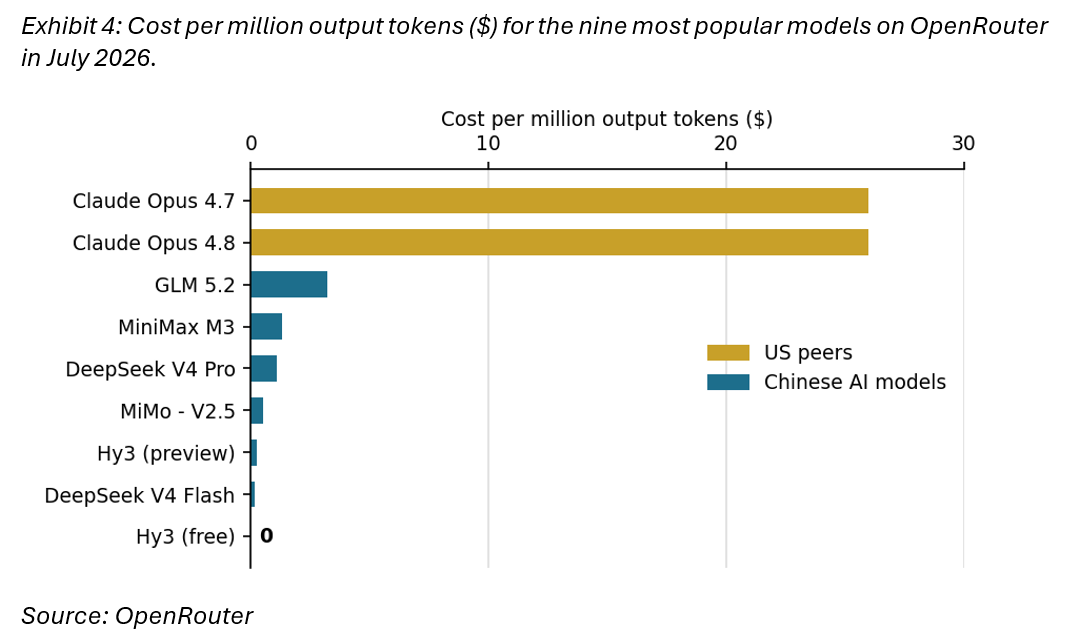
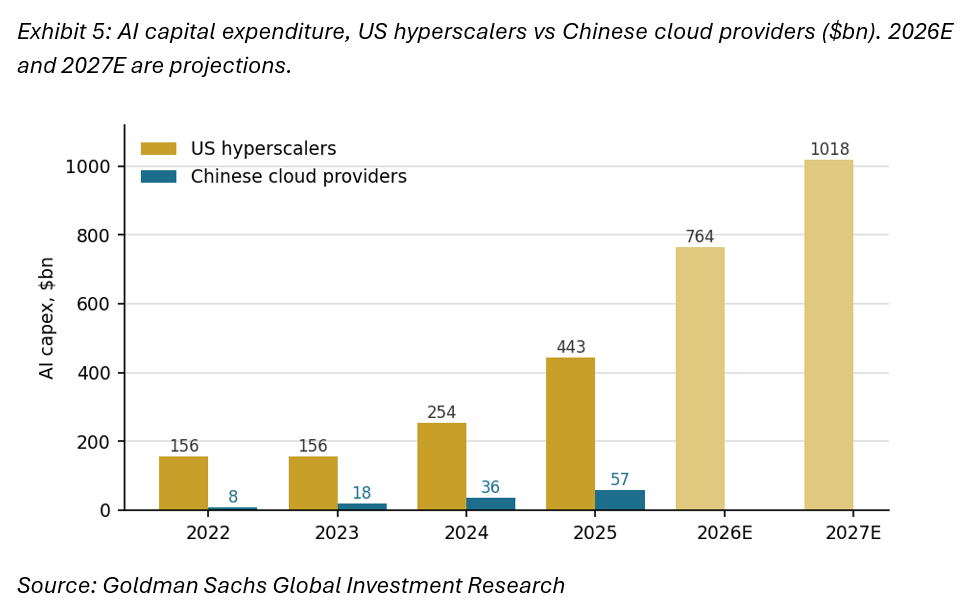
This is a direct assault on the American AI labs’ business model. OpenAI and Anthropic must recoup colossal data centre spending (Goldman Sachs projects US hyperscalers capex of $764bn in 2026 alone, against $57bn for China’s cloud providers in 2025) through premium pricing.[11]
The Chinese labs, spending a fraction of that, are happy to commoditise the very product the Americans need to sell dearly. By mid-2026, OpenAI was reportedly weighing deep cuts to its token prices in response (see exhibit below).
Price is only half the difference. The other half is openness. The leading American models are closed: you rent them through an API, and the weights stay locked in San Francisco. Most leading Chinese models are open weight, released under permissive licences that let any company download, modify and self-host them. For enterprises and governments nervous about their data leaving their borders, that is a compelling proposition, which is precisely why open source has become China’s chosen instrument of AI statecraft.
Sarvam: India’s answer, three years and several zeroes behind
India’s most prominent foundational model company is Sarvam AI, founded in Bengaluru in August 2023 by Vivek Raghavan and Pratyush Kumar, both formerly of the AI4Bharat research group at IIT Madras. Sarvam raised about $41mn in late 2023 from Lightspeed, Peak XV and Khosla Ventures, and in April 2025 the government selected it from 67 applicants to build India’s sovereign large language model under the IndiaAI Mission, handing it access to 4,086 Nvidia H100 GPUs.[13]
Sarvam has delivered. In February 2026 it unveiled Sarvam-30B and Sarvam-105B at the India AI Impact Summit, both trained from scratch on government provided compute, optimised for 22 Indian languages, and open sourced under the same permissive licence DeepSeek uses. In June 2026 it became a unicorn, raising $234mn as the first close of a $300mn Series B at a $1.5bn valuation, with HCLTech investing $150mn as strategic lead.[13]
But scale tells its own story: Sarvam’s revenue in the last reported year was about Rs 45 crore, and its 105bn parameter flagship is an order of magnitude smaller than the frontier Chinese models. Sarvam is best understood not as India’s DeepSeek but as India’s insurance policy: a sovereign fallback, not yet a global disruptor (see exhibit below).
Why India’s giants did not pile in
DeepSeek’s breakthrough triggered tens of billions of dollars of follow- on investment from China’s corporate ecosystem within months. Sarvam’s launches triggered applause, one strategic investor, and little else. Three reasons explain the gap:
- The money is different: the IndiaAI Mission’s entire budget is Rs 10,372 crore, about $1.25bn, spread over five years and seven pillars.[14] Alibaba alone is spending roughly forty times that on AI infrastructure over three years. India’s listed technology giants are services firms whose business model is selling engineering hours, not products; they have never funded speculative research at scale, and their shareholders have never asked them to.
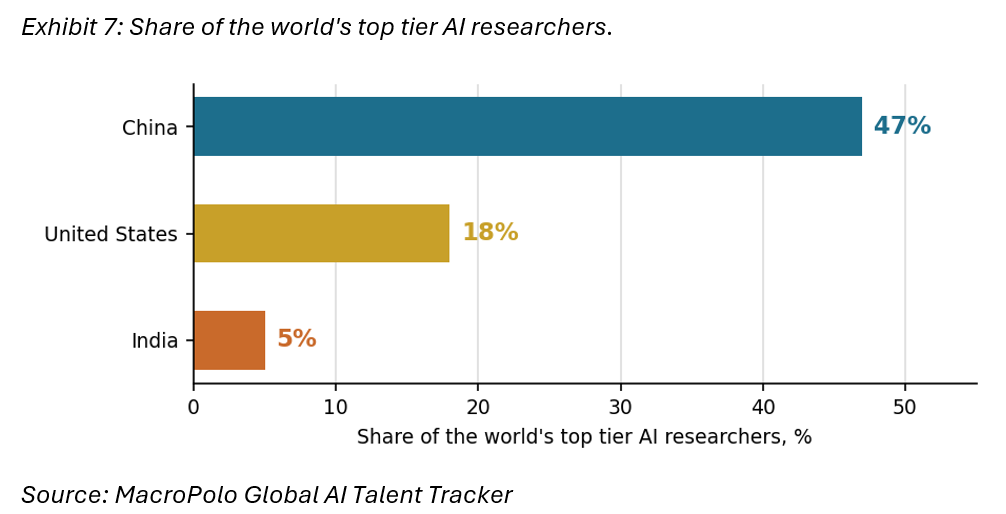
- The talent is elsewhere: by one widely cited estimate, China is home to 47% of the world’s top tier AI researchers and the US 18%; India’s share is about 5%, because our best AI researchers usually emigrate to the US to work for the American AI labs.[12]
- The market structure is different: China banned American AI products, guaranteeing domestic champions a protected home market. India’s market is open, so any Indian model must beat OpenAI, Google and now DeepSeek on merit from day one, with no runway.
India lacks the deep bench of frontier research talent, the corporate balance sheets willing to burn billions on uncertain research, the protected home market, and, perhaps most fundamentally, the industrial culture of building products rather than servicing other people’s products.
The realistic answer is that India probably will not produce a frontier DeepSeek in the next few years, but it may not need to. The Chinese labs have open sourced their crown jewels. Indian firms can take Qwen, Kimi or DeepSeek’s weights, adapt them for Indian languages and Indian enterprises, and capture much of the value at a hundredth of the cost.
What cheap tokens mean for India’s white collar workforce
If Chinese models keep crushing the price of tokens, the price of routine cognitive work falls with it, and routine cognitive work exported at a wage discount is precisely what India’s $300bn per annum IT services industry sells.
The impact of cheap Chinese computing power is already being felt in India. TCS, India’s largest private sector white collar employer, announced 12,000 job cuts in mid 2025 and finished FY26 with headcount down more than 23,000; its chairman told shareholders in June 2026 that within three years the firm could have as many AI agents as human employees.[15]
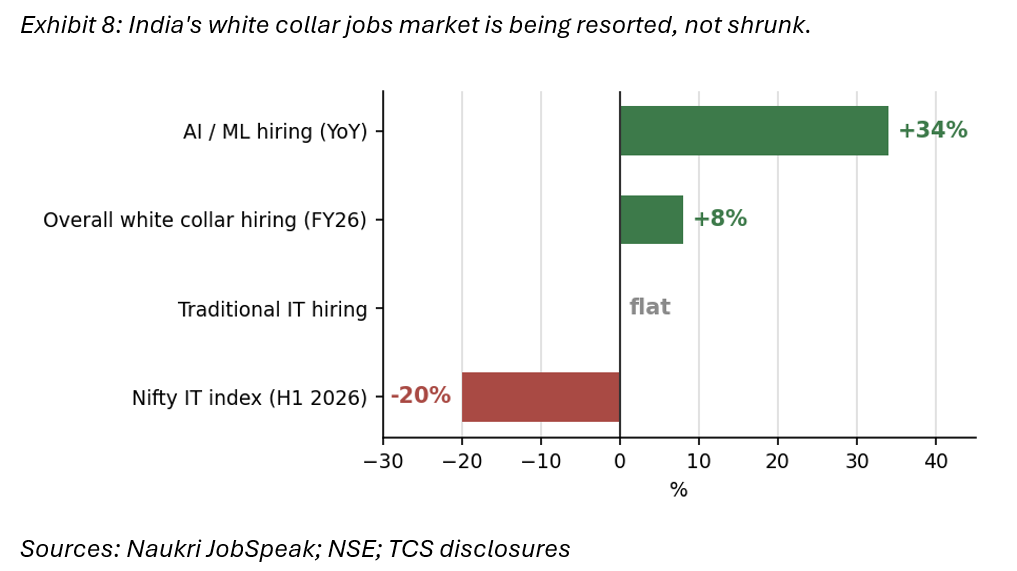
A Nasscom and Indeed study found that over a third of Indian IT companies already run AI across 40% of their core operations.[16] The Nifty IT index fell more than 20% in the first half of 2026 even as the broader market held up.
Yet the aggregate picture is more nuanced than the doom headlines: overall white collar hiring grew 8% in FY26, its best three year run on record, with AI and machine learning roles up 34% year on year while traditional IT hiring stayed flat.[17] The workforce is not shrinking; it is being violently resorted, away from the middle of the pyramid where the labour arbitrage lived, towards those who can direct machines and those whose work machines cannot yet reach (see exhibit below).
Investment implications: Don’t wait to build the boat. Board the one that is sailing.
First, be wary of business models whose margin is the gap between an Indian salary and a Western one for codified, repeatable work; that gap is exactly what token deflation will attack.
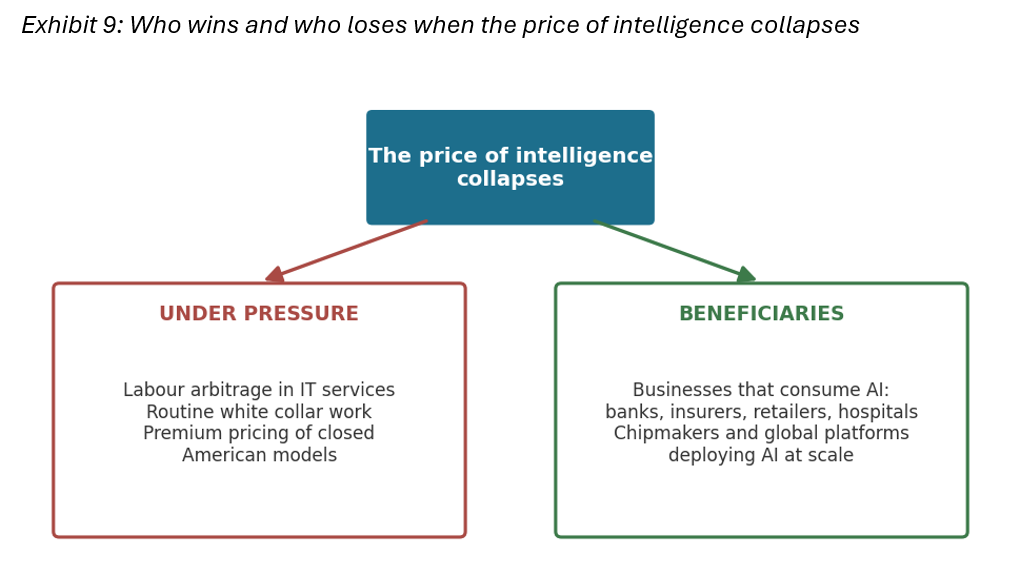
Second, when the price of an input collapses, the winners are its consumers, not its producers: cheap intelligence is a gift to Indian banks, insurers, hospitals and retailers that own distribution, customer relationships and proprietary data.
Third, to the extent the enormous profits of the AI era accrue to builders, the frontier labs, the chipmakers and the platforms deploying AI at scale sit largely outside India. Which is why Indian savers should own the world’s mightiest compounding machines rather than assume the AI dividend will arrive on the NSE by default (see exhibit below).
Marcellus offers THREE ways in which investors (resident and non-resident) can gain access to the same underlying $ assets in the form of Europe, America and East Asia’s best managed companies:
1. A US$ fund in global stocks in GIFT City with a minimum ticket size of $5,000 (Rs 4.5 lakhs). This fund is ideal for RESIDENT retail investors in India.
2. A US$ AIF in global stocks in GIFT City. This is the Alternative Investment Fund version of our Global Compounders Portfolio. Minimum ticket size is $150K. This fund is ideal for HNW RESIDENT Indians.
3. A Cayman Islands domiciled version of our Global Compounders Portfolio. This fund is only for NRIs and provides K-1 to American residents. Minimum ticket size is $100K.
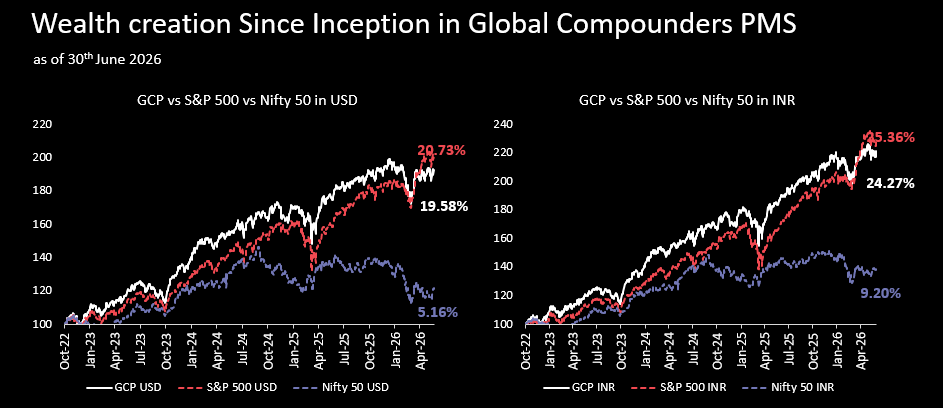
Note: Marcellus’ performance data shows the gross of taxes and net of fees & expenses charged till end of last month on client account. Performance fees are charged annually in December. Returns more than 1 year are annualized. Marcellus’ GCP USD returns are converted into INR using USD: INR exchange rate from RBI – Link for the reference
*Since Inception performance calculated from 31st Oct 2022. The inception date is 31st Oct 2022, the next business day after the account got funded on 28th October 2022. S&P 500 net total return is calculated by considering both capital appreciation and dividend payouts. The calculation or presentation of performance results in this publication has NOT been approved or reviewed by the IFSCA or US SEC. Performance is the combined performance of RI and NRI strategies. S&P 500 NTR is the benchmark for the strategy. Nifty 50 is provided for reference to illustrate the relative performance of the US and Indian markets. Past performance pertains to Marcellus’ GCP PMS strategy, not to this IFSC Retail Scheme and is not indicative of future results.
Marcellus GCP PMS is offered by Marcellus Investment Managers GIFT Branch in a segregated managed accounts format.
In our Consistent Compounders Portfolio (CCP), we invest in some of India’s biggest users of computing power – lenders, insurers, hospitals and e-commerce giants. More generally, this portfolio focuses on investing in clean, well-managed franchises providing essential goods & services to Indian households and companies. This PMS is available with a min ticket size of Rs 50 lacs.
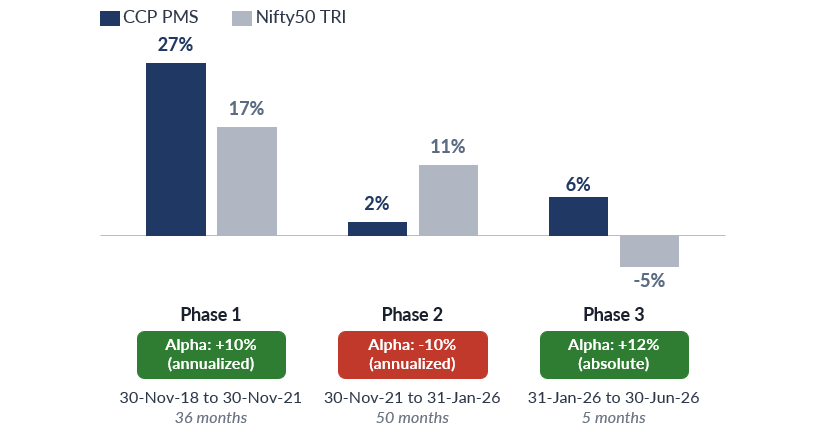
Consistent Compounders Portfolio — CCP performance vs Nifty50 TRI, by period (as of 30th June 2026)
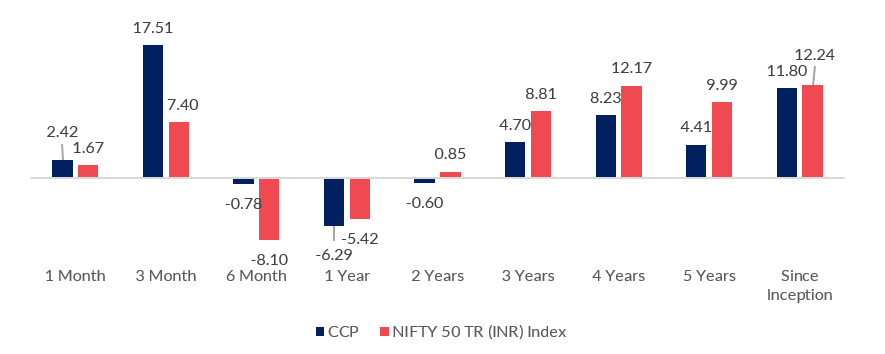
Note: Performance data for the domestic portfolio is shown net of fixed fees and expenses, and net of performance fees, charged till the last quarter end for client accounts. Short-period returns are absolute; longer-period returns are annualized. The calculation or presentation of performance results has NOT been approved or reviewed by the SEC, SEBI or any other regulatory authority. Past performance is not indicative of future results.
Marcellus also provides its clients the option to be directly onboarded, without the intervention or intermediation of any person engaged in distribution services (including distributors/referral partners)

Asset allocation shall not be considered as Investment advice.
Click here for details about our regulatory registration and licensing information.
Endnotes
[1] DeepSeek-AI, “DeepSeek-R1 incentivizes reasoning in LLMs through reinforcement learning”, Nature, September 2025
[2] Reuters, “China’s DeepSeek says its hit AI model cost just $294,000 to train”, September 2025; The Register, September 2025; DeepSeek-V3 technical report, December 2024
[3] CNN Business, “China’s DeepSeek shook the tech world”, September 2025, citing Sam Altman’s 2023 remark that frontier model training cost “much more” than $100mn
[4] Reuters, “DeepSeek sparks global AI selloff, Nvidia loses about $593 billion of market value”, January 2025
[5] Bloomberg, “OpenAI accuses China’s DeepSeek of distilling US AI models to gain an edge”, February 2026; OpenAI memo to the US House Select Committee on China, 12 February 2026
[6] The Information / Reuters, “ByteDance, Alibaba and Tencent order $16 billion of Nvidia H20 chips”, April 2025
[7] South China Morning Post, “Alibaba, Tencent present a tale of two strategies for AI spending”, May 2026; company earnings disclosures
[8] The Information, “Tencent, Alibaba in talks to invest in DeepSeek at $20 billion-plus valuation”, April 2026
[9] Hugging Face download data, as compiled by Inference Hub, “Chinese frontier open-source AI models in 2026”, April 2026
[10] OpenRouter weekly model usage and pricing data; FT research, July 2026
[11] Goldman Sachs Global Investment Research, US and China hyperscaler capex estimates, 2026
[12] Bloomberg Opinion (Andy Mukherjee), “DeepSeek is India’s final call to board the AI flight”, February 2025, citing MacroPolo Global AI Talent Tracker data
[13] Sarvam AI company announcements, February 2026 (Sarvam-30B and Sarvam-105B launch at the India AI Impact Summit) and June 2026 (Series B); Business Standard, February 2026
[14] Ministry of Electronics and Information Technology, Government of India, IndiaAI Mission cabinet approval, March 2024; India AI Impact Summit disclosures, February 2026
[15] Reuters, “Indian tech company TCS to cut workforce by 2%”, July 2025; TCS FY26 disclosures and Annual General Meeting remarks, June 2026
[16] Nasscom and Indeed, report on AI adoption in Indian IT companies, January 2026
[17] Naukri JobSpeak index releases, January to June 2026
Disclaimer:
This material is for informational purposes only and does not constitute investment advice or research. Marcellus Investment Managers Private Limited (“Marcellus”) is regulated by the International Financial Services Centres Authority (IFSCA) as a Fund Management Entity (Retail) and offers Retail and Non-Retail products and is registered with the U.S. Securities and Exchange Commission (SEC) as an Investment Advisor. The PMS strategy, Category III AIF products (non-retail schemes), and IFSCA retail schemes are distinct offerings with different regulatory frameworks, risk profiles, fee structures, and investment thresholds. Minimum investment amounts referenced (e.g., ~US$5K) are applicable to specific IFSCA retail schemes and may not apply to PMS or Category III AIF products. Investors should refer to product-specific documents for details before investing. This communication is not a solicitation in jurisdictions where Marcellus is not regulated. It is confidential and intended solely for the addressed recipient; unauthorized use or distribution is prohibited. Investors should carefully read the Disclosure Document, Form ADV, Form CRS and any other documents or disclosures provided to them by Marcellus, as applicable. Actual results may differ materially from those suggested in this note due to risks or uncertainties associated with our expectations with respect to, but not limited to, exposure to market risks, general economic and political conditions globally, inflation, etc. Information provided is based on data available at the time of preparation and may change without notice. Marcellus makes no representation regarding accuracy or completeness and assumes no obligation to update. Recipients should rely on their own judgment and consult independent legal, tax, and financial advisors before making any investment decisions. Investments are subject to market risks and uncertainties. This material may include “forward looking statements”. All forward-looking statements involve risk and uncertainty. Any forward-looking statements contained in this document speak only as of the date on which they are made. Past performance is not indicative of future results, and there is no assurance that investment objectives will be achieved. Marcellus, its affiliates, employees, and authors may have financial interests in securities discussed. To the fullest extent permitted by law, Marcellus disclaims all liability arising from the use of this material. This is not meant for US investors.