OVERVIEW
POPULAR ARTICLES

In our new book “The Art of Enduring: How Great Companies Turn Crisis into Opportunity”, Divi’s Labs is one of the five extended case studies. The stock also happens to be one of earliest holdings of Marcellus’ Consistent Compounders Portfolio which owns around 20 high quality Indian companies. CCP’s wealth creation track record since inception in 2018 is highlighted at the end of this blog. If you would like to invest with us in such portfolios, contact us via ccp.marcellus.in
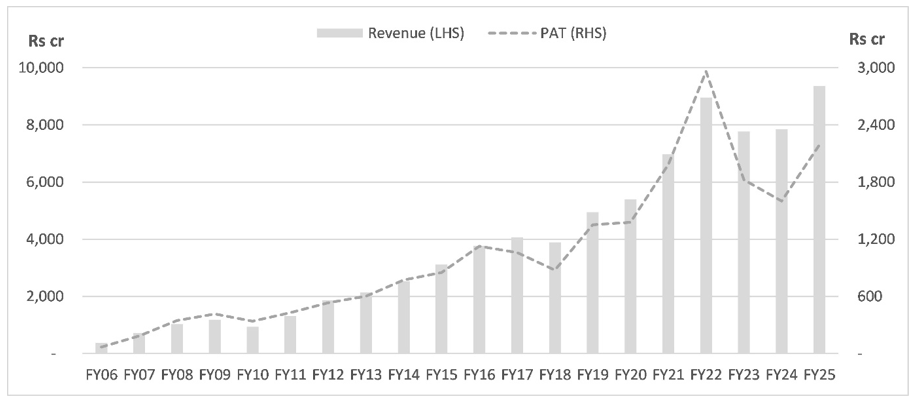
Exhibit 1: Divis has grown revenues and PAT at a CAGR of 18% and 20%, respectively, over 19 years
Why write about Divi’s Labs, a low profile 36-year old Hyderabadi company?
‘The most valuable resource in any business is management attention, especially the attention of high-level management. This attention should not be squandered on a range of unfocused or inappropriate objectives or consumed by endless discussions about the proper direction for the firm’ – Bruce Greenwald & Judd Kahn, Competition Demystified
There comes a time in the life of almost every successful company, when the temptation to do more comes knocking. Emboldened by the success achieved in one thing, entrepreneurs or managers think they have cracked the formula to replicate those achievements in doing something else. Why not forward integrate and juice up profit margins? Or, why not buy a smaller competitor and defray fixed costs across a higher revenue base?
The smart companies, however, resist that pull. They pick one unglamorous layer of their industry, become the best in the world at it, and then refuse to climb “up the value chain,” even when the move looks obvious. Divi’s Laboratories is a textbook example of this. Founded in 1990 by Dr Murali Divi, they make active pharmaceutical ingredients (API) which is the core chemical compound inside a pill or a tablet that actually treats a patient’s condition. And in all its years of existence, they have steadfastly refused to get into formulations, the branded and generic pills that patients consume. Even though that is a larger market, and arguably the more glamourous one where your product could be a household name – like a Benadryl or Crocin or Ozempic.
In our new book, The Art of Enduring, we discuss in detail the story of Divis and how its refusal to get into formulations is a key source of competitive advantage. The passages that follow are excerpts from the book.
“APIs are the core of any medicine, branded or generic. Hence, the lower the cost of an API, the higher the profit margins. This enables the pharma company to invest in other areas – such as R&D for innovators (to make drugs with exclusive selling rights) and scale for generic manufacturers (since pricing is the only differentiator for them in the market).”
“Since inception, Divis has played a complementary role for its clients and has never competed with them in the formulations segment. The majority of the other contract manufacturing companies in India have either divisions or associate companies where they also compete with clients in the end market. As a result, the innovator companies are wary of loss of intellectual property despite having non-disclosure agreements in place with their suppliers. Divis does not have any conflict of interest vis-à-vis its clients and hence, there is higher trust while doing technology transfer and sharing product-level intellectual property by innovator clients. A statement from their FY07 annual report is indicative of the company’s approach. It reads, ‘From the very inception of manufacturing operations, the company committed itself to respecting intellectual property and playing a complementary role to its innovator customers thus ensuring a consistent business in custom synthesis.’”
“Divis…produces at humongous scale and the benefit is shared with clients through globally competitive prices for these APIs.”
“In terms of capital allocation, Divis sticks to its core competencies and only adds projects that are in adjacencies from medicine-related APIs. Divis forayed into contrast media APIs that are not consumed for therapeutic benefit but are administered for better imaging through X-ray, CT and MRI. Even in this foray, Divis initially stuck to its core competence of iodine chemistry that has been with it for several years and made a big push in FY22 when visibility on contracts and competitive advantages was high.”
“Divis is a very conservative company, and it is very focused and selective in foraying into any project or segment. Due to these attributes, historically, the company has incurred capex only when it has either strong visibility on client contracts or high conviction on garnering market share in any new product.”
What we learnt from writing about Divi’s Labs?
Divi’s focus is the foundation of the trust it has built with its customers. A contract manufacturer that also sells finished drugs is a competitor in disguise. Hand it your molecule and you are handing a rival your intellectual property. A company that makes only APIs, and has publicly staked its identity on never going further, is just a partner. That is why the world’s largest innovator pharma companies are willing to share their most sensitive chemistry with Divi’s. This restraint is the moat.
What is remarkable is that the discipline is not a one-time decision but something held through more than three decades. Because Divi’s ploughs its profits back into the same line of business rather than scattering them across new ventures, it has built genuine global cost leadership. And when it does expand, it expands only into true adjacencies – contrast-media APIs built on its existing iodine chemistry – never into the tempting leap of formulations. Saying no to profitable and glamorous growth is in itself a competitive advantage. In fact it is one of the threads that runs through all five companies studied in the book.
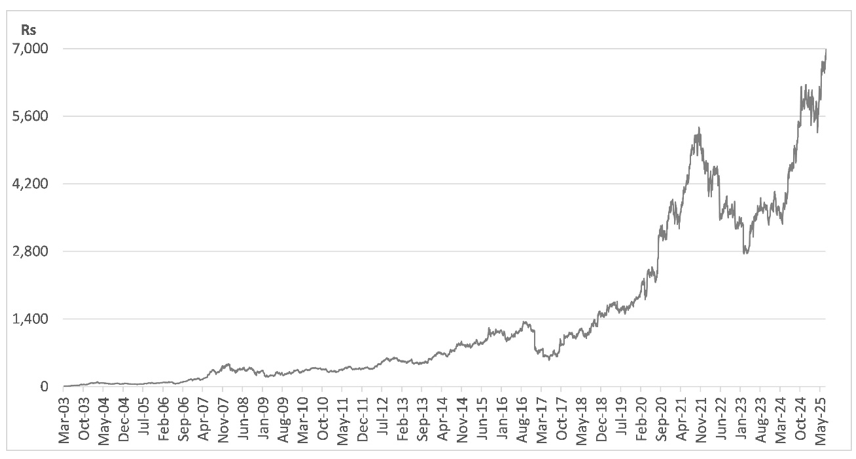
The market has rewarded the discipline handsomely. A rupee invested in Divi’s at its 2003 IPO would have grown to roughly Rs 773 by mid-2025 – a compound annual return of about 35%, nearly twenty-nine times what the Sensex delivered over the same period.
It is the quietest of lessons, and one of the hardest to live. Greatness often lies not in the things a company chooses to do, but many a times in things it deliberately chooses not to.
Exhibit 2: Between its IPO in 2003 and June 2025, Divis’s share price has compounded at a rate of 35%
Why does this matter to you?
If you like the idea of investing in such companies, you should consider investing in our Consistent Compounders Portfolio (CCP as well call it). CCP consists of 20 clean, well-managed franchises with ‘Unusual Billionaire style’ moats.
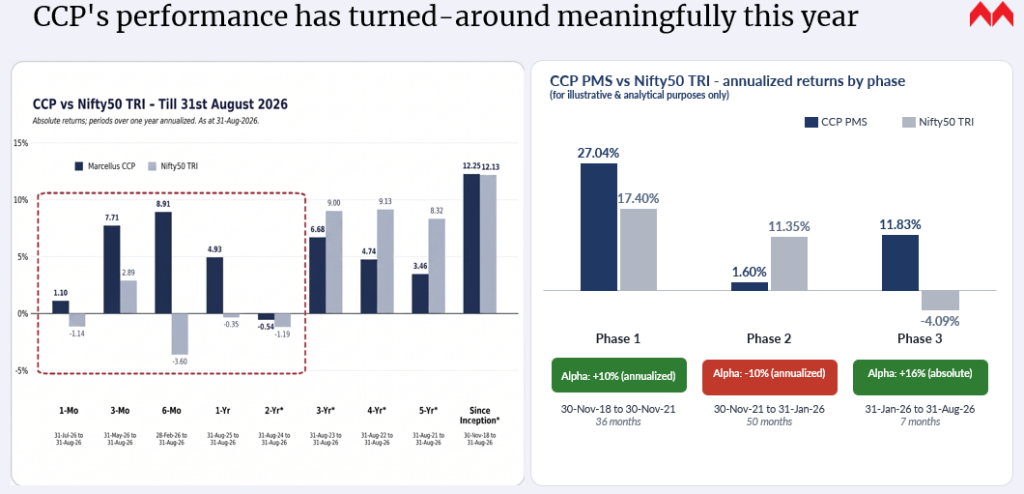
Source: Marcellus Performance Data shown is net of fixed fees and expenses charged till latest quarter and is net of Performance fees charged for client accounts, whose account anniversary / performance calculation date falls upto the last date of this performance period; since inception & 3 years returns are annualized; other time period returns are absolute. For relative performance of particular Investment Approach to other Portfolio Managers within the selected strategy, please refer https://www.apmiindia.org/apmi/welcomeiaperformance.htm?action=PMSmenu, Under PMS Provider Name please select Marcellus Investment Managers Private Limited and select your Investment Approach Name for viewing the stated disclosure. The calculation or presentation of performance results in this publication has NOT been approved or reviewed by the SEC, SEBI or any other regulatory authority.
ndeed some of the UB companies are sitting inside CCP and making us richer as we speak. After 5 blockbuster years ending Diwali 2021 when portfolio compounded at 27% p.a., CCP ran into rough weather for the next 4 years as Quality itself got hammered in India. In 2026 however Quality is back with a bang as you can see on the charts above.
CCP is available as a PMS offering from Marcellus. Indians and NRIs can invest in it with a minimum investment amount (as per SEBI’s rules) being Rs 50 lakhs.
If you would like to invest with us, please scan the QR code below OR visit ccp.marcellus.in

Disclaimer:
Click Here for details about our regulatory registration and licensing information.
The above material is neither investment research, nor investment advice. Marcellus does not seek payment for or business from this material/email in any shape or form. Marcellus Investment Managers Private Limited (“Marcellus”) is regulated by the Securities and Exchange Board of India (“SEBI”) as a provider of Portfolio Management Services. Marcellus is also a US Securities & Exchange Commission (“US SEC”) registered Investment Advisor and is regulated by the International Financial Services Centres Authority (IFSCA) as a Fund Management Entity. No content of this publication including the performance related information is verified by SEBI, IFSCA or US SEC. If any recipient or reader of this material is based outside India and USA, please note that Marcellus may not be regulated in such jurisdiction and this material is not a solicitation to use Marcellus’s services. The PMS strategy, Category III AIF products and IFSCA retail schemes are distinct offerings with different regulatory frameworks, risk profiles, fee structures and investment thresholds. Investors should refer to product-specific documents for details before investing. All recipients of this material must, before dealing and or transacting in any of the products and services referred to in this material, make their own investigation and seek appropriate professional advice. Past performance is not indicative of future results. Marcellus and/or its associates, the authors of this material (including their relatives) may have financial interest by way of investments in the companies covered in this material. Marcellus does not receive compensation from the companies for their coverage in this material. This material may contain confidential or proprietary information and user shall take prior written consent from Marcellus before any reproduction in any form. Clients have an option to be on-boarded directly by the Portfolio Manager without intermediation of persons engaged in distribution services.
# This tool is designed to help users explore products and asset allocation guidance; it does not constitute a formal financial plan or investment advice.