Marcellus Investment Managers - One of the Best Portfolio Management Service Companies in India
  • Region
    India USA
  • Our Philosophy
  • Offerings

    Portfolio Management Services (PMS)


    Indian Equities
    Consistent Compounders Rising Giants Little Champs Kings of Capital MeritorQ PMS Curation Portfolio
    Global Equities
    Global Compounders PMS
    Global Equities Fund (Retail)
    Multi Asset
    Multi Asset PMS

    Asset Allocation Services


    Asset Allocation        

    Portfolio Advisory Services


    Indian Equities
    MeritorQ Advisory (Smallcase)        
    Multi Asset
    Aggressive Allocation Balanced Allocation Conservative Allocation
  • Insights

    Newsletters


    Consistent Compounders Kings Of Capital Little Champs Rising Giants Marcellus Erudite MeritorQ PMS Global Compounders

    Insights


    Recents Blogs Newsletters Portfolio Updates 3 Longs and 3 Shorts

    Videos


    Featured Webinars Client Exclusive

    Podcasts


    All MeritorQ Podcasts (English) MeritorQ Podcasts (Hindi)
    Client Exclusive Content

    Others


    Client Exclusive Content Three Longs & Three Shorts Blogs Videos Media Centre
  • Resources
    Support Resources Online Access Guide Marcellus’ Forms UPI Payment
    Disclosure document GIFT City Disclosure PMS Fees Calculator
  • Team
  • PLAN YOUR GOALS
    • Invest Now
      • Portfolio Management Services (PMS)
      • Investment Advisory Services
      • Global Equities Fund (Retail)
  • Subscribe
  • Connect
  • Login
  1. Newsletter
  2. April 2025
Apr 2025 MeritorQ PMS

MeritorQ: Minimizing Risk by Focusing on Errors of Commission

Published on Apr 14, 2025 · 3 Min Read

Balancing the trade off between errors of commission and errors of omission in stock picking is essential to any investing process. In this newsletter we explain why these two errors are NOT created equal and usually portfolio hit rate is more sensitive to errors of commission. MeritorQ‘s rigorous rules-based screening steps in which we reject nearly 80% of the investment universe, ensures that we minimize risk by focusing on errors of commission, even as we forego some of the upside due to errors of omission.
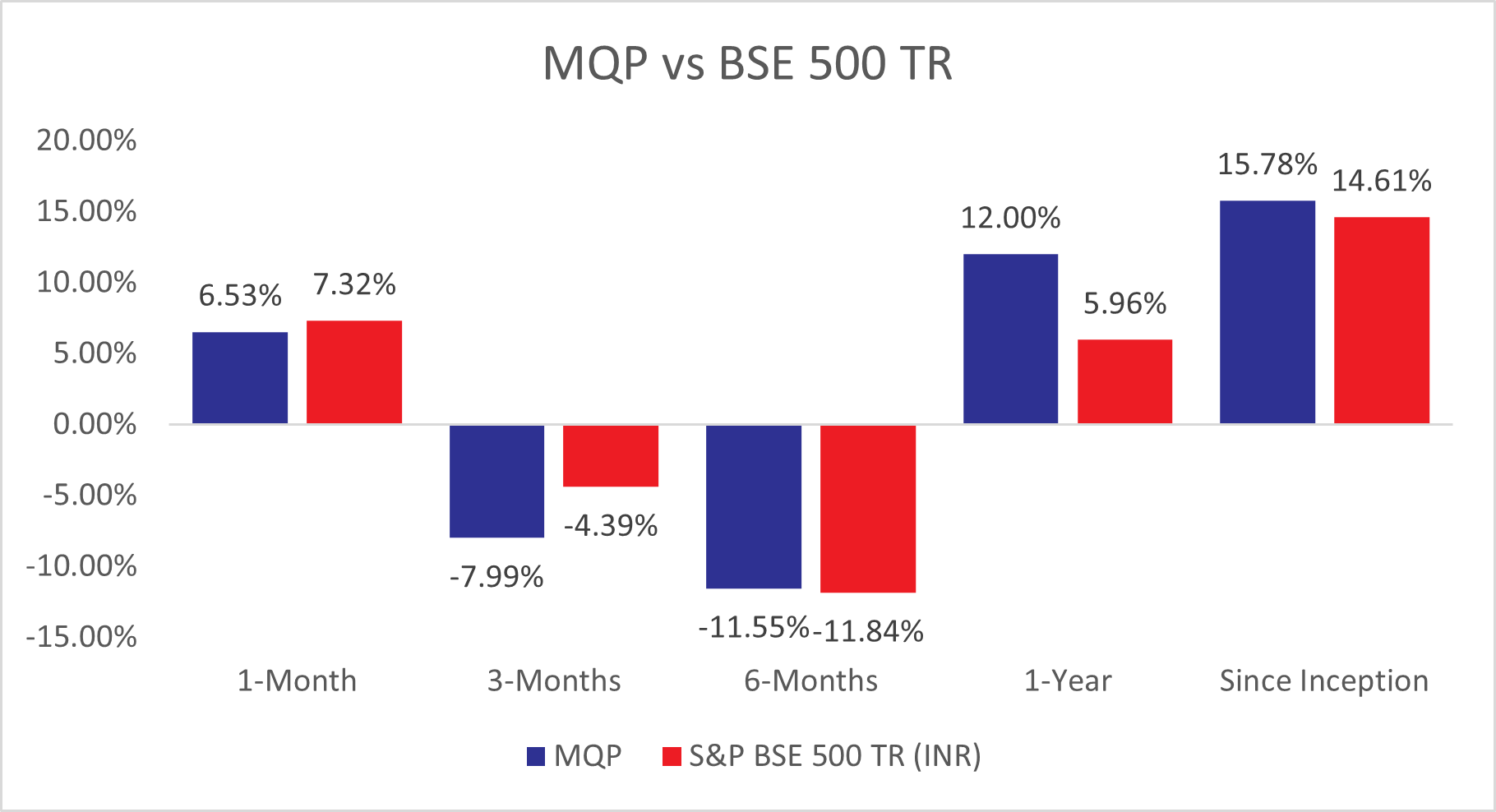
MeritorQ PMS Performance - March 2025

Source: Marcellus Investment Managers. (i) Portfolio inception date is November 15, 2022. (ii) Returns shown are as of March 31, 2025.Performance Data shown is net of fixed fees and expenses charged till March 31st, 2025 and is net of Performance fees charged for client accounts, whose account anniversary / performance calculation date falls upto the last date of this performance period; since inception & 3 years returns are annualized; other time period returns are absolute.For relative performance of particular Investment Approach to other Portfolio Managers within the selected strategy, please refer  https://www.apmiindia.org/apmi/welcomeiaperformance.htm?action=PMSmenu, Under PMS Provider Name please select Marcellus Investment Managers Private Limited and select your Investment Approach Name for viewing the stated disclosure. The calculation or presentation of performance results in this publication has NOT been approved or reviewed by the US SEC, SEBI or any other regulatory authority.


“Rule No. 1: Never lose money.

Rule No. 2: Never forget Rule No. 1.” – Warren Buffett (source: link)

One of the core tenets of MeritorQ’s investment approach is to reduce the risk of making investments where there could be permanent loss of capital. Investing errors can be broadly classified into two distinct buckets: errors of commission and errors of omission, which are also called as Type 1 and Type 2 errors, respectively.

• Type 1 Errors (Errors of Commission): This occurs when an investor makes an investment, believing it will be profitable, but it ultimately turns out to be loss making (whether in absolute terms or relative to the benchmark). It is the act of committing capital to a bad investment, resulting in self-inflicted harm. In the medical profession, this is called a ‘false positive’.

• Type 2 Errors (Errors of Omission): This arises when an investor fails to invest in an opportunity that subsequently generates significant returns. It is the error of rejecting a potentially beneficial investment. In the medical profession, this is called as a ‘false negative’.

The Inherent Trade-off Between Type I and Type II Errors

Minimizing the likelihood of committing a Type I error (making bad investments) often increases the probability of making a Type II error (missing good investments), and vice versa. An overly optimistic investor, inclined to see potential upside in numerous ventures, may commit several Type I errors by investing in flawed businesses. However, this same optimism might lead them to participate in a higher proportion of genuinely successful investments, thus reducing Type II errors.

Conversely, an overly cautious investor, perpetually scrutinizing potential downsides and finding reasons to reject opportunities, is likely to make fewer Type I errors by avoiding bad investments. However, their stringent selectivity will inevitably cause them to miss out on some genuinely good investments, increasing the incidence of Type II errors. This inherent trade-off necessitates a conscious decision on the part of the investor regarding which type of error they are more willing to tolerate.

Let’s assume an investment universe of 500 stocks similar to what we consider in MeritorQ. Further assume, that 30% of these or 150 companies are “good investments”. This is not too far from empirical evidence and our own analysis, which shows that on an average only ~35% of stocks in the BSE 500 outperformed the index over subsequent 10 years.  From the 150 “good” companies, an investor whose Type II error rate is 20%, will correctly select 80% (120 good companies) as good investments and mistakenly reject 20% (30 companies- a Type II error). From the remaining 350 “bad” investments, assuming the type I error rate is again 20%, the investor will correctly reject 80% (280 companies) and mistakenly accept 20% (70 companies- a Type I error).

Therefore, the investor’s universe of what they think are good investments comprises the 120 correctly identified good investments plus the 70 mistakenly identified bad investments, totalling 190 companies.

The actual probability of a chosen investment being good is then calculated as the number of correctly identified good investments divided by the total number of investments the investor believes to be good: 120 / 190 = 63% (this can be the considered the investor’s hit rate). Hence, even with a seemingly impressive 80% accuracy rate, ~37% of the investor’s investments will turn out to be bad. The underlying reason is the disproportionately large number of “bad investment” opportunities relative to good ones available in the market.

Exhibit 1 shows the asymmetrical impact of reducing each type of error on an investor’s overall success rate, with the same assumptions as detailed in the hypothetical example above.  As Type I error rate increases from 10% to 40% (keeping Type II error at 20%)- the investor’s hit rate decreases from 77% to 46%.  Conversely, if Type II error rate increases from 10% to 40% (keeping Type I error at 20%)- investor’ hit rate decreases by only about 10 pts.  The steeper slope of the hit rate versus Type I error (compared to Type II error; orange versus blue line) means that every 1% change in errors of commission has relatively larger impact on hit rate than errors of omission.
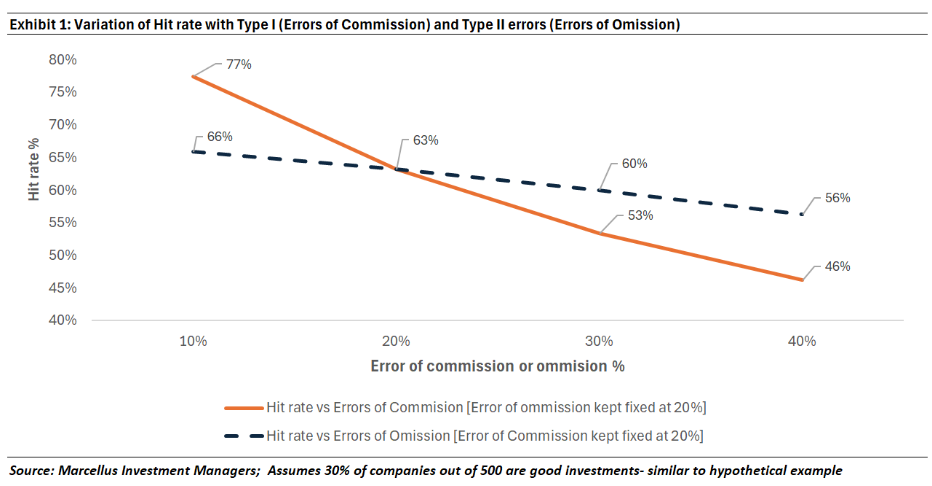
Exhibit 1: Variation of Hit Rate with Type 1(Errors of Commission) and Type 2(Errors of Omission) errors

Given the inverse relationship between the Type I and II errors, the practical implication is that investors should pay greater attention to avoiding losers than worry about the foregone benefits from having missed identifying future outperformers. For example, as exhibit 2 shows, controlling Type I error at 20% even with Type II error at 40% is more acceptable, than the converse case (shown highlighted).
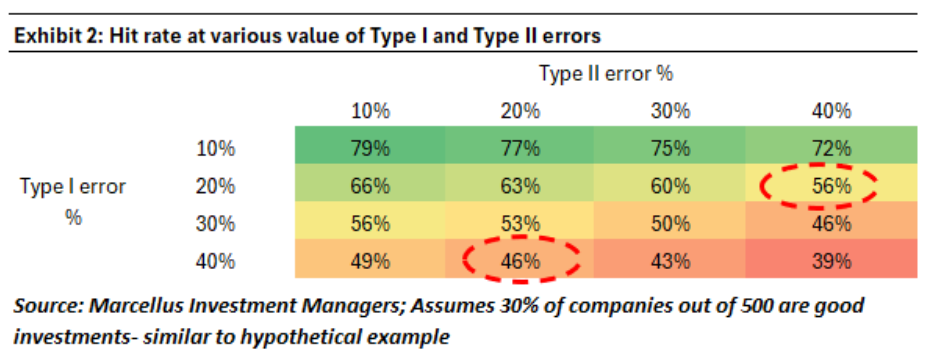
Exhibit 2: Hit rate at various value of Type 1 and Type 2 errors

We have not considered the investment time horizon. Empirical study across countries has shown fewer proportion of companies outperform the market as the time horizon increases. This means with increasing investment horizon, the proportion of “bad” investments (we assumed this to be 70% in the hypothetical example), in overall market opportunity set increases, making the hit rate more sensitive to Type I errors for longer time horizons.

In this context, the screening steps in MeritorQ, in which we reject roughly ~80% of the investment universe before selecting basis value and quality, helps us in reducing the Type I errors at the cost of missed opportunities.

  • About half of the rejections (~200 companies) are due to the forensic screening step where we remove companies with accounting irregularities based on financial disclosures. The forensic screen penalizes companies in sectors where there is higher chance of poor accounting quality like real estate, infrastructure and industrials.  More details on forensic screening can be found in our February-2023 and March-2023 newsletters.
  • We also remove companies with high debt and inconsistent profitability Excessive leverage increases vulnerability to unforeseen events and economic downturns (though it can also boost of return on capital in short run). Over last decade, one can find numerous examples of high debt companies (ADAG group companies, Essar Steel etc.) going bankrupt.  
  • The consistent profitability screen ensures that we avoid highly cyclical companies (mostly in oil & gas, metals/mining sectors), turnaround situations and companies in new age industries with no previous track record of profitability. Though there is a risk that we miss out on next multi-bagger with this screen, we think we are better off looking elsewhere and avoiding speculative bets, where downside could be equally large.
The final portfolio is selected from the 80-100 companies which survive all the above screening steps. Finally, before each rebalance, the portfolio after selection step, is also vetted by Marcellus team for any unquantifiable corporate governance risks (promoters with doubtful integrity, shady history etc.) and any such identified company is completely removed from the portfolio. Arguably, MeritorQ’s quantitative, rules-based approach further minimizes errors of commission during screening due to cognitive errors and biases, though we risk ignoring good investments due to lack of flexibility.

Hence, MeritorQ’s rules-based multi-step screening process reflect a conscious decision to prioritize the risk minimization by avoiding Type I errors, even if it means potentially sacrificing some high-return opportunities in the future.

Regards,
Team Marcellus
If you want to read our other published material, please visit https://marcellus.in/
Disclaimer:

 The above material is neither investment research, nor investment advice. Marcellus does not seek payment for or business from this material/email in any shape or form. Marcellus Investment Managers Private Limited (“Marcellus”) is regulated by the Securities and Exchange Board of India (“SEBI”) as a provider of Portfolio Management Services. Marcellus is also a US Securities & Exchange Commission (“US SEC”) registered Investment Advisor. No content of this publication including the performance related information is verified by SEBI or US SEC. If any recipient or reader of this material is based outside India and USA, please note that Marcellus may not be regulated in such jurisdiction and this material is not a solicitation to use Marcellus’s services. This communication is confidential and privileged and is directed to and for the use of the addressee only. The recipient of this material is urged to consult their own legal and tax consultants/advisors before making any investments. The recipient, if not the addressee, should not use this material if erroneously received, and access and use of this material in any manner by anyone other than the addressee is unauthorized. If you are not the intended recipient, please notify the sender by return email and immediately destroy all copies of this message and any attachments and delete it from your computer system, permanently. No liability whatsoever is assumed by Marcellus as a result of the recipient or any other person relying upon the opinion unless otherwise agreed in writing. The recipient acknowledges that Marcellus may be unable to exercise control or ensure or guarantee the integrity of the text of the material/email message and the text is not warranted as to its completeness and accuracy. The material, names and branding of the investment style do not provide any impression or a claim that these products/strategies achieve the respective objectives. Further, past performance is not indicative of future results. Marcellus and/or its associates, the authors of this material (including their relatives) may have financial interest by way of investments in the companies covered in this material. Marcellus does not receive compensation from the companies for their coverage in this material. Marcellus does not provide any market making service to any company covered in this material. In the past 12 months, Marcellus and its associates have never i) managed or co-managed any public offering of securities; ii) have not offered investment banking or merchant banking or brokerage services; or iii) have received any compensation or other benefits from the company or third party in connection with this coverage. Authors of this material have never served the companies in a capacity of a director, officer or an employee. All recipients of this material must before dealing and or transacting in any of the products referred to in this material must make their own investigation, seek appropriate professional advice and carefully read the Private Placement Memorandum/Disclosure Document, Form ADV, Form CRS and any other documents or disclosures provided to them by Marcellus, as applicable.

The stocks described about in the presentation do form the part of our Marcellus’ portfolio so we as Marcellus, our clients and our immediate relatives do have interest and stakes in the described stocks. The described stocks are for illustration purpose only and not recommendatory.

This material may contain confidential or proprietary information and user shall take prior written consent from Marcellus before any reproduction in any form.

Regards, Team Marcellus

If you want to read our other published material, please visit https://marcellus.in/pms-investment-blog/


Copyright © 2026 Marcellus Investment Managers Pvt Ltd, All rights reserved


RELATED NEWSLETTERS

  • Aug 12, 2026

    Marcellus Portfolio Updates & Insights – August 2026

    READ MORE
  • Aug 06, 2026

    Global Compounders: Why have we underperformed the S&P500 in 2026?

    READ MORE
  • Jul 27, 2026

    Isaac Newton and the Madness of Men

    READ MORE

RELATED NEWSLETTERS

  • Aug 12, 2026

    Marcellus Portfolio Updates & Insights – August 2026

    READ MORE READ MORE
  • Aug 06, 2026

    Global Compounders: Why have we underperformed the S&P500 in 2026?

    READ MORE READ MORE
  • Jul 27, 2026

    Isaac Newton and the Madness of Men

    READ MORE READ MORE
PREV ISSUE

Navigating our Rising Giants through the SMID Meltdown


Published on Mar 31, 2025
NEXT ISSUE

Portfolio Performance and Update on Fundamentals - April 2025


Published on Apr 16, 2025

Did`t receive OTP? 00:00 Resend
Be the First to Know

Marcellus logo

At Marcellus, our Purpose is to make wealth creation simple and accessible by being trustworthy and transparent capital allocators.

  • Twitter-Marcellus Investment
  • LinkedIn-Marcellus Investment

Marcellus Investment Managers Private Limited

Please reach out to us at

Board Line : 0806-9199-400

Sales Desk: 0806-9199-401

e-mail: invest@marcellus.in


Marcellus Investment Managers
102, First Floor, Boston House, Suren Road,
Near 'Western Express Highway' Metro Station,
Andheri East, Mumbai 400093

Please reach out to us at

e-mail: help.gift@marcellus.in


Marcellus Investment Managers
IFSC Branch – Unit no. 431 and 432, Signature Building, Fourth Floor, Block 13B, Zone-1, GIFT SEZ, GIFT City, Gandhinagar – 382 355/382 050

  • Home
  • Our Team
  • Invest with us
  • GIFT City Corporate Disclosures
  • Marketing Disclosure
  • Investing Books
  • FAQs
  • Videos
  • Newsletters
  • Corporate Regulatory Disclosure
  • Company Information
  • Terms & Conditions
  • Privacy Policy
  • Responsible Investing
  • Contact Us

2026 © | All rights reserved.

Privacy Policy | Terms and Conditions

Please read the following carefully and select your residency jurisdiction


If accessing this website by giving false declaration, the person shall be solely liable/responsible for any adverse consequences suffered, legally as well as financially, pursuant to use of any information contained in this website

Beware of fraudulent websites and applications!

Marcellus or its employees will never ask you to join WhatsApp groups or social media accounts created by or on behalf of Marcellus. Marcellus does not have any App facilitating trading in securities, nor does Marcellus issue any advertisement for investment in any specific stocks or for any cash transactions.

If you come across any such activity, please report to the appropriate law enforcement authorities, and inform us on compliance@marcellus.in.

Click here for the list of our official social media handles.

Close