Marcellus’ Global Compounders Portfolio (GCP) strategically invests in ~40 deeply moated global companies aligned with megatrends, with an aim to provide steady earnings growth and shareholder wealth compounding. Our underperformance vs S&P500 in 2026 has played out in two parts – in line until Feb’26 and underperformance post that. Two factors explain the underperformance: 1) The momentum driven rally in AI adjacent names fueled by near-term shortages in the ecosystem; and 2) The lack of investor interest in companies with steady earnings compounding. In-line with our view that AI is a potentially transformative technology, rather than chasing momentum we’ve invested in businesses where the AI opportunity can add to an existing earnings engine, rather than businesses where the entire investment case depends on the continuation of an AI-driven shortage. In short, the recent underperformance reflects what the market has rewarded, not what our companies earned. While we cannot predict when this gap will close, our portfolio’s stronger earnings growth at a comparable valuation gives us confidence that the portfolio is well-positioned for normalization.
Portfolio performance:
Exhibit 1: Global Compounders Portfolio performance (until 30th June 2026)
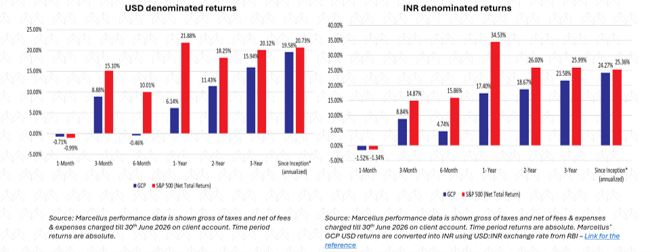
Source: Marcellus Investment Managers Note: * Since Inception performance calculated from 31st Oct 2022. The inception date is 31st October 2022, being the next business day after the account got funded on 28th October 2022. S&P 500 net total return is calculated by considering both capital appreciation and dividend payouts. The calculation or presentation of performance results in this publication has NOT been approved or reviewed by the IFSCA or US SEC. Performance is the combined performance of RI and NRI strategies.
The last newsletter laid out an overview of the “AI will change everything” narrative and how it has led to increasing frothiness in the broader AI linked technology ecosystem. This newsletter goes a little deeper into the weeds, as we try and answer some of the most pertinent questions around where we stand and why?
What data suggests frothiness in the US markets?
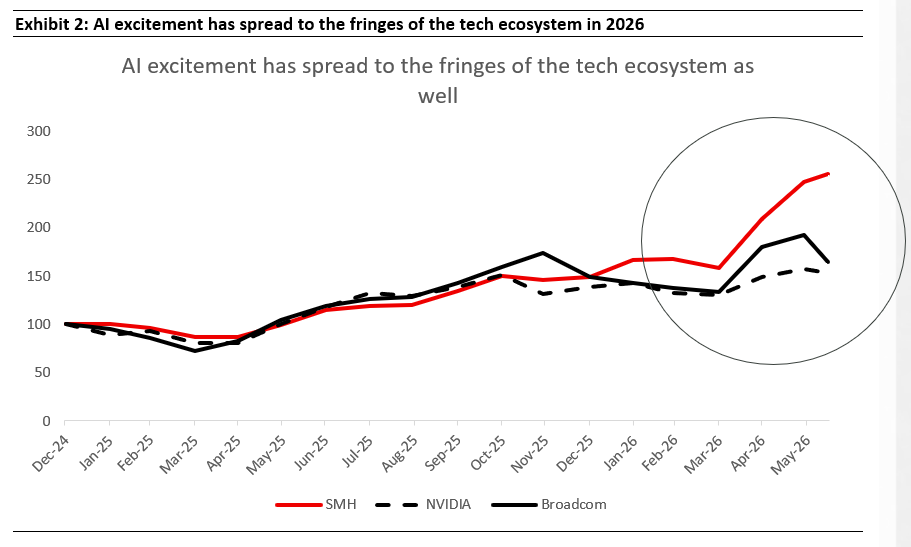
The chart below is reproduced from our previous newsletter and shows how the VanEck Semiconductor ETF (SMH) has outperformed the more foundational AI names like Nvidia and Broadcom – especially over the 3 months from April-June 2026.
Exhibit 2: AI excitement has spread to the fringes of the tech ecosystem in 2026
Source: Bloomberg
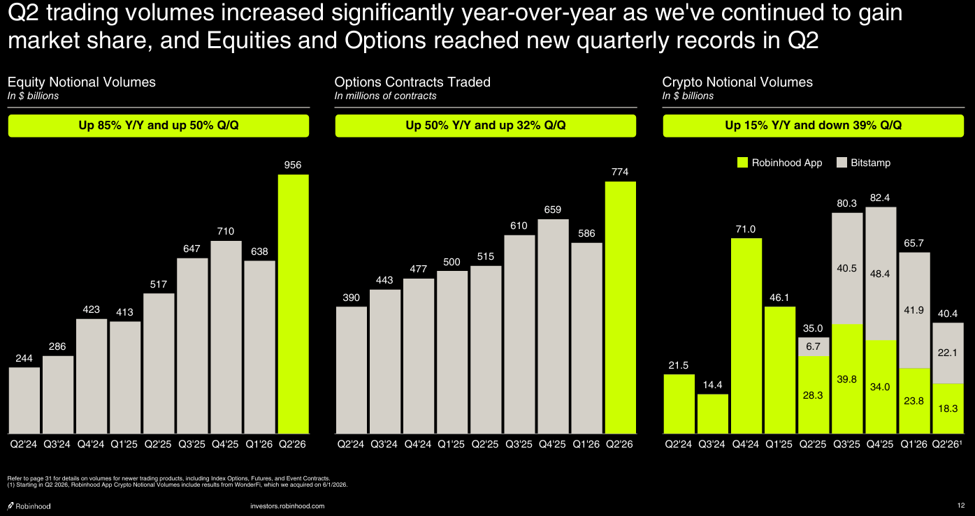
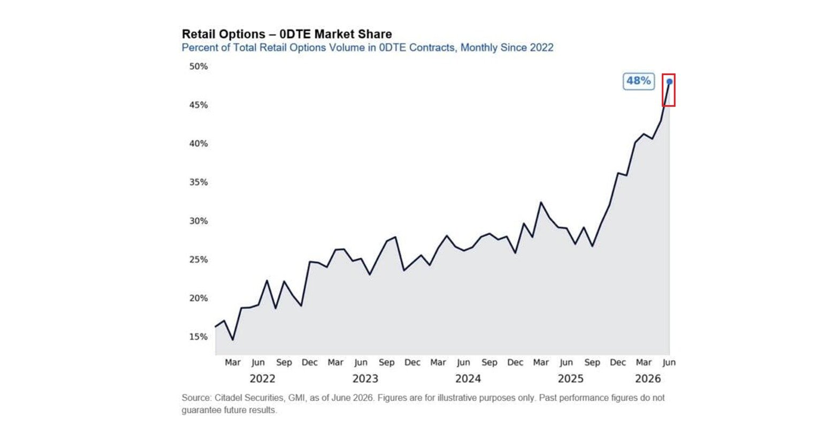
The increased excitement around the AI theme from retail investors is visible in the numbers published by brokers like Robinhood who’ve been a key beneficiary of the retail participation in the US equity market. It is also visible in the increase in volume of daily expiry option contracts traded on the CBOE exchange.
Exhibit 3: Retail trading activity increased substantially in June 26 quarter
Source: Robinhood
Exhibit 4: Same day expiry options (0DTE) now account for almost half of retail option volumes
Source: The Kobeissi Letter (@Kobeissiletter on X)
Why do we think the names which ran up during this period warrant scepticism?
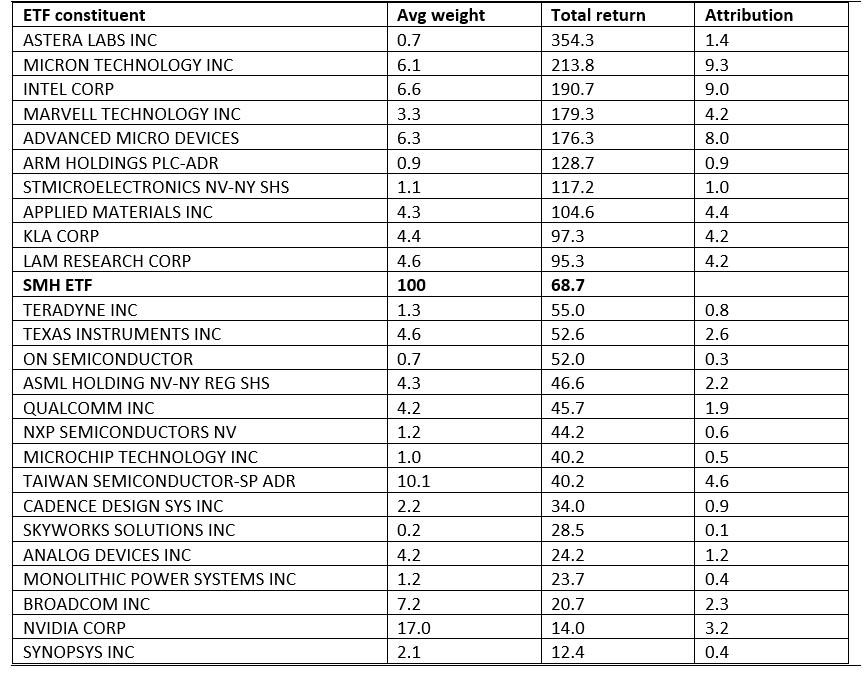
Some of our clients have asked us why we believe the SMH ETF’s outperformance is led by not-so-great scrips. Before we do that, lets break down the returns from SMH (~69% from 01 April’26 to 30 Jun’26) into the various index constituents.
Exhibit 5: SMH returns attribution from April’26 to Jun’26
Source: Bloomberg
Two of the largest companies in SMH are Nvidia and Broadcom – the largest suppliers of AI chips in the world. They delivered 85% and 48% revenue growth in the quarter ended April respectively. Despite the growth, they trade at 23x and 20x CY2027 PE respectively vs 30x for the median name in SMH as of 20th July 2026.
Despite the valuation discount and growth, Nvidia and Broadcom were two of the three worst performing stocks in SMH in the June Quarter. This is reflecting the “bottleneck trade” where investors are specifically going after smaller suppliers into the AI supply chain seeing shortages. Players which supply to these two leaders are companies like Astera and Micron, which are two of the best performing stocks in SMH. Similarly, companies in the CPU space provide complementary hardware of AI workloads and are seeing shortages as a result, driving much better than SMH share price performance.
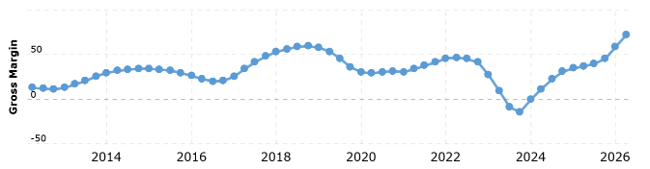
Some of these bottleneck trade names often command much higher multiples (for example Intel at 62x CY27 PE as of July 20th 2026) or have a much more chequered financial history with current margins representing new peaks (for example, look at the history of Micron’s gross margins below).
This aggressive shift towards bottleneck names over the past quarter makes us worry about the AI cycle. Some of these worries are showing up in Korea in July with the benchmark index, which is dominated by the two memory players, down ~34% MTD as of 30th July.
Exhibit 6: Micron gross margins (TTM)
Source: Macrotrends
Why have we underperformed the S&P500? Why do we own some AI adjacent stocks vis-à-vis others in S&P500?
Our underperformance over the past few months has not been caused by a deterioration in the earnings of the companies we own. In fact, portfolio earnings growth has remained resilient and, in several cases, have exceeded our expectations. The difference has largely come from what the stockmarket chose to reward.
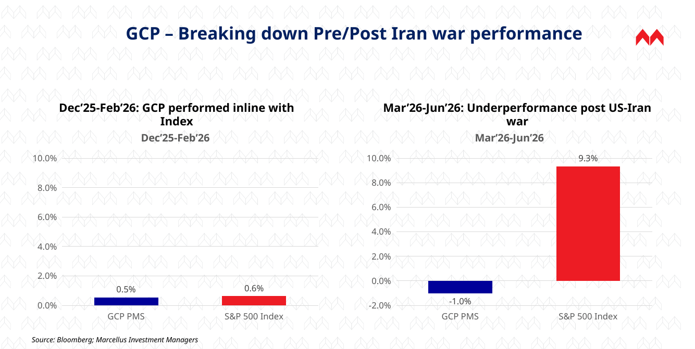
From December 2025 through February 2026, GCP performed broadly in line with the S&P 500. Most of the subsequent underperformance emerged between March and June, following the US-Iran conflict. A few assumptions underpinning our positioning did not play out as expected – US bond yields rose by around 50 basis points, oil prices became significantly more volatile, developed markets outside the US weakened, and AI-related stocks continued to outperform sharply. Aerospace, one of our largest overweight positions, also became a meaningful drag during this period.
Exhibit 7: The YTD GCP underperformance has been concentrated post the US- Iran conflict
Errors of omission: the cost of not owning momentum (Primarily the AI Trade)
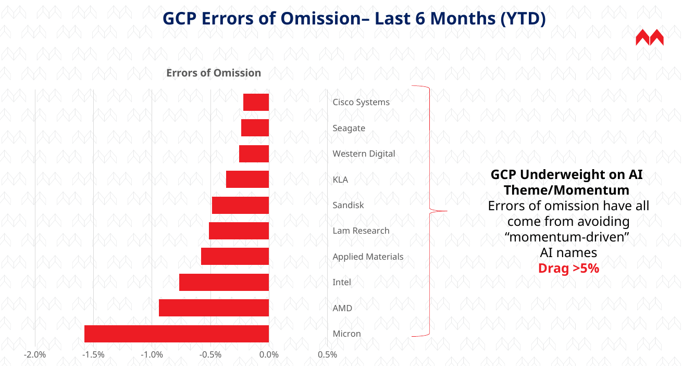
That said, we lost more than 5% points of relative performance because we did not own several of the strongest momentum-driven semiconductor names, including memory companies, chip-equipment manufacturers and businesses perceived to be benefiting from shortages across the AI supply chain. These were errors of omission from a performance perspective, even though avoiding many of these stocks was a conscious decision based on our assessment of valuation, cyclicality and the sustainability of current earnings.
The largest omissions were not Nvidia and Broadcom. As discussed in the previous section, they were primarily more cyclical and bottleneck-driven parts of the ecosystem, where the market rapidly recognised near-term shortages into long-duration earnings expectations.
Exhibit 8: Errors of omission were concentrated in momentum-driven AI and semiconductor names
Errors of commission: where our holdings hurt
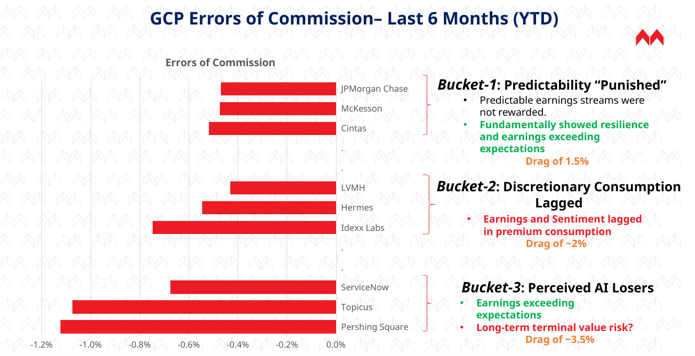
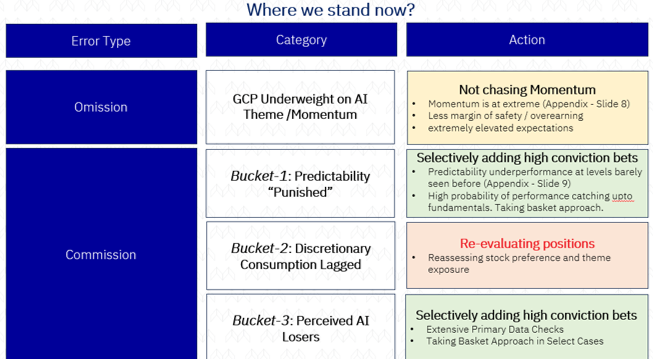
Our owned positions also detracted from relative performance. Importantly, however, the weakness did not arise from one common fundamental problem. It was scattered across three distinct buckets:
- Predictability was punished. Cintas, McKesson continued to demonstrate resilient operating performance, but their dependable earnings streams were not rewarded in a market focused on AI exposure. This is the bucket where we have the greatest confidence that stock prices can catch up with fundamentals over time.
- Premium and discretionary consumption lagged. In companies such as Hermès and LVMH, both earnings momentum and investor sentiment weakened. We do not assume that every laggard will recover simply because it has underperformed. We are reassessing our stock preferences and the portfolio’s exposure to this theme.
- Perceived AI losers de-rated. ServiceNow, Topicus, Constellation Software, and some of the underlying holdings of Pershing Square (e.g. Uber) were marked down as investors questioned whether AI could impair their long-term terminal value, even where current earnings were resilient or ahead of expectations. We are selectively adding only where our conviction in the underlying economics remains high.
This distinction matters. Some of the underperformance appears disconnected from current fundamentals and may offer opportunity for us to increase our holdings. Other stocks might require genuine re-evaluation. Our response is therefore selective rather than a blanket decision to buy every position that has fallen.
Exhibit 9: Errors of commission came from three different buckets
Source: Bloomberg, Marcellus, Note: YTC refers to Period till Jun’26
Why did we not simply follow the AI trade?
As we’ve mentioned in our communications, we are not skeptical about AI as a technology. We are skeptical about the assumption that every company connected to AI will necessarily create durable shareholder value.
Over the past few months, the trade moved from the largest and most fundamental beneficiaries towards increasingly peripheral parts of the semiconductor ecosystem. Between April and June, the semiconductor ETF SMH rose almost 69% and much of the incremental return came from memory companies, equipment suppliers and businesses perceived to be benefiting from immediate supply constraints.
That distinction matters. A shortage can create extraordinary earnings growth for a period. It can also attract new capacity, encourage substitution and accelerate commoditization. In several parts of the semiconductor ecosystem, investors are currently underwriting strong volume growth, favorable pricing, high utilization and peak or near-peak margins at the same time.
When every part of the income statement is moving in the same direction, earnings can rise very quickly. The risk is that the reversal can be equally powerful once supply catches up, customer behavior changes or the bottleneck moves elsewhere.
Why we own select AI-adjacent businesses?
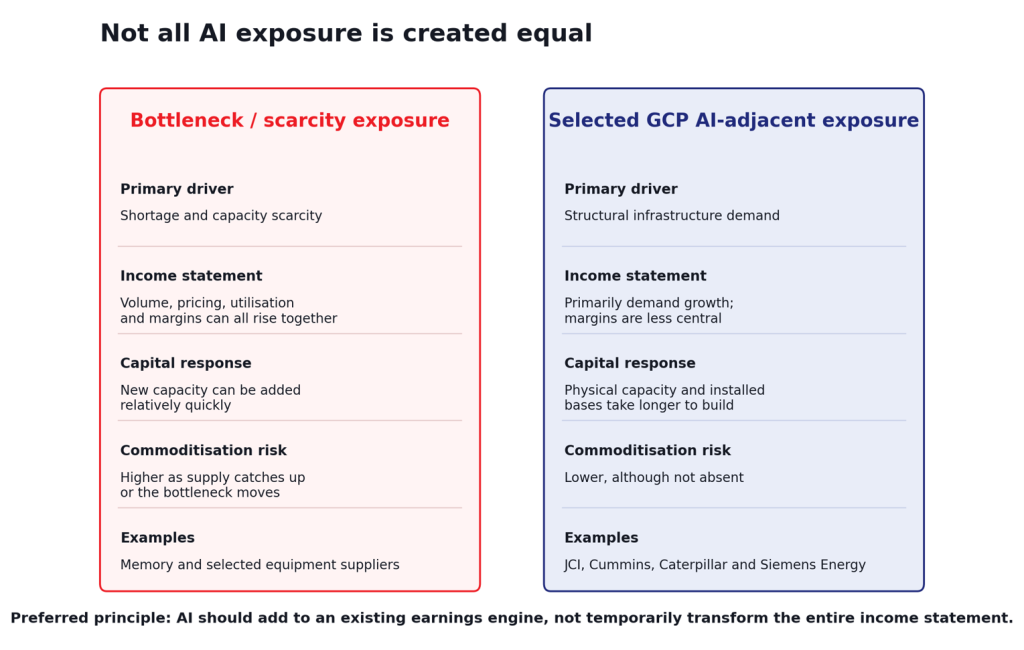
Our preference has generally been to invest in businesses where the AI opportunity can add to an existing earnings engine, rather than businesses where the entire investment case depends on the continuation of an AI-driven shortage.
Companies such as Johnson Controls, Cummins, Caterpillar and Siemens Energy illustrate this distinction. Their potential exposure to AI comes through physical infrastructure such as data-centre cooling, power generation, electrical grids, large engines, backup power and related services. These companies can benefit if electricity demand, data-centre construction and grid investment remain strong. However, their investment cases do not require shortage pricing, peak utilisation and record margins across the entire income statement to persist indefinitely.
The potential excess in these holdings is therefore more concentrated in expectations around future demand growth. It is less dependent on unusually favourable revenue growth, pricing, gross margins and working capital all continuing simultaneously.
This does not make these companies immune to cycles. Caterpillar can face weaker equipment demand. Cummins remains exposed to industrial activity and power-generation investment. Johnson Controls depends on commercial construction, retrofit activity and execution. Siemens Energy is benefiting from both end-market growth and company-specific margin recovery. Nevertheless, we believe the risk of structural overearning is lower because the core opportunity is supported by sustained demand for physical infrastructure, installed-base services and replacement spending. In short…
We prefer companies where AI creates an additional growth opportunity, rather than companies where AI has temporarily transformed the entire income statement.
Exhibit 10: The quality and durability of AI exposure matter more than the label
Source: Marcellus
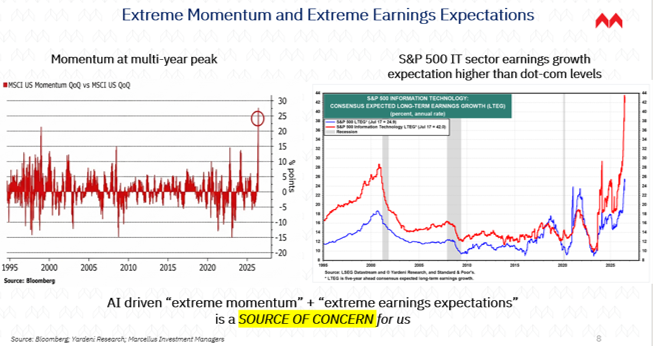
Exhibit 11: Extreme momentum and extreme earnings expectations increase the risk of overearning.
Has the correction already happened?
It may appear that the recent weakness in parts of the semiconductor market represents a meaningful correction. We believe that such a conclusion may be premature.
The market is beginning to consider whether expectations across parts of the AI ecosystem have moved too far ahead of what can ultimately be recognized. It is also beginning to recognize that commoditisation could happen faster, and at more layers of the technology stack, than current valuations imply.
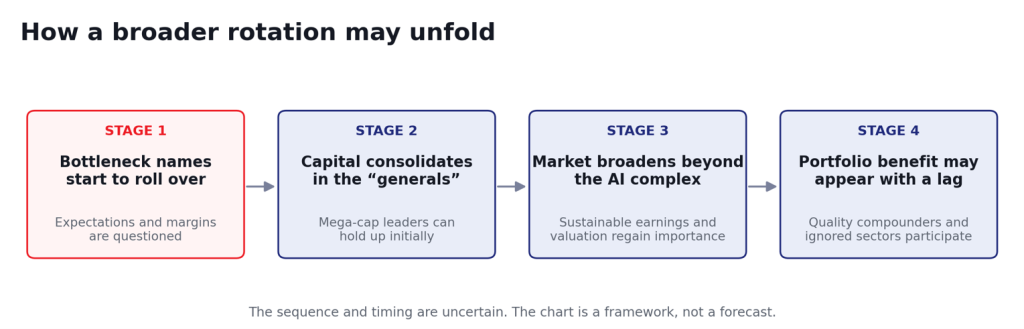
However, rotations of this kind rarely happen all at once. The first stage often involves capital moving from the most speculative beneficiaries towards the perceived “generals” of the market. This may explain why Apple has risen sharply recently and why Nvidia and Broadcom have remained relatively resilient, even as several memory, semiconductor and equipment stocks have begun to weaken.
Exhibit 12: We may be in early stages of broader rotation of liquidity
Source: Marcellus
Exhibit 13: Our response remains selective rather than momentum-driven
Source: Marcellus
The visible benefit to our portfolio could therefore arrive with a lag. Before money rotates towards ignored sectors, predictable compounders and businesses outside the technology complex, it may first consolidate in the largest technology franchises.
We would not claim to know the precise timing or sequence. AI momentum could remain powerful for longer than expected, and we could continue to lag during that period. But we believe we are closer to the later stages of the indiscriminate bottleneck trade, and closer to the beginning of a broader rotation, than we were five months ago.
Our response has been gradual. We are not chasing stocks after large moves. We are selectively adding to high-conviction businesses whose fundamentals remain strong, reassessing positions where the earnings outlook has changed, and using a basket approach where the opportunity is attractive but individual-company risk remains elevated.
Why we remain confident of GCP’s strength?
Ultimately, long-term investment returns are driven by earnings growth and the valuation paid for those earnings. Over the past three years, the portfolio’s adjusted EPS has compounded at approximately 16%, compared with roughly 8% for the S&P 500. Over the latest year, portfolio EPS growth has also remained materially ahead of the benchmark. Yet the portfolio’s forward EV/EBITDA multiple has converged with, and is now marginally below, that of the index.
Exhibit 14: Earnings growth and valuation provide comfort around future compounding
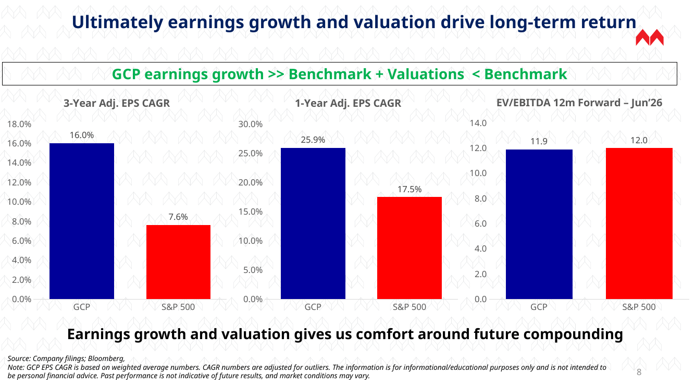
We understand these numbers do not guarantee an immediate reversal in relative performance. If the market continues to reward a narrow set of AI and semiconductor stocks, we can continue to lag despite delivering healthy absolute earnings growth.
However, stronger underlying earnings growth than the benchmark and valuations in-line with the benchmark provide a significantly better starting point for future compounding than recent stock-price performance alone would suggest.
Regards
Team Marcellus
If you want to read our other published material, please visit https://marcellus.in/

